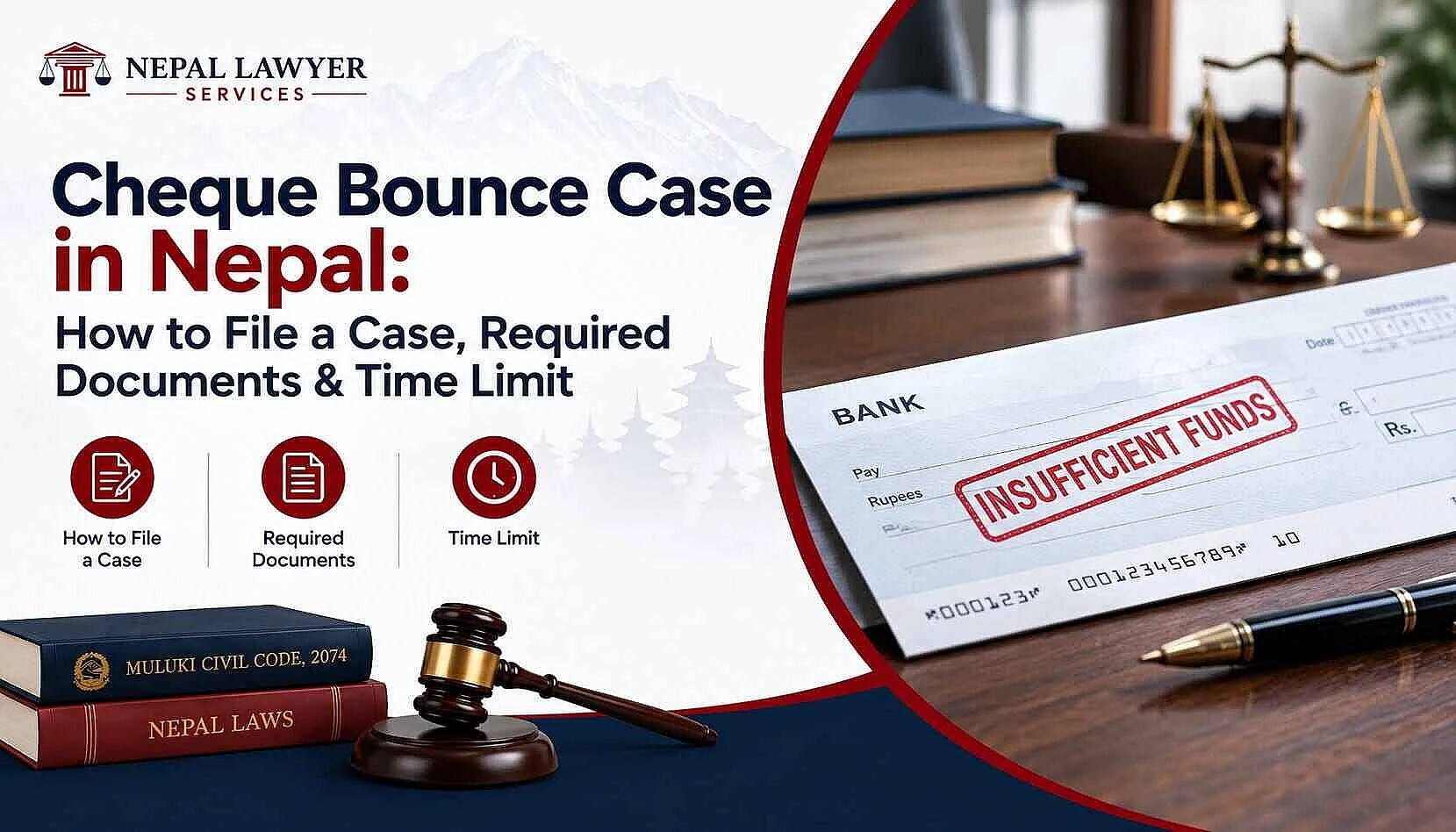
A bounced cheque is more than just an inconvenience; it can result in lost money and a broken commitment. If a cheque you were given for payment has been returned unpaid by the bank, Nepali law allows you to reclaim the funds and hold the drawer liable. That route has changed dramatically since the 2025 amendment, and being the timing, forum, and documentation wrong can cost you the case outright.
This article explains how to file a cheque bounce case in Nepal, including what to do when a cheque fails, what documents are required, how the current method works, and the time constraints you cannot afford to miss. For the broader legal background including how the law developed and what the rules mean for drawers and payees generally see Nepal Lawyer's complete guide to cheque bounce law in Nepal.
Quick Answer
A check bounce case in Nepal is initiated by acquiring the bank's certified dishonor record and filing a complaint with the police within one year of certification. A police investigation is required before the subject can be heard in District Court, and the case must normally be heard within a specific time frame after the complaint is filed. Settlement between the parties is possible at practically any point.
For expert guidance and legal assistance, Contact a Corporate Lawyer to discuss your queries and get tailored legal advice.
What Is a Cheque Bounce Case in Nepal?
A cheque bounce case in Nepal occurs when a bank refuses to cash out a cheque given for payment, and the aggrieved party takes legal action after the drawer fails to repay the amount willingly.
Common reasons for the dishonored cheque include insufficient funds in the drawer's account, a signature mismatch, an overwritten or altered cheque, a stopped payment order, account closure, or presentation after the cheque's validity period has expired.
Not every returned cheque results in a court case. A purely technical issue, such as a missing signature or a date mismatch, is frequently resolved by producing a rectified cheque. A case becomes significant when a cheque is dishonored due to a lack of cash and the drawer refuses to pay when asked. This is why the bank's documentation of the dishonor serves as the evidentiary foundation for the entire case. For the fuller legal definitions and background, see the Nepal cheque bounce law guide.
What Should You Do After a Cheque Bounces?
1. Obtain the Bank's Return/Dishonor Record
As soon as your bank returns the cheque unpaid, get a formal return memo or cheque return slip outlining the cause for nonpayment. Banks are also required to notify the drawer and provide a specific opportunity to settle the account before formally certifying the dishonor. Request this certified record as well, as the case chronology flows from it.
2. Preserve the Original Cheque and Related Evidence
Keep the original cheque safe. Keep the return memo, your bank statements, and any deposit slips from when the cheque was handed.
3. Review of the Transaction and Payment Obligation
Gather documentation that demonstrates why the check was issued to you, such as an invoice, loan agreement, receipt, contract, or written communication. This is important for both proving the underlying debt and determining your future steps.
4. Consider Legal Notice or Demand for Payment
Before taking official action, many people send a written notice to the drawer seeking payment within a set time frame. This generates a paper trail demonstrating that the drawer had a genuine opportunity to pay, and it frequently resolves issues without ever reaching a trial.
5. Take Legal Action Within the Applicable Time Limit
If the drawer still does not pay, the next step is to initiate formal procedures, but only within the legally authorized time frame, which is discussed below.
Cheque Bounce Case Procedure in Nepal
In short: present the cheque → obtain the bank's certified dishonor record → send a legal notice (recommended) → file a complaint with the police → police investigate → the matter proceeds to the District Court → hearing, evidence, and judgment (or settlement at any stage).
Under present law, the usual procedure for filing a cheque bounce case in Nepal is as follows. It should be noted that a 2025 (2082 B.S.) amendment to the Banking Offense and Punishment Act, 2064 significantly altered this process: cheque dishonor is now handled through a mandatory police investigation, and the previous option of filing a private civil suit directly in court under the Negotiable Instruments Act is no longer applicable. Always consult a lawyer to confirm your existing standing.
- Presentation and dishonor- The cheque is presented to the bank and returned unpaid.
- Bank notice and settlement window- The bank informs the drawer and allows a defined period to fund the account before certifying dishonor.
- Certification of dishonor- If the account remains unfunded, the bank certifies the cheque as dishonored and issues documentation to the holder.
- Legal notice (recommended)- The holder may send a formal demand for payment to the drawer.
- Filing a complaint with the police- The aggrieved party lodges a written complaint/FIR with the police, since police investigation is now a mandatory first step.
- Police investigation- The police investigate, gather bank records and transaction evidence.
- Referral to the District Court- The matter proceeds to the concerned District Court within the applicable statutory period.
- Court registration and notice to the drawer- The court registers the case and issues notice to the drawer/accused.
- Hearing and evidence- Both sides present documents and arguments; the court examines the bank's dishonor record and supporting evidence.
- Settlement option- At almost any stage during investigation or even after filing the parties may reach a compromise once the drawer pays what's owed, which can end proceedings.
- Judgment and enforcement- If the case proceeds to judgment, the court orders recovery of the amount (often with interest and a penalty) and determines any further punishment.
Because this is now handled primarily through the police-and-court criminal process rather than a private civil suit, getting the paperwork and timing right at the complaint stage matters more than ever. If you're unsure where your case stands in this sequence, NepalLawyer's team can review your documents and advise on next steps see the consultation options at the end of this article.
Documents Required for a Cheque Bounce Case in Nepal
You'll generally need the original cheque, the bank's certified dishonor record, bank statements, proof of the underlying transaction, and if sent your legal notice with delivery proof.
Commonly useful documents
- The original bounced cheque
- The bank's return memo or certified dishonor record
- Bank statements showing presentation and return of the cheque
- The underlying agreement, invoice, receipt, or loan document explaining why the cheque was issued
- Correspondence with the drawer, including any settlement discussions
- A copy of the legal notice sent to the drawer, with proof of delivery (postal receipt, courier confirmation, or acknowledgment)
Documents that may be specifically required for filing
- Your citizenship or identity document
- Authorization documents if filing on behalf of a company or another person
- Any complaint/FIR format required by the police office concerned
Requirements can vary by case and filing location a lawyer can confirm exactly what your specific filing needs. See the Complete guide to cheque bounce law in Nepal for how documentation ties into the broader legal framework.
Cheque Bounce Case Time Limit in Nepal
A cheque generally must be presented within six months of issuance; a police complaint generally must be filed within about one year of certified dishonor; and the case must typically reach the District Court within a further limited window after that.
Several different clocks run at different stages of a cheque bounce case time limit in Nepal:
- Cheque validity for presentation: A cheque generally needs to be presented to the bank within six months of its issue date; after that, the bank isn't obligated to honor it.
- Filing the complaint with police: Under current law, a complaint concerning cheque dishonor generally must be filed with the police within roughly one year from the date the dishonor is certified by the bank.
- Filing the case in court: Following the police complaint, the matter must normally be brought before the District Court within a further limited time frame, which is commonly given as six months from the date of complaint.
These timeframes correspond to the post-2025 amendment framework and are significantly shorter than the multi-year limitation period that many older articles (based on previous law) still specify. Because missing a limitation period might permanently prohibit a claim, do not depend solely on this summary; consult with a Nepal-qualified lawyer to confirm the exact applicable timeframe for your situation, especially if time has gone after the cheque bounced.
Cheque Bounce Penalty and Bank Charges in Nepal
Short answer: Bank charges are a distinct administrative fee imposed regardless of the case; legal consequences for repayment, interest, an additional fine, and possible jail apply only if a case is filed and proven.
Bank charges are fees the bank itself may deduct when a cheque is returned unpaid independent of whether any case is ever filed.
In contrast, legal penalties come only when a case is prosecuted and proven. Under the existing system, a liable drawer is often required to refund the cheque amount plus interest and an additional monetary penalty, and may even face incarceration, which is generally proportionate to the size of the cheque amount. Because the actual fine brackets and imprisonment terms have been reformed by the recent amendment and depend on the amount involved, we do not provide figures here. Before relying on any number, you see online, consult with a lawyer about the current bracket that relates to your cheque amount. Is Cheque Bounce a Criminal Case in Nepal?
Short answer: Yes, under present law, cheque dishonor owing to inadequate money is treated as a banking offense tried by the police and courts, rather than a completely private civil dispute.
This is a departure from the previous system, which allowed an offended person to choose between a civil claim (to recover money with interest) and a separate criminal case. That option has decreased, with cheque dishonor instances now typically going through the criminal/banking-offence procedure.
However, not every dishonored cheque results in criminal culpability; in general, the law requires that the cheque be issued with knowledge that the account lacked sufficient funds. A cheque that has bounced due to a legitimate bank or clerical error is differently than one that was purposefully issued against an empty account. Because this distinction influences both approach and outcome, consult a lawyer before filing.
What Are the New Rules for Cheque Bounce in Nepal?
If you searched "check bounce new rules" or "cheque bounce new rules Nepal," here's the short version: a 2025 change to the Banking Offense and Punishment Act altered how cheque bounce cases are handled. The headline changes.
- Mandatory police investigation before a case reaches court
- A formal bank notice-and-settlement window before a cheque is certified as dishonored
- Shortened filing deadlines
- A restructured, amount-based penalty system replacing the older flat penalty
- Formal recognition of settlement between the parties at almost any stage
Common Mistakes to Avoid in a Cheque Bounce Case
- Losing or misplacing the original cheque
- Not obtaining the bank's dishonor/return documentation promptly
- Missing the applicable time limit while waiting for informal promises to pay
- Failing to keep records of the underlying transaction
- Skipping the legal notice step when it could have resolved the matter faster
- Assuming a bank charge is the same as a legal penalty
- Filing the complaint at the wrong office or forum
- Relying on outdated information describing the old civil-suit process
- Not documenting settlement discussions with the drawer
When Should You Consult a Lawyer for a Cheque Bounce Case?
You don't need a lawyer to understand the basics, but professional advice becomes especially valuable when:
- The cheque involves a large sum of money
- The drawer disputes that any debt or obligation exists
- You're dealing with multiple bounced cheques from the same person or business
- You're unsure which time limit applies to your situation
- Some of your documentation is missing or incomplete
- There's a dispute over the signature or the drawer's authority to issue the cheque
- The transaction involves business, cross-border element, or multiple parties
- A case or complaint has already been filed against you as the drawer
- You've received legal notice and aren't sure how to respond
- You're unsure which authority or forum should handle your filing
Frequently Asked Questions About Cheque Bounce Cases in Nepal
How do I file cheque bounce case in Nepal?
Obtain the bank's certified dishonor record, consider sending the drawer a legal notice, and then register a complaint with the police within the timeframe specified. Before the case is heard in District Court, police investigate.
What documents are required for a cheque bounce case in Nepal?
At a minimum, include the original cheque, the bank's return/dishonor memo, bank statements, proof of the underlying transaction, and, if sent, a copy of the legal notice with proof of delivery.
What is the time limit for filing a cheque bounce case in Nepal?
A complaint must be submitted to the police within around one year of certified dishonor, with an additional limited window to bring the matter to the District Court after that. Confirm exact periods with a lawyer, as they have been shortened by a 2025 change.
Does cheque bounce a criminal case in Nepal?
In general, yes, under the existing Banking Offense and Punishment Act framework, if the cheque was issued with knowledge that the account did not have adequate funds. Certain facts may have an impact on this.
What happens after a cheque is dishonored by the bank?
The bank usually notifies the drawer and gives them time to fund the account before formally certifying the dishonor. Once certified, the holder may seek a legal notification and, if necessary, a formal complaint.
Who pays the bank cheque bounce charges?
Bank charges for a returned cheque are normally carried by the drawer's account, independent of any court-ordered recovery or penalty.
What is the penalty for a bounced cheque in Nepal?
Penalties may include return of the amount with interest, an additional monetary penalty, and potential incarceration, all scaled to the amount of the cheque. Exact values are based on current statutory brackets and should be checked with a lawyer.
Conlusion
Each cheque bounce case is unique in terms of facts, papers, and timing, and the deadlines are strict. If you have a bounced cheque, the easiest approach to safeguard your position is to have your documentation evaluated before the limitation period expires. Book a consultation with Nepal Lawyer!
Our team can evaluate your cheque, bank records, and transaction history, confirm which deadlines apply to you, and assist you in submitting everything from the legal notification to the police complaint and beyond.
Nepal Lawyer Services provides all kind of legal help in Nepal. Contact now for:
- 24/7 emergency legal consultation
- Same-day complaint drafting and filing
- Digital evidence preservation guidance
- Direct liaison with Cyber Bureau officials
- Court representation across all districts
📞 Emergency Hotline: 9801884499
📧 Email: [email protected]
📍 Office: Nirajan Bikram Marg-31, New Baneshwor, Kathmandu
🌐 Website: www.nepallawyer.com
Sources:
https://www.lawcommission.gov.np/en/
Disclaimer: This text is intended for general information purposes only and does not constitute legal advice. Nepal's cheque bounce structure was extensively altered in 2025, and procedural specifics, dates, and penalty amounts may be clarified or revised. Every case is unique and determined by its facts. Before taking any legal action or relying on any of the deadlines listed here, consult a certified Nepal-qualified lawyer to confirm the current law as it applies to your situation. NepalLawyer.com and its authors accept no responsibility for actions performed solely based on this material.