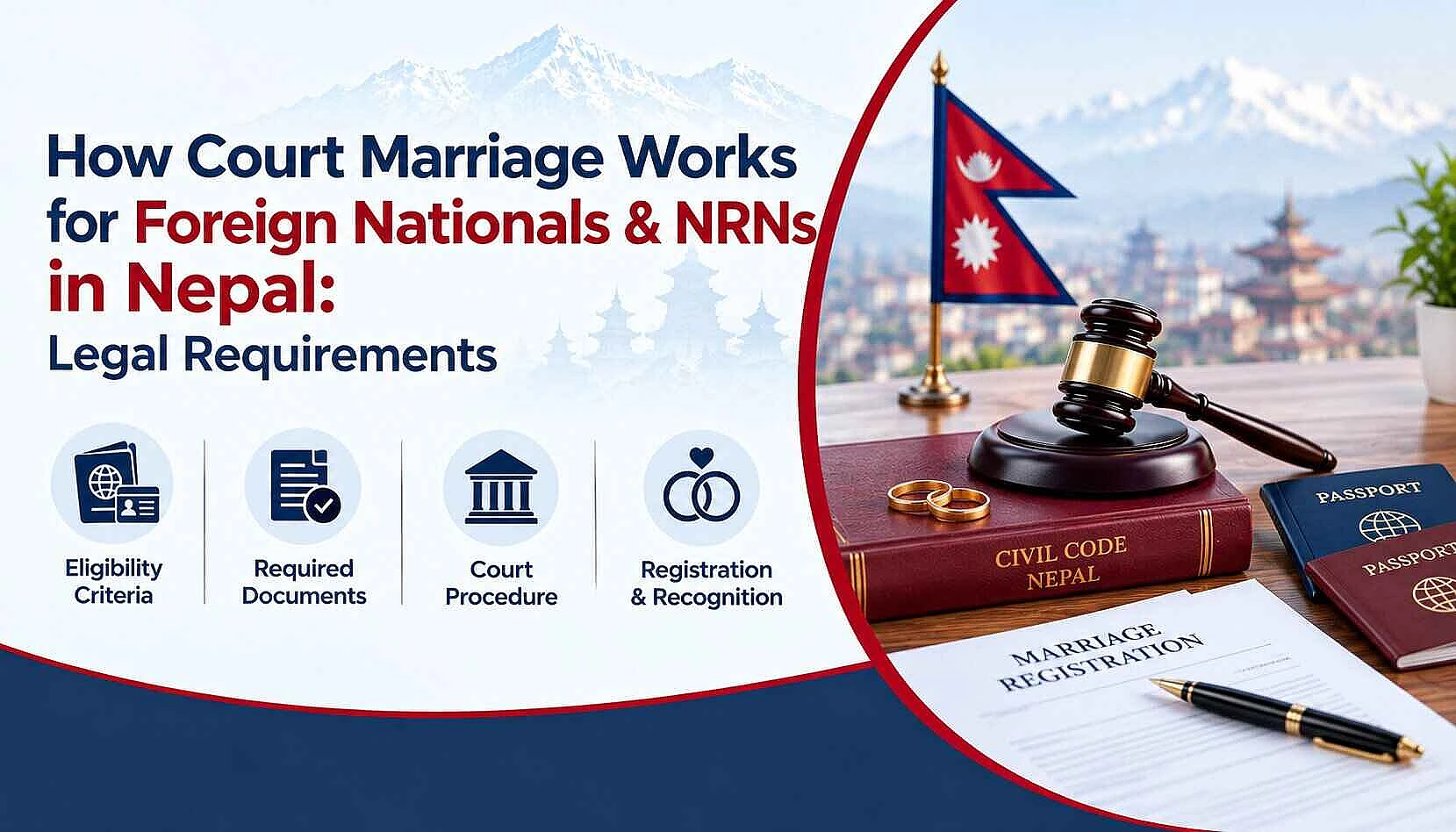
If they satisfy Nepal's standards for age, consent, marital status, domicile, and documents, foreign nationals and NRNs may register a judicial marriage in Nepal through the relevant District judicial. A valid passport, a Nepal visa issued by the embassy, proof of continuous residency, translated paperwork, witnesses, and proof of marital status are typically required for foreign candidates.
Key Takeaways
- Eligibility: Both partners generally must be at least 20, consent freely, be legally free to marry, and fall outside the prohibited relationships under the Muluki Civil Code 2074 (National Civil Code 2017).
- 15-day residence: Prior to submitting, foreign candidates are typically required to provide proof of 15 days of continuous residency in Nepal. Verify the precise procedure with the relevant court.
- Embassy evidence: Usually, one needs a No Objection Letter, Single Status Certificate, Certificate of No Impediment, or Affidavit of Eligibility to Marry. Each country has a different name.
- Translation and notarization: Foreign-language documents generally need a certified Nepali translation and notarization or authentication.
- Legal help: Cross-border cases, prior marriages, and NRN document problems are easier to resolve with a lawyer's review before filing.
Who This Guide Is For
This article covers the points that change when one or both partners are not ordinary Nepali residents. It is written for:
- A Nepali citizen marrying a foreign national
- Two foreign nationals marrying in Nepal
- An NRN marrying a Nepali citizen or a foreign national
- Previously married applicants, whether divorced or widowed
- Couples who plan to use the Nepali marriage certificate abroad, for example for a spouse visa
It deliberately does not repeat the general procedure. For the basics that apply to every couple, read our complete court marriage process in Nepal.
Can a Foreign National Legally Marry in Nepal?
Yes. Court marriage (adalati bibaha) is generally available to eligible foreign nationals and NRNs, not only to Nepali citizens. The marriage is registered before the District Court (Jilla Adalat) under the marriage provisions of the Muluki Civil Code 2074, also called the National Civil Code 2017 (2074 is the Bikram Sambat year).
A foreign partner is not viewed as an obstacle by the law. The proof required by the court is what shifts. A ward-level recommendation and citizenship can be demonstrated by a Nepali national. A foreign national must demonstrate that they are legally present in Nepal, that they reside there, and that they are free to get married in accordance with domestic laws. Each prerequisite is discussed here.
Court Marriage Options for Foreign Nationals and NRNs
|
Couple type |
Main legal focus |
Practical considerations |
|
Nepali citizen + foreign national |
Foreigner's eligibility documents |
Embassy evidence, visa, residence proof |
|
Foreign national + foreign national |
Both parties' home-country requirements |
Both may need embassy or status documents |
|
NRN + Nepali citizen |
Nepali identity and foreign-residence documents |
NRN status and overseas residence evidence |
|
NRN + foreign national |
Cross-border documentation |
Embassy, translation, and residence requirements |
The categories can overlap. An NRN who holds a foreign passport is usually documented as a foreign national, even if they were born in Nepal.
2026 Legal Eligibility Requirements
|
Requirement |
What it means in practice |
|
Age of at least 20 |
Both parties must have completed 20 years. Passports or citizenship certificates are used to check this. |
|
Free consent |
Each party must agree voluntarily. The court asks about this directly at verification. |
|
Legal capacity to marry |
Each must be unmarried, legally divorced, or widowed. A previous marriage must be properly ended and documented. |
|
No prohibited relationship |
The parties must not be related within the degrees the Civil Code prohibits. |
|
Physical appearance |
Both parties appear in person before the District Court. Appearing only through a representative is not the usual route. |
|
Foreign-national conditions |
Foreign applicants must meet the residence and documentation requirements described in this guide. |
What Is the 15-Day Residence Requirement for Foreign Nationals in Nepal?
A foreign applicant must have resided in Nepal consistently for approximately 15 days prior to the court accepting their marriage application, according to a procedure known as the 15-day residence requirement. Its goal is to enable the court to verify the individual's identity, legal presence, and sincere desire to get married.
What is meant by "continuous"? In general, the foreign national should remain in Nepal for the entire duration without departing. The count may be interrupted by a quick travel overseas or a journey across the border to India.
Commonly accepted proof. Depending on the court, couples may be asked for:
- A hotel or guesthouse recommendation or stay confirmation
- A recommendation (sifaris) from the ward office (Wada Karyalaya) or municipality where the person is staying
- A rental agreement or host letter, where the foreigner lives in a private home
- Other residence evidence the court considers reliable
Passport-entry records. The entry stamp, visa, and immigration records may be compared by the court with your stated place of abode. The dates on the passport, visa, and hotel letter should match.
Common mistakes:
- Leaving Nepal during the 15-day period
- Presenting a hotel letter that covers only part of the stay
- Moving between lodgings without proof for each address
- Assuming the period begins when the couple first met rather than when the foreigner entered Nepal
Rules and administrative guidelines may vary, and District Courts may have different practices. Before making trip arrangements, confirm the current residency requirement and acceptable proof with the relevant District Court or a lawyer.
Documents Required for Court Marriage in Nepal for Foreign Nationals
The following is a general checklist for the foreign partner. The court's own list controls.
|
Document |
Purpose |
Issued by |
Translation / notarization |
|
Valid passport |
Proves identity, nationality, age, and entry date |
Home country |
Copy usually certified; Nepali translation of key details may be requested |
|
Valid Nepal visa |
Shows lawful stay in Nepal |
Department of Immigration, Nepal |
No translation needed; keep it valid through filing |
|
No Objection Letter, Single Status Certificate, Certificate of No Impediment, or Affidavit of Eligibility to Marry |
Proves the person is free to marry |
Embassy or consulate, or another authority named by the embassy |
Typically needs Nepali translation and notarization or authentication if not in Nepali |
|
Proof of 15-day continuous residence |
Shows uninterrupted stay |
Hotel, ward office, municipality, or host |
Nepali translation if issued in another language |
|
Marriage law of the foreign national's home country |
Shows the marriage is not barred by home-country law, where the court requests it |
Official government source or embassy |
Usually translated and certified |
|
Divorce decree or former spouse's death certificate, if applicable |
Proves a previous marriage has ended |
Foreign court or civil registry |
Translation, notarization, and often legalization |
|
Passport-size photographs |
Attached to the application and registration record |
The applicant |
Not applicable |
|
Witness identification documents |
Identify the witnesses |
Witnesses (citizenship certificate or passport) |
Translation if not in Nepali |
|
Other documents requested by the District Court |
Fill gaps in the file |
Varies |
Varies |
Bring several photocopies and keep the originals available for verification.
What Are Embassy NOC, Single Status Certificate and Affidavit of Eligibility to Marry?
These documents all have the same function: they demonstrate the foreign national's legal right to marry. Each country and embassy has its own terminology. A customary letter is issued by some embassies. Others require the applicant to make a sworn affidavit in front of a consular officer rather than certifying marital status at all.
|
Term |
Plain-English meaning |
|
No Objection Letter (NOC) |
A letter from the embassy or consulate stating it has no objection to the marriage, usually based on the applicant's declared status. |
|
Single Status Certificate |
A written declaration or paperwork from the person's home country attesting to the fact that they are single, divorced, or widowed. |
|
Certificate of No Impediment |
A statement that no legal obstacle to marriage is known. |
|
Affidavit of Eligibility to Marry |
A sworn declaration that the petitioner is free to marry, usually signed in front of a consular official. |
|
Attestation |
Official verification of a document's signature, seal, or authenticity so another authority will accept it. |
|
NRN |
A Non-Resident Nepali, discussed below. |
Because the wording and process vary, couples should confirm the exact document name, format, validity period, and appointment process with the relevant embassy before travelling to Nepal. Check whether it must be dated recently, whether it must name your partner, and whether it needs a separate Nepali translation. If the original is in a language other than Nepali, the court generally expects a certified translation, followed by notarization or authentication. Embassy practice differs widely. The Swiss Embassy, for example, describes an affidavit prepared from attested and translated civil-status documents, while Australia's notarial service issues a Certificate of No Impediment. Check your own embassy, such as the U.S. Embassy in Kathmandu, for its current form.
Documents Required From the Nepali Partner
The Nepali citizen's file is usually shorter. Commonly requested items are:
- Citizenship certificate (Nagarikta Pramanpatra)
- Passport-size photographs
- Single-status evidence from the ward office, commonly an unmarried recommendation (abibahit sifaris)
- Divorce decree or spouse's death certificate, if previously married
- Witness documents
For the details that apply to every couple, see the full list of court marriage documents in Nepal.
How Does Court Marriage Work for NRNs in Nepal?
In practical terms, a Non-Resident Nepali (NRN) is a person of Nepali origin who lives abroad. Under the Non-Resident Nepali Act, 2064 (2008), the term broadly covers holders of NRN citizenship, foreign citizens of Nepali origin, and Nepali citizens living abroad, subject to the Act's conditions. The legal category matters for your paperwork:
- An NRN who still holds Nepali citizenship is documented like a Nepali citizen, with extra evidence of foreign residence.
- An NRN who holds foreign citizenship is generally treated as a foreign national for embassy documents and residence proof.
NRNs often need both sets of papers: Nepali identity documents and evidence about their life overseas. Common complications include:
- Expired or damaged citizenship certificates
- Name spelling that differs between the citizenship certificate and the foreign passport
- Foreign address proof that does not match other records
- A previous marriage or divorce abroad that has not been translated or authenticated
Legal assistance helps most when records conflict or when a prior marriage was registered in another country. A lawyer can identify what the court will accept before you travel.
Step-by-Step Marriage Process for Foreign Nationals and NRNs
- Confirm eligibility and marital status. Check age, consent, prohibited relationships, and the status of any earlier marriage.
- Check passport, visa, and residence period. Verify that both are still valid and that the foreigner will remain in Nepal for the necessary amount of time.
- Obtain embassy marital-status evidence. Ask the embassy for the NOC, Single Status Certificate, Certificate of No Impediment, or Affidavit of Eligibility to Marry.
- Obtain the home-country marriage-law document if required. Ask the court or your lawyer whether it is needed.
- Translate and notarize foreign documents. Use a competent translator and follow the court's format.
- Collect the Nepali partner's documents. Citizenship certificate, ward recommendation, and any prior-marriage papers.
- Arrange witnesses. Identify adults who can appear with valid identification.
- Prepare the court application. The application should be consistent with every attached document.
- File with the District Court concerned. Submit the application and support documents.
- Attend verification or hearing. Both partners and the witnesses appear in person. The court confirms identity, consent, and eligibility.
- Sign the consent deed and complete registration. Once the court is satisfied, the marriage is registered.
- Obtain the marriage certificate and plan attestation. If you will use it abroad, decide on the legalization route immediately.
Which District Court Handles Court Marriage for Foreign Nationals?
Not every foreign couple is handled by a single court. In general, jurisdiction is determined by the parties' residence or the location of the application's legal filing. For instance, depending on their address, couples residing in the Kathmandu Valley would find that the District Court in Kathmandu, Lalitpur, or Bhaktapur is pertinent, whereas couples residing in Pokhara or the Terai would look to the District Court that covers those regions.
The address on your proof of residency is important because tourists and visitors travel between accommodations. Before gathering documents, confirm the correct court with the court's registration office or a lawyer so that your application and residency letter point to the same location.
How Long Does Court Marriage Take for Foreign Nationals?
There is no fixed number of days that apply to every case. Timing depends on:
- How quickly the embassy issues its document
- Translation and notarization turnaround
- Whether the file is complete on the first filing
- Whether the 15-day residence period is already satisfied and well documented
- Court workload and scheduling
- Verification of any prior marriage
The 15-day residence time provides a reasonable minimum for the foreigner's stay, but once embassy and translation procedures are considered, the entire process typically takes longer. Wait until your attorney or the court verifies the expected schedule before making a non-refundable return flight reservation.
How Do I Use a Nepali Court Marriage Certificate Abroad?
In most cases, a Nepali marriage certificate (Bibaha Darta Pramanpatra) cannot be utilized abroad without further procedures. The document may require legalization or attestation, depending on where it will be used.
- The process can involve the District Court, the Ministry of Foreign Affairs in Nepal, and the embassy of the destination country.
- Immigration authorities abroad may ask for a certified translation into their language.
- Some countries accept a different chain of certification, so requirements vary by destination country.
- The Ministry of Foreign Affairs has described Nepal's system as attestation and notarization rather than apostille, so many couples need legalization through the consular chain (The Kathmandu Post, August 2026). The ministry has also launched an online platform, the Nepal e-Attestation System (NEATS), with service reported to begin on 17 August 2026. Verify the current steps with the Department of Consular Services and your destination country.
Ask the recipient embassy or immigration office what procedures they require and in what order before departing Nepal. In general, doing this in Kathmandu is simpler than doing it after returning home.
Common Reasons Foreign-National Court Marriage Applications Are Delayed
- Missing or expired embassy letter
- Invalid or unofficial translation
- Less than 15 days' continuous residence
- Passport or visa issues, including an expired visa
- Unresolved prior marriage
- Witness-document problems
- Name or date mismatches across documents
Most of these can be avoided by comparing every document against the passport before filing.
When Should You Hire a Court Marriage Lawyer in Nepal?
Many couples register without a lawyer, and nothing in this article suggests it is always necessary. Professional help is most useful when:
- One or both parties are foreign nationals
- Either party was previously married
- Embassy documentation is delayed or complex
- NRN status or foreign residence creates document issues
- The couple needs certificate attestation for immigration or overseas use
- The couple wants a document review before filing
Speak with a verified court-marriage lawyer in Nepal before filing your application.
FAQs About Court Marriage for Foreign Nationals and NRNs in Nepal
Q. Can a foreigner marry a Nepali citizen in Nepal?
Yes. If the legal procedures and documentation requirements are fulfilled, an eligible foreign individual can often marry a Nepali citizen through the District Court.
Q. What documents does a foreigner need for court marriage in Nepal?
A valid passport, a valid Nepal visa, proof of 15 days of residency, translations, passport-sized photos, witness documents, and any previous marriage records are frequently required. The court might ask for more.
Q. Does a foreigner need a no objection letter to marry in Nepal?
In most cases, a document demonstrating marital eligibility is needed. Depending on the embassy, it could be referred to as an Affidavit of Eligibility to Marry, Single Status Certificate, Certificate of No Impediment, or NOC.
Q. How long must a foreigner stay in Nepal before court marriage?
It is customary for foreign applicants to provide proof of 15 days of continuous residency. Consult the relevant District Court to confirm the current procedure.
Q. Can two foreigners get court married in Nepal?
In general, yes, provided that both fulfilll Nepal's standards and can present proof of residency and embassy credentials. The laws of both parties' home countries might also be important.
Q. Can an NRN marry in Nepal through court?
Yes. NRNs are allowed to register a judicial marriage, but they must present proof of their overseas residency as well as Nepali identity certificates. In most cases, an NRN with foreign citizenship is listed as a foreign national.
Q. Is a tourist visa acceptable for court marriage in Nepal?
Many international visitors have tourist visas, and courts frequently demand a valid visa. Make sure the visa doesn't expire throughout the process and check with the court or a lawyer as practice differs.
Q. What if the foreign national was previously married?
Provide evidence of the previous marriage's dissolution, such as a divorce decree or the death certificate of a former spouse, along with any necessary translation and validation. Delays are frequently caused by an unsettled previous marriage.
Q. How do I attest a Nepali court marriage certificate for use abroad?
The embassy of the destination nation and the Ministry of Foreign Affairs are frequently involved in the process, which may also entail a certified translation. Consult the receiving authority first as requirements differ.
Q. Do I need a lawyer for court marriage with a foreign national in Nepal?
Although cross-border documentation makes legal examination worthwhile, especially for previous marriages, NRN difficulties, or overseas use of the certificate, the law does not require a lawyer in every circumstance.
Get Help with Foreign-National and NRN Court Marriage in Nepal
Nepal Lawyer links couples seeking advice on post-marriage attestation, document review, and foreign-national and NRN marriage registration with skilled court-marriage, family, and divorce attorneys.
- 24/7 emergency legal consultation
- Same-day complaint drafting and filing
- Digital evidence preservation guidance
- Direct liaison with Cyber Bureau officials
- Court representation across all districts
📞 Emergency Hotline: 9801884499
📧 Email: [email protected]
📍 Office: Nirajan Bikram Marg-31, New Baneshwor, Kathmandu
🌐 Website: www.nepallawyer.com
Response Time: Initial consultation within 2 hours. Complaint filed within 24 hours of engagement.
Sources:
- Muluki Civil Code 2074 (National Civil Code 2017), Nepal Law Commission
- Non-Resident Nepali Act, 2064 (2008), Nepal Law Commission
- Embassy of Nepal: attestation of a Nepali marriage certificate, which must first be attested by the Ministry of Foreign Affairs
- U.S. Embassy in Kathmandu
- U.S. Department of State: Nepal civil documents
- Department of Immigration, Nepal: visa information
- Supreme Court of Nepal: court directory and notices
Disclaimer: This article provides general legal information about Nepal and is not legal advice. Court practice, embassy procedures, and legal requirements change and can differ between courts and countries. Verify current requirements with the concerned authority or a qualified Nepali advocate before acting.