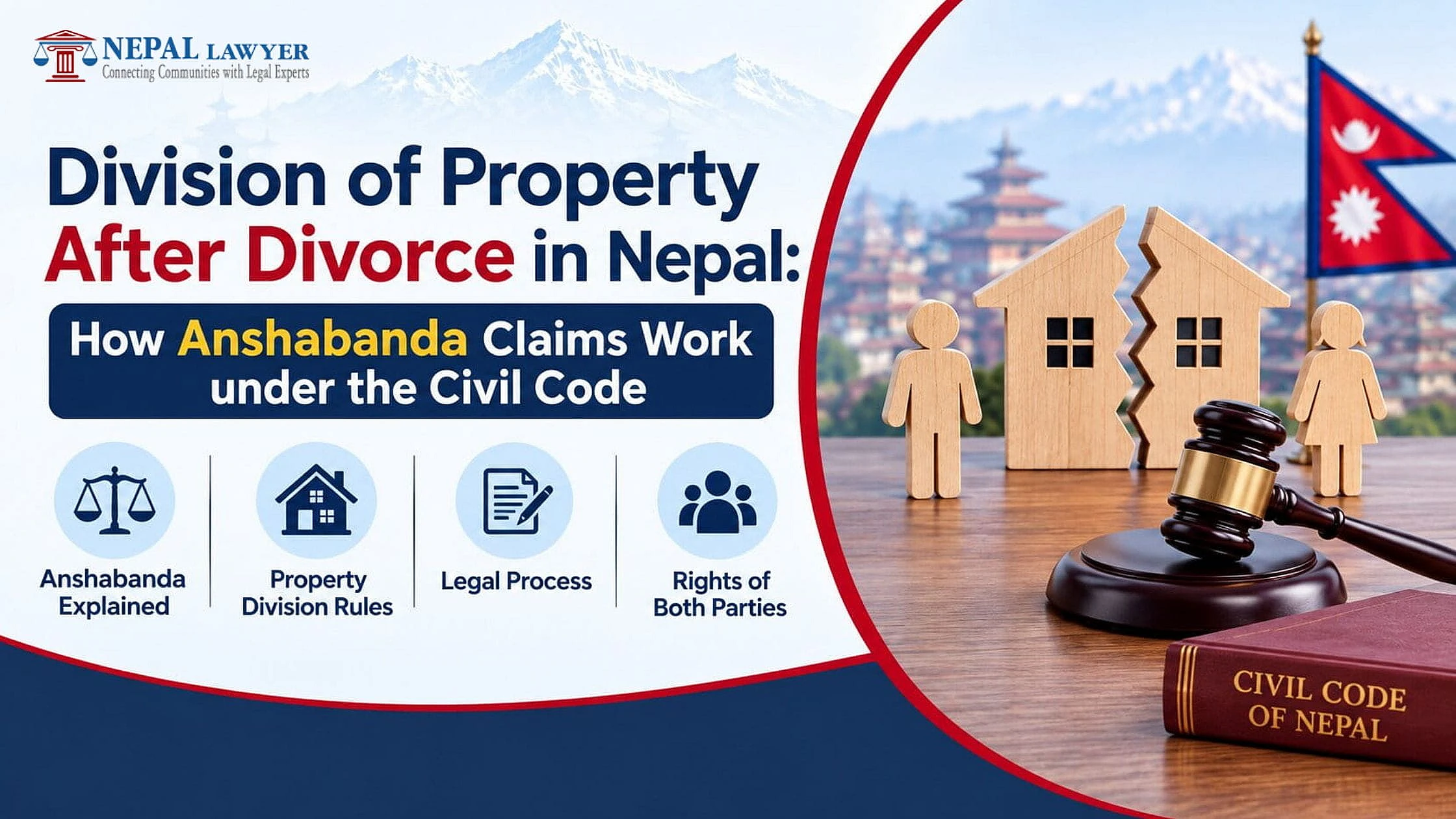
In Nepal, property can be distributed upon the dissolution of a marriage. The Muluki Civil Code 2074 (National Civil Code) permits the court to divide a spouse's property as part of a divorce; the division of a share is known as anshabanda. Depending on how the property was obtained, who legally owns it, and what proof each party can provide, each spouse will receive a different amount. There isn't a formula that works in every situation.
Facing a property dispute right now? Do not sign or move out before you know your position. Speak with a divorce lawyer in Nepal about your case.
Key Takeaways
- Anshabanda means “division of shares.” It is the legal route for dividing property among those entitled to it.
- Divorce and property division are linked in the Muluki Civil Code 2074, but they are separate claims that need separate evidence.
- How the property was acquired (jointly, inherited, or before marriage) shapes the outcome.
- Courts expect proof: land ownership certificates (lalpurja), bank records, and registrations matter more than verbal claims.
- Hiding property from a partition is prohibited under the Code, so evidence of concealment can strengthen your case.
- Property, child custody, and maintenance are often decided in the same dispute, so plan them together.
What Does “Anshabanda” Mean?
Anshabanda (also spelled ansabanda or anshabanda) is the Nepali term for partition of property. The written deed of partition is called the anshabanda kagaj.
Two situations often get mixed up:
- Family partition: relatives who share an undivided family property (called coparceners, anshiyar) divide it among themselves. This is covered in the partition chapter of Part 3 (Family Law) of the Civil Code.
- Partition connected to divorce: the spouses’ property is divided when the marriage is dissolved. The Code deals with this in the divorce provisions, and sources commonly point to Section 99.
Both situations can overlap. For example, a wife may live in a joint family home where the land is still registered in her father-in-law’s name. Working out which kind of claim you have is the first step, and a divorce lawyer in Nepal can usually tell you after one review of your documents.
7 Types of Property to Sort Before You File
Divide your assets into categories before speaking to a lawyer. The category often decides how strong your claim is.
- Property bought jointly during marriage: land, a house, or a flat bought with both spouses’ money or effort.
- Property in one spouse’s name but bought during marriage: a common situation in Nepal, where land is registered in the husband’s name alone.
- Ancestral property: land inherited from parents or grandparents. Who holds a share, and when, matters a great deal.
- Property owned before marriage: assets one spouse already held when the marriage began.
- Gifts and inheritance received by one spouse: these can be treated differently from joint earnings.
- A wife’s personal property: items such as pewa or stridhan (gifts given to a woman at or after marriage, jewellery, and similar assets).
- Business, vehicles, and financial assets: shop shares, companies, vehicles, bank deposits, and insurance.
Note for the reader: Depending on the circumstances and the court's interpretation of the Code, each category may or may not be divided in a divorce. Don't make assumptions. Request confirmation of each category for your case from your advocate.
What the Muluki Civil Code 2074 Says
Nepal’s family and property rules are mainly in the Muluki Civil Code 2074 (2017), which came into force in August 2018 and replaced the older Muluki Ain. Court procedure follows the Civil Procedure Code 2074.
Here are the main parts that matter for a divorce property claim:
- Divorce provisions (commonly cited as Sections 93 to 104): these set out mutual-consent divorce, contested divorce, and related consequences. Read the full Act (English translation)
- Partition of property on divorce (commonly cited as Section 99)
- Partition chapter (Part 3, Chapter 10, commonly cited as Sections 205 to 236): covers who qualifies as a coparcener, equal shares, the unborn child’s right, and a mother’s or wife’s share.
- Equal entitlement (Section 206): each coparcener has an equal partition share, regardless of gender.
- Concealment (commonly cited as Section 226): hiding property that is liable to partition is prohibited.
- Child custody (commonly cited as Section 115)
Important: Section numbers are cited differently across secondary sources. Confirm the exact numbering against the official text (see Sources) or ask your advocate before relying on any number.
The Anshabanda Process After Divorce: 9 Steps
The exact route depends on the facts, but a typical case moves like this:
- Consult an advocate. Explain marriage, the assets, and any ancestral land.
- List every asset. Include land, buildings, vehicles, savings, loans, and businesses, with approximate values.
- Collect ownership proof. Gather lalpurja, building permits, vehicle bluebooks, and bank statements.
- Decide your position. Is this a mutual-consent divorce with an agreed split, or a contested case?
- File in the proper District Court. The petition covers the divorce and the property claim, or the claim is raised through the partition provisions where appropriate.
- Notice and response. The other spouse is served and files a written response.
- Evidence and hearing. Both sides present documents and witnesses. The court can order disclosure of property.
- Court decision. The court decides the divorce and orders the partition and the share each person receives.
- Execution and transfer. The decision is carried out, and ownership is changed at the Land Revenue Office or the relevant registry.
Why this matters: a court order alone does not change the name on a land certificate. Follow through on the transfer step, or the property will still show the old owner.
Ready to file, or need to answer a claim? Our family law advocates in Nepal can review your documents, plan the evidence, and represent you in the District Court. Book a case evaluation today.
12 Documents to Gather
- Marriage certificate (or marriage registration record)
- Citizenship certificates of both spouses
- Land ownership certificates (lalpurja) and land maps (naksa)
- Land tax (malpot) receipts
- Building permit and completion records
- Vehicle registration (bluebook)
- Bank statements and fixed deposit records
- Business or company registration documents
- Loan and mortgage papers
- Previous partition deeds (if any)
- Proof of gifts or inherited property
- Children’s birth certificates (if custody or maintenance is also involved)
Tip: keep photocopies in two places and bring the originals to your advocate only when asked.
6 Common Problems and How to Handle Them
|
Problem |
Why it happens |
What to discuss with your advocate |
|
Property is registered only in the other spouse’s name |
Land is often bought in the husband’s name |
Proof of your contribution, such as bank transfers and joint loans |
|
Hidden or transferred assets |
One side moves assets before filing |
Evidence of timing and the Code’s ban on concealment |
|
Ancestral land still in a parent-in-law’s name |
Partition within the family has not yet happened |
Whether a family partition must be addressed first |
|
Housewife with no income records |
Contribution is unpaid |
How contribution to the household is presented to the court |
|
Spouse abroad or an NRI |
Service of notice and evidence are harder |
Notice methods and power-of-attorney arrangements |
|
Property abroad |
Another country’s law may apply |
Whether foreign counsel is needed |
Are worried assets being hidden or transferred? Time matters. Contact our divorce and property team before the evidence disappears.
5 Mistakes That Weaken a Property Claim
- Waiting too long. Evidence disappears, and assets can be transferred.
- Relying on verbal promises. A promise to “give you the house” is hard to prove without a written, registered document.
- Signing a settlement you do not understand. Always have your advocate read it first.
- Ignoring property in joint-family arrangements. You may have a share you do not know about.
- Treating property and children as separate fights. The two often affect each other in negotiation and in court.
How Property, Custody and Maintenance Connect
People usually come to a lawyer with one worry, but the issues are linked:
- Property: who gets the house or land.
- Custody: which parent the child lives with. See our guide to a child custody lawyer in Nepal.
- Maintenance: financial support for a spouse or children, if applicable.
- Proof of marriage: if the marriage itself was registered abroad or through a court marriage, you may need documents to prove it first. See our page on a court marriage lawyer in Nepal.
Treat these as one strategy, because a position on one will affect the others.
Need help with more than property? Get advice on the related issues:
- Children and guardianship: child custody lawyer in Nepal
- Proof of marriage, including international marriages: court marriage lawyer in Nepal
When Should You Hire a Lawyer?
Get legal advice before you sign anything or move out if any of these apply:
- Your spouse has threatened to sell or transfer property
- Land is in the other spouse’s or a relative’s name
- Ancestral property is involved
- A child’s custody is also disputed
- Your spouse lives abroad
- You have been asked to sign a settlement document
A qualified divorce lawyer in Nepal can explain how the Civil Code applies to your facts, prepare the evidence, and represent you in court.
Frequently Asked Questions
Q. Can a wife claim property after divorce in Nepal?
Yes. The Civil Code is gender-neutral and applies to both couples. The kind of property, how it was obtained, and the supporting documentation all affect what she gets.
Q. Is property always divided equally on divorce?
Not by default. In division, the Code grants equal rights to coparceners; but, in divorce cases, the nature of each asset and the available evidence determine the outcome. Find out from your advocate how this relates to your situation.
Q. What happens to ancestral property in a divorce?
Property acquired jointly during a marriage is not treated the same as ancestral property. The identity of the coparceners and the existence of a family partition determine whether it is divisible and in what share.
Q. Can my spouse sell property while the case is going on?
A spouse might try. The Code forbids concealing property that is subject to partition, and your advocate can offer advice on how to safeguard the property throughout the legal proceedings.
Q. How long does property division take?
A set timetable does not exist. In general, mutual-consent cases proceed more quickly than contested ones; delays are frequently caused by missing paperwork, disputed ownership, or a spouse living overseas.
Q. Do I need to divorce first before claiming anshabanda?
Not all the time. Family division may be requested separately from divorce, and it may also be a part of a divorce process. Which course of action is best for you can be determined by your advocate.
Q. What if my spouse hides property?
Provide your advocate with any documentation that demonstrates the asset, such as bank transfers, tax receipts, or registrations. Property that is subject to partition cannot be concealed, according to the Code.
Q. Can I do this without a lawyer?
However, property cases include procedures and rules pertaining to evidence that are prone to error. It is highly advised to consult a lawyer.
Need Help with a Property Claim?
If you are facing divorce and have questions about land, a house, or ancestral property, our family law team can review your documents, explain how the Civil Code applies to your situation, and represent you in court.
- Divorce and property claims: Divorce lawyer in Nepal
- Custody and guardianship: Child custody lawyer in Nepal
- Marriage registration and proof: Court marriage lawyer in Nepal
Book a case evaluation:
📞 Emergency Hotline: 9801884499
📧 Email: [email protected]
📍 Office: Nirajan Bikram Marg-31, New Baneshwor, Kathmandu
🌐 Website: www.nepallawyer.com
Sources and Further Reading
- The National Civil (Code) Act, 2017 (2074), English translation (FAOLEX)
- Nepal Law Commission
- Property Division after Divorce
- Alimony in Nepal
Disclaimer: This is not legal advice; it is merely general information. A lawyer-client relationship is not established by it. Every case is unique, and Nepali legislation, court procedures, and section numbers are subject to modification or interpretation. Before acting, review the most recent official version of the legislation and speak with a skilled attorney who is registered with the Nepal Bar Council. NepalLawyer.com disclaims all obligations for decisions based just on this material.