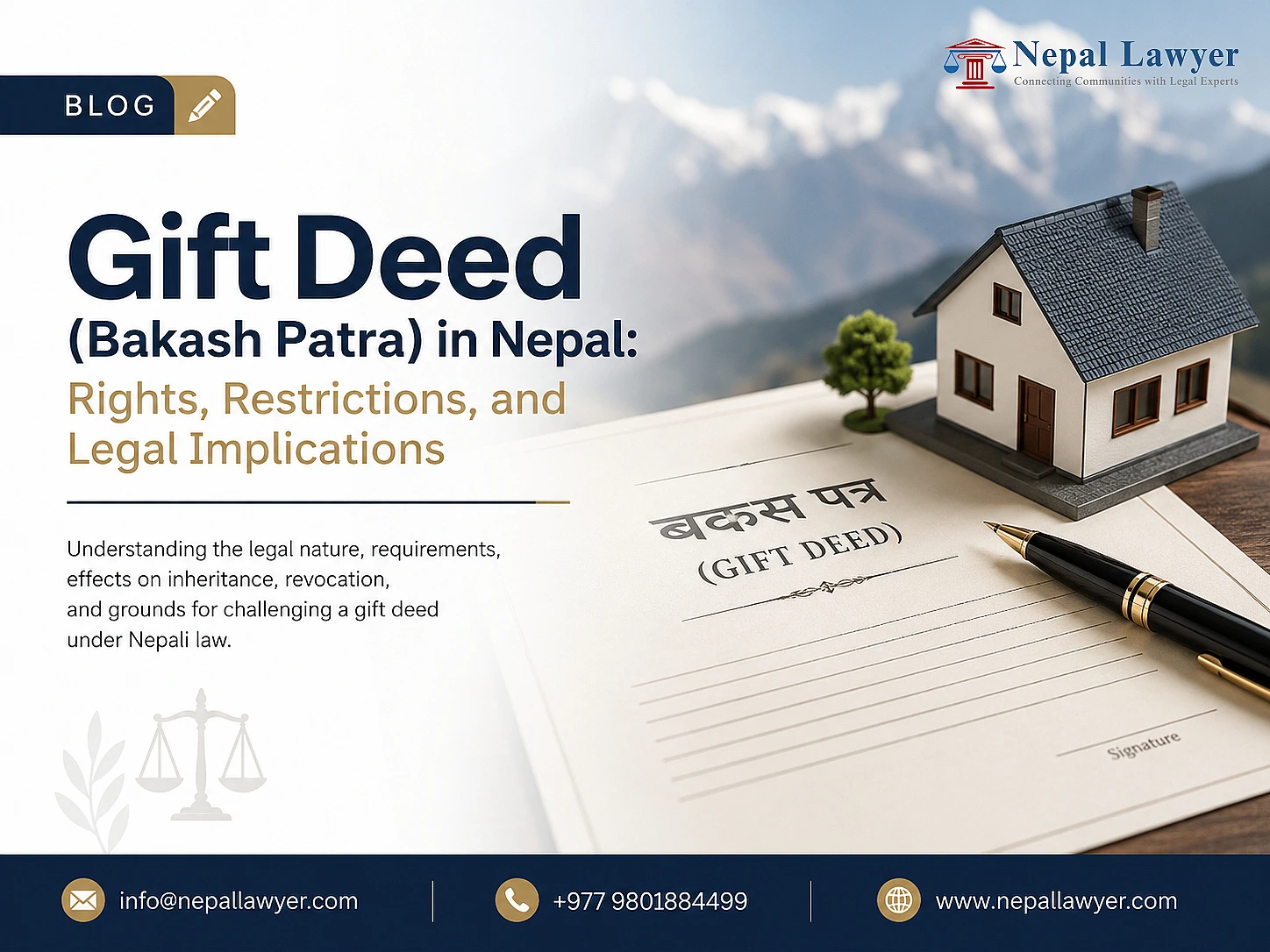
In Nepal, a Gift Deed commonly known as Bakash Patra, is a legally recognized instrument for transferring property without consideration under the Chapter 10 of Muluki Civil Code, 2074.It is widely used for transferring land, houses, and other immovable property, particularly among family members.
Parents often use gift deeds for succession planning, financial security, or avoiding future inheritance disputes. However, a gift deed is not merely a private family arrangement; it is a legally binding transaction that permanently transfers ownership rights.
Improper execution or lack of legal understanding often leads to disputes after the donor’s death, especially among legal heirs.
What is a Gift Deed (Bakash Patra) in Nepal?
A Gift Deed is a voluntary legal document through which a person(donor) transfers ownership of property to another person(donee) without receiving any payment.
Unlike a sale deed, there is no monetary consideration involved. The transfer is based solely on the donor’s free will and intention.Once properly executed and registered, ownership of the property is permanently transferred to the done, and the donor loses all legal rights over it.
Types of Gift Deeds in Nepal
- Immediate Gift (Inter Vivos Gift)
A gift made during the lifetime of the donor that takes effect immediately upon its valid execution,acceptance,and completion in accordance with law.
- Gift Effective Upon Death(शेषपछिको बकसपत्र)
A gift in which the transfer of ownership becomes effective only upon the death of the donor,subject to the legal requirements governing such gifts.
- Conditional Gift
A gift made subject to the fulfillment of a specified condition,provided that the condition is lawful and not contrary to public policy.
- Family Gift (Bakash Patra among family members)
A gift made between family members,such as parents ,children, spouses or other close relatives.While governed by the same legal principles as other gifts,such as transfers are commonly used for family succession and property planning purposes.
Essential Requirements for a Valid Gift
For a gift deed to be legally valid, several legal requirements must be satisfied.
- Ownership of the property
A person can only gift property that they legally own.A donor cannot transfer rights greater than those they possess.Accordingly,ownership and title should always be verified before a gift deed is executed.
- Free and Voluntary Consent
The donor must execute the gift deed voluntarily.A gift obtained through coercion,fraud,misrepresentation,undue influence,or pressure may be challenged before a competent court.This issue commonly arises where elderly individuals transfer valuable property to family members upon whom they are financially or physically dependent.
- Legal Capacity of the Donor
The donor must possess the legal capacity to understand the nature and consequences of the transaction. Questions regarding mental capacity often arise where the donor was suffering from illness, cognitive impairment, or other conditions affecting decision-making ability.
- Acceptance by the Donee
A gift is not complete merely because the donor intends to transfer property.The donee must accept the gift. Acceptance may be expressed or implied depending on the circumstances of the case.
- Compliance with Legal Formalities
Where immovable property is involved, the gift deed must comply with applicable legal and registration requirements. Failure to satisfy mandatory formalities may expose the transaction to legal challenge.
Procedure for Gift Deed Registration in Nepal
The process of property transfer through gift deed includes:
- Verification of ownership documents
- Preparation of the gift deed (Bakash Patra)
- Execution before Land Revenue Office
- Presence of both donor and donee
- Payment of registration fees
- Official registration of the deed
- Mutation (Naamsaari) of property records
Effect of a Gift Deed on Inheritance Rights
One of the most significant consequences of a gift deed is its effect on succession and inheritance. Property that has been validly transferred during the donor’s lifetime generally ceases to form part of the donor’s estate. As a result, property that has already been gifted may not be available for distribution among heirs after the donor’s death.
This is often the point at which disputes arise. Family members who expected to inherit the property may challenge the validity of the gift, alleging that the transfer was not voluntary or was otherwise legally defective.
Can a Gift Deed be Revoked or Cancelled?
A gift deed is generally intended to be a permanent transfer of ownership.Once a gift has been validly executed,accepted by the donee,and completed in accordance with law,the donor ordinarily loses ownership rights over the gifted property. Accordingly,a donor cannot revoke a gift deed merely because they later change their mind,become dissatisfied with the donee,or wish to transfer the property to someone else.The law seeks to ensure certainty in property transactions and protect the rights acquired by the donee.
However,Section 409 of the Muluki Civil Code,2074 provides certain specific circumstances under which a granted gift deeds may be revoked or cancelled.These grounds include:
- Where the gifted property was subject to the ownership rights or coparcenery share of another person.
- Where the gift was made without obtaining legally required consent or approval.
- Where the gift was made by legally incompetent or partially competent person.
- Where the gift was executed otherwise than in accordance with the formalities and requirements prescribed by law.
Therefore, while a gift deed is generally irrevocable, it may be challenged and set aside by a competent court where any of the above statutory grounds exist. The burden of proving such grounds ordinarily rests upon the party seeking cancellation of the gift. For example, disputes may arise where it is alleged that the donor’s consent was obtained through fraud, coercion, misrepresentation, or undue influence. Similarly, questions relating to the donor’s legal capacity or compliance with mandatory legal requirements may also become relevant.
Conclusion
The legal significance of a Gift Deed extends beyond the act of gifting itself. By enabling the transfer of property during the donor’s lifetime, a gift deed has the potential to reshape ownership structures, influence succession outcomes, and affect the interests of family members who may otherwise expect rights in the property.
Given these consequences, a Gift Deed should not be viewed merely as a familiar arrangement but as an important legal transaction requiring careful planning and compliance with applicable law.A properly executed gift deed can provide certainty and facilitate the orderly transfer of property,whereas an inadequately considered transfer may become the source of future legal disputes and challenges.
Sources:Muluki Civil Code,2074, Nepalese legal practice and judicial interpretations.