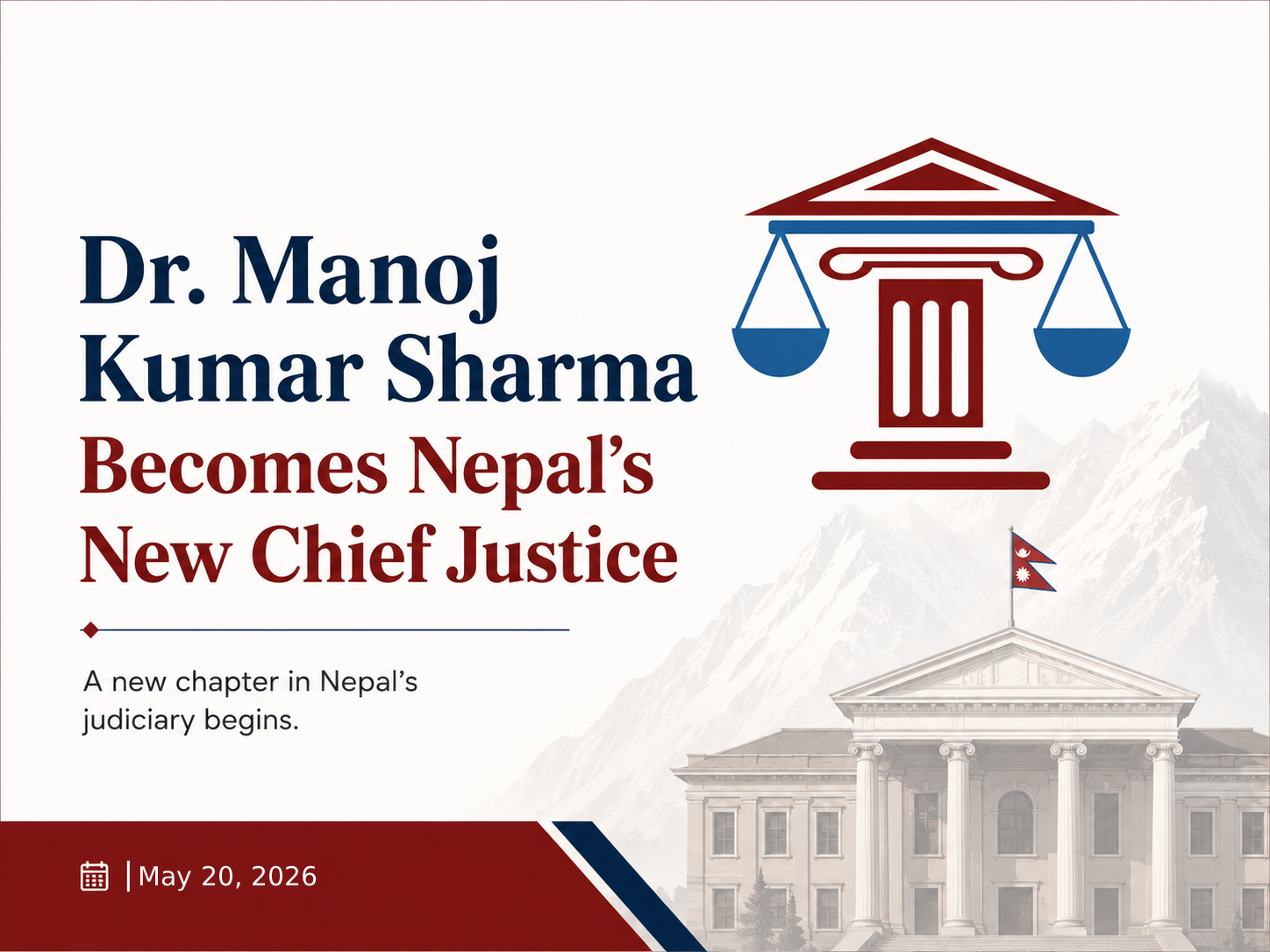
Kathmandu: Dr. Manoj Kumar Sharma has officially assumed office as the 33rd Chief Justice of the Supreme Court of Nepal, marking a significant shift in the country’s judicial leadership.
Dr. Sharma was recommended for the post by the Constitutional Council on Baishakh 24 and later approved by the Parliamentary Hearing Committee. With his appointment finalized, he is set to serve a full six-year tenure until Jestha 2089.
Born on Asar 4, 2027 BS in Birgunj, Parsa, Sharma completed his law degree from Nepal Law Campus under Tribhuvan University and earned a master’s degree in law from Pune University, India.
Unlike previous practices where senior-most justices were traditionally elevated to the position of Chief Justice, Sharma’s appointment broke the seniority convention. The Constitution of Nepal only requires that a candidate must have served as a Supreme Court judge for at least three years, without mandating seniority as a criterion.
Dr. Sharma entered the judiciary from a legal professional background and previously served as a legal advisor for several companies and organizations. He also worked as an additional judge at the then Appellate Court from Jestha 27, 2070, to Mangshir 26, 2072. Throughout his career, he has participated in various national and international legal conferences.
His appointment, however, has not been free from controversy. Allegations have resurfaced regarding past judicial “transactions” involving former Chief Justice Cholendra Shumsher Rana and former Chief Justice Damodar Prasad Sharma, who is also Sharma’s uncle. Critics had previously questioned Sharma’s elevation to the Supreme Court bench after his earlier judicial post was dissolved following constitutional reforms in 2072.
As Chief Justice, Sharma inherits major challenges within Nepal’s judiciary. More than 22,000 cases remain pending in the Supreme Court, with many cases delayed for years despite efforts to accelerate hearings through special campaign units.
During his tenure, 11 current Supreme Court justices are expected to retire, including Sapana Pradhan Malla, Kumar Regmi, Binod Sharma, Abdul Aziz Musalman, Mahesh Sharma Paudel, Nityananda Pandey, Shanti Singh Thapa, Sharanga Subedi, Meghraj Pokharel, and Shrikant Paudel.
Legal experts say Sharma faces the difficult task of restoring public confidence in the judiciary by addressing allegations of corruption, controlling the influence of middlemen, and improving the efficiency of case disposal. He is also expected to strengthen the implementation of court verdicts, as billions of rupees in fines and thousands of years of prison sentences remain unenforced.
Additionally, Sharma must navigate strained relations between the judiciary and the Nepal Bar Association, particularly over disputes related to judicial appointments and Judicial Council regulations.
With the judiciary under intense public scrutiny, Chief Justice Sharma’s leadership will be closely watched as he attempts to reform Nepal’s highest court and improve the delivery of justice.
Source: Ratopati English