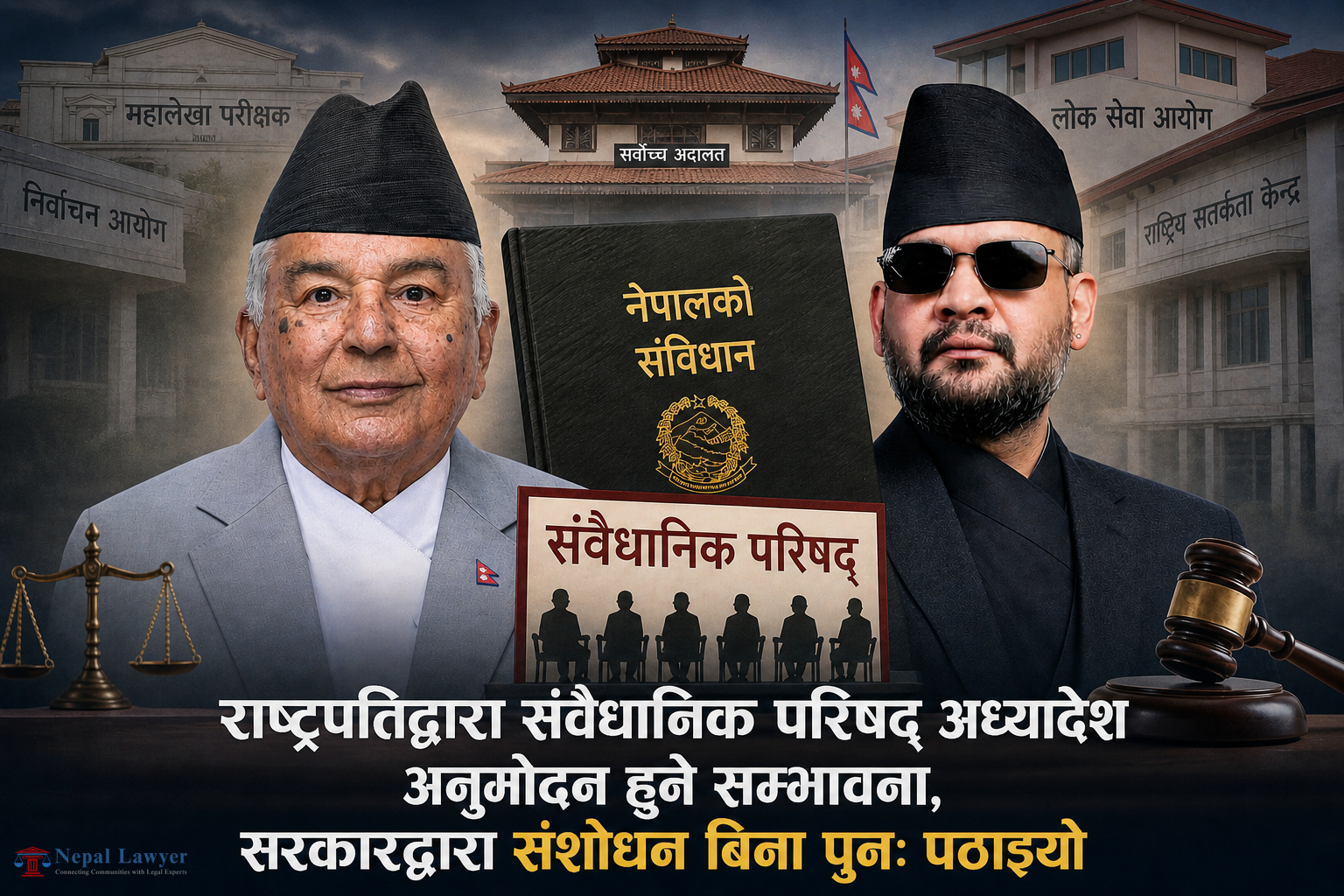
Following a short period of disagreement between राष्ट्रपति Ramchandra Paudel and the government, the Constitutional Council ordinance (अध्यादेश) is now expected to be approved in its original form.
President Paudel had earlier returned the ordinance concerning the functions, duties, powers, and procedures of the Constitutional Council, citing concerns that it did not fully reflect the spirit of the Constitution (संविधान) particularly the principle of majority-based decision-making (बहुमतको सिद्धान्त). He maintained that in a six-member council, at least four members should be required to make decisions to ensure true majority representation.
However, the government led by Balendra Shah chose not to amend the draft. A Cabinet (मन्त्रिपरिषद्) meeting decided to resend the ordinance in the same form, effectively rejecting the President’s concerns. With the ordinance now returned for a second time, officials indicate that the President is likely to authenticate it in accordance with constitutional practice.
At the center of the debate is how decisions are made within the Constitutional Council. The proposed ordinance allows meetings to be held with a quorum (गणपूरक संख्या) of at least four members, and decisions can be made by a majority of those present. This means that decisions could potentially be taken by just three members, even though the council consists of six in total. Critics, including the President, argue that this weakens the concept of majority (बहुमत) envisioned by the संविधान.
This issue is not new. In the past, President Paudel had also returned a similar bill passed by the संघीय संसद (Federal Parliament), raising concerns that such provisions could undermine institutional integrity and democratic norms. He had stressed that decision-making processes must align with the मूल भावना (core spirit) of the Constitution.
Legal experts point out that while the President has the authority to return a bill or ordinance once for reconsideration, there is no provision allowing repeated obstruction. Drawing from Article 114 of the संविधान, an ordinance can be issued upon the recommendation of the मन्त्रिपरिषद् when Parliament is not in session. Once re-submitted, the President is generally expected to approve it, regardless of whether earlier concerns have been addressed.
Similarly, Article 113 provides that if a bill is returned once and later passed again whether revised or not the President must authenticate it within a specified time. Constitutional experts argue that the same principle (सिद्धान्त) applies to ordinances as well.
Meanwhile, government officials defend the ordinance, stating that it is necessary to prevent deadlock (अवरोध) in appointments to constitutional bodies. They argue that more flexible decision-making provisions ensure that the council’s work is not stalled due to political disagreements among its members.
With the ordinance now set to be approved, the responsibility for its legal and political consequences will rest squarely with the government.
Source: Adapted from reporting by The Kathmandu Post (May 5, 2026)