1. Introduction: A Party Confronting Its Moment of Reckoning
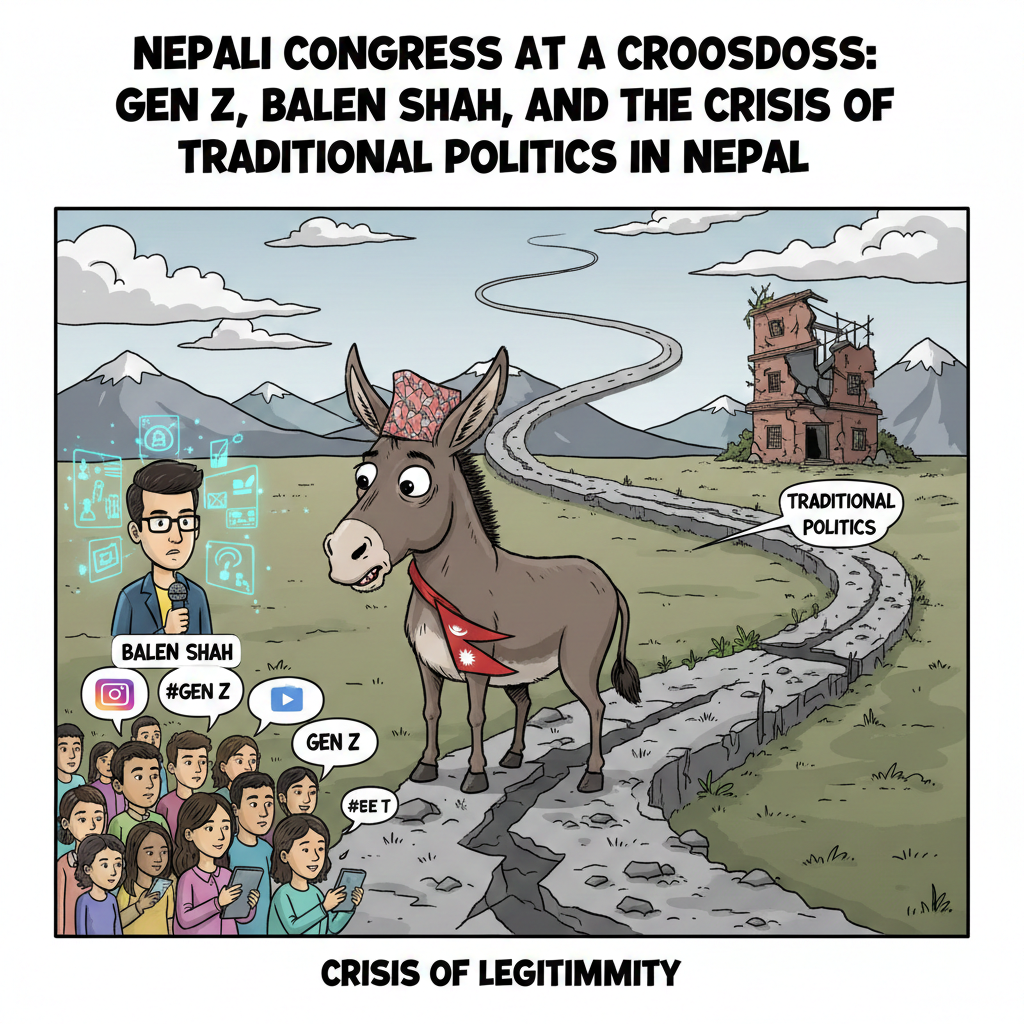
The Nepali Congress (NC), once the undisputed pillar of Nepal’s democratic struggle and parliamentary politics, is facing one of the most profound crises in its history. This crisis is not merely electoral; it is generational, ideological, and institutional. Two interconnected developments have accelerated this decline: the emergence of a politically assertive Gen Z movement and the meteoric rise of independent leaders, most notably Balendra “Balen” Shah, the elected mayor of Kathmandu Metropolitan City.
Together, these forces have disrupted Nepal’s traditional party-centric political order. They have exposed deep fractures within the Nepali Congress—fractures rooted in outdated leadership structures, weakened moral authority, and an inability to resonate with a new generation of voters. For a party that once embodied reform, constitutionalism, and democratic aspiration, the challenge today is existential: adapt meaningfully or risk long-term irrelevance.
2. The Gen Z Challenge: A Rejection of Legacy Politics
Nepal’s Gen Z movement is not organized around a single party, ideology, or leader. Instead, it is driven by shared grievances and expectations: frustration with corruption, impatience with inefficiency, demand for accountability, and skepticism toward entrenched political elites. This generation has grown up after the civil war and the 2006 democratic transition. Unlike earlier generations, they feel little emotional loyalty to parties that claim credit for historical struggles.
For the Nepali Congress, this shift has been particularly damaging. The party’s legitimacy has long rested on its legacy—its role in overthrowing the Rana regime, resisting authoritarianism, and leading democratic movements. However, Gen Z voters evaluate politics through outcomes, not history. To them, the NC increasingly appears indistinguishable from other mainstream parties: hierarchical, faction-ridden, and dominated by aging leaders disconnected from everyday realities.
Institutionally, the party has failed to cultivate credible youth leadership. Student wings and youth organizations often function as patronage networks rather than platforms for policy innovation. As a result, young voters see little space within the NC to influence decision-making or advance reform agendas. This has led to disengagement, protest voting, or support for non-party alternatives.
In essence, Gen Z has not merely criticized the Nepali Congress; it has psychologically exited the party system that the NC helped build.
3. Balen Shah: The Anti-Establishment Disruption
The election of Balen Shah as Kathmandu’s mayor marked a political earthquake. Running as an independent, without the backing of major parties or traditional political machinery, Balen defeated candidates from both the Nepali Congress and the CPN-UML. His victory symbolized a direct rejection of party dominance in urban governance.
For the Nepali Congress, the loss was more than symbolic. Kathmandu has historically been a prestige battleground—a space where party visibility, intellectual credibility, and urban support converge. Losing it to an independent candidate exposed the party’s erosion among educated, urban, and young voters.
Balen’s appeal lay in contrast. Where parties offered rhetoric, he projected decisiveness. Where party leaders spoke in abstractions, he focused on implementation. His communication style—direct, confrontational, and unfiltered—resonated with a generation accustomed to social media transparency rather than scripted political discourse.
Importantly, Balen did not just defeat NC candidates; he made them look obsolete. The party’s campaign machinery, internal compromises, and cautious messaging appeared weak against a candidate who embodied frustration with the system itself.
4. The Intersection: Gen Z Energy and Independent Politics
The Gen Z movement and Balen Shah’s rise are not separate phenomena; they reinforce each other. Gen Z provides the social base and moral energy, while independent candidates offer a vehicle for political expression outside party structures.
This intersection has exposed a core weakness of the Nepali Congress: its inability to channel dissent internally. In earlier eras, frustration within society could be absorbed by parties through reformist factions or leadership renewal. Today, dissatisfaction spills outward, finding expression in independent candidates, civic movements, and online activism.
The NC’s response has largely been defensive. Rather than engaging substantively with critiques, party leaders have often dismissed independents as inexperienced or temporary phenomena. This misreading ignores a critical reality: independent victories are symptoms, not anomalies. They reflect a structural loss of trust in party institutions.
5. Institutional Weaknesses and Strategic Paralysis
At the heart of the crisis lies institutional stagnation. Decision-making within the Nepali Congress remains centralized and personality-driven. Leadership contests often prioritize internal power balances over ideological clarity or public credibility. Policy articulation is reactive rather than visionary.
Moreover, the party has struggled to articulate a clear ideological position in a rapidly changing society. Once identified with liberal democracy and social reform, the NC now appears ideologically blurred—oscillating between populism, centrism, and coalition pragmatism. For younger voters seeking authenticity and direction, this ambiguity is deeply unattractive.
Strategically, the party has failed to modernize its communication, embrace data-driven campaigning, or integrate civic activism into its organizational culture. In contrast, Gen Z movements and independent leaders operate fluidly across digital platforms, public spaces, and issue-based campaigns.
6. Implications for Nepal’s Political Future
The decline of the Nepali Congress among younger voters has broader implications for Nepal’s democracy. If mainstream parties fail to reform, politics may increasingly fragment into personality-driven leadership and ad hoc movements. While this can energize accountability in the short term, it also risks weakening institutional continuity and policy coherence.
For the Nepali Congress, the path forward is narrow but not closed. Rebuilding trust will require genuine internal democratization, leadership renewal, ideological clarity, and meaningful engagement with youth-led demands for reform and transparency. Symbolic gestures will not suffice; structural change is essential.
7. Conclusion: Reform or Irrelevance
The Gen Z movement and the rise of Balen Shah have forced the Nepali Congress to confront uncomfortable truths about its present condition. The party is no longer judged by its past achievements but by its current performance and future relevance.
This moment represents a crossroads. If the Nepali Congress can transform itself into a modern, accountable, and participatory political institution, it may yet regain credibility among younger voters. If not, it risks becoming a party of history—respected for its legacy, but bypassed by the future of Nepali politics.