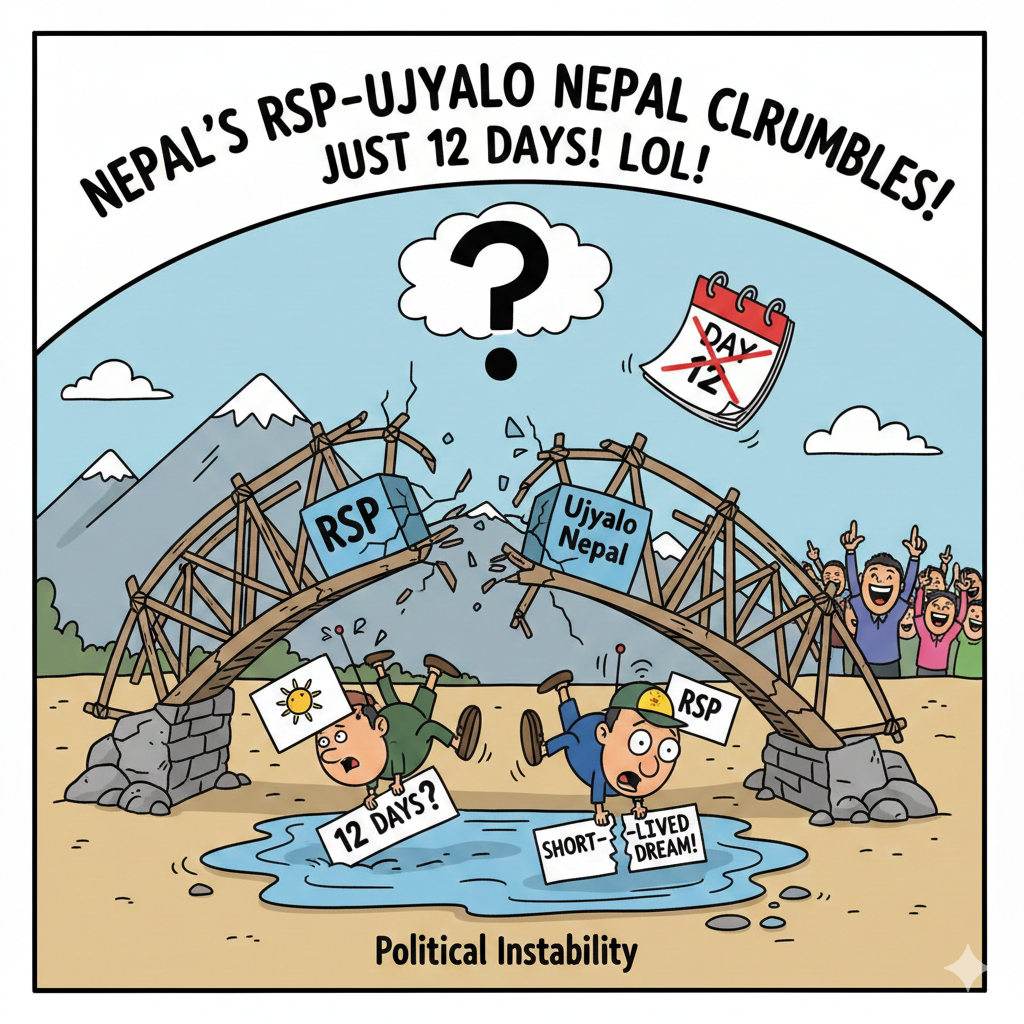
Kathmandu, Jan 11 — A surprise political alliance formed to unite Nepal's emerging alternative forces collapsed on Friday after a mere 12 days, as the Rastriya Swatantra Party (RSP) and Ujyalo Nepal Party (UNP) failed to resolve deepening disputes over leadership roles and ideological direction.
The unity agreement, signed with much fanfare on December 29 in the presence of Kathmandu Mayor Balendra Shah, was intended to consolidate alternative politics following the September Gen Z movement. However, by January 10, the pact had disintegrated amid public accusations and simmering internal dissent.
Power Struggle at the Core
Under the initial agreement, UNP patron Kulman Ghising was to serve as RSP vice-chair, subordinate to Chairman Rabi Lamichhane and Mayor Shah, the party's projected prime ministerial candidate. However, tensions quickly emerged over Ghising's demands for a greater say in party affairs.
RSP leaders claimed Ghising sought the senior vice-chairmanship, a general secretary position, and a 33-member central committee with 30-35 percent representation for his faction—requests they deemed excessive. Disputes also arose over proportional representation seat allocation and Ghising's proposal to shift the party's ideological orientation from democratic to left-leaning socialism.
"The 12 days after the agreement were deeply painful for us," Ghising said at a press conference Saturday, denying he had bargained for posts. "I accepted a low-ranking vice-chair position and was even willing to remain an ordinary member to preserve consensus."
Ghising cited delays in implementation and the absence of clear arrangements on inclusiveness and federalism as contributing factors, accusing the RSP of unilaterally terminating discussions.
Immediate Fallout
Following the split, Ghising officially reclaimed leadership of Ujyalo Nepal Party on Saturday, with a lit bulb as its election symbol. The party immediately faced internal ruptures, with second-ranked leader Dr. Tara Joshi and over 20 central committee members defecting to remain with the RSP.
RSP General Secretary Kabindra Burlakoti confirmed the party would retain its name and bell symbol, while continuing negotiations with other emerging forces. The swift collapse has left analysts questioning whether Nepal's new political actors can avoid the pitfalls of their predecessors.
"This follows the same pattern of old parties—opaque negotiations, personality clashes, and power-centric maneuvering," said political analyst Uddhab Pyakurel. "The expectation that new faces would bring fresh integrity has quickly met reality."
The failed merger comes just weeks before the March 5 House elections, potentially fragmenting the alternative vote and bolstering established parties like the Nepali Congress and CPN-UML.