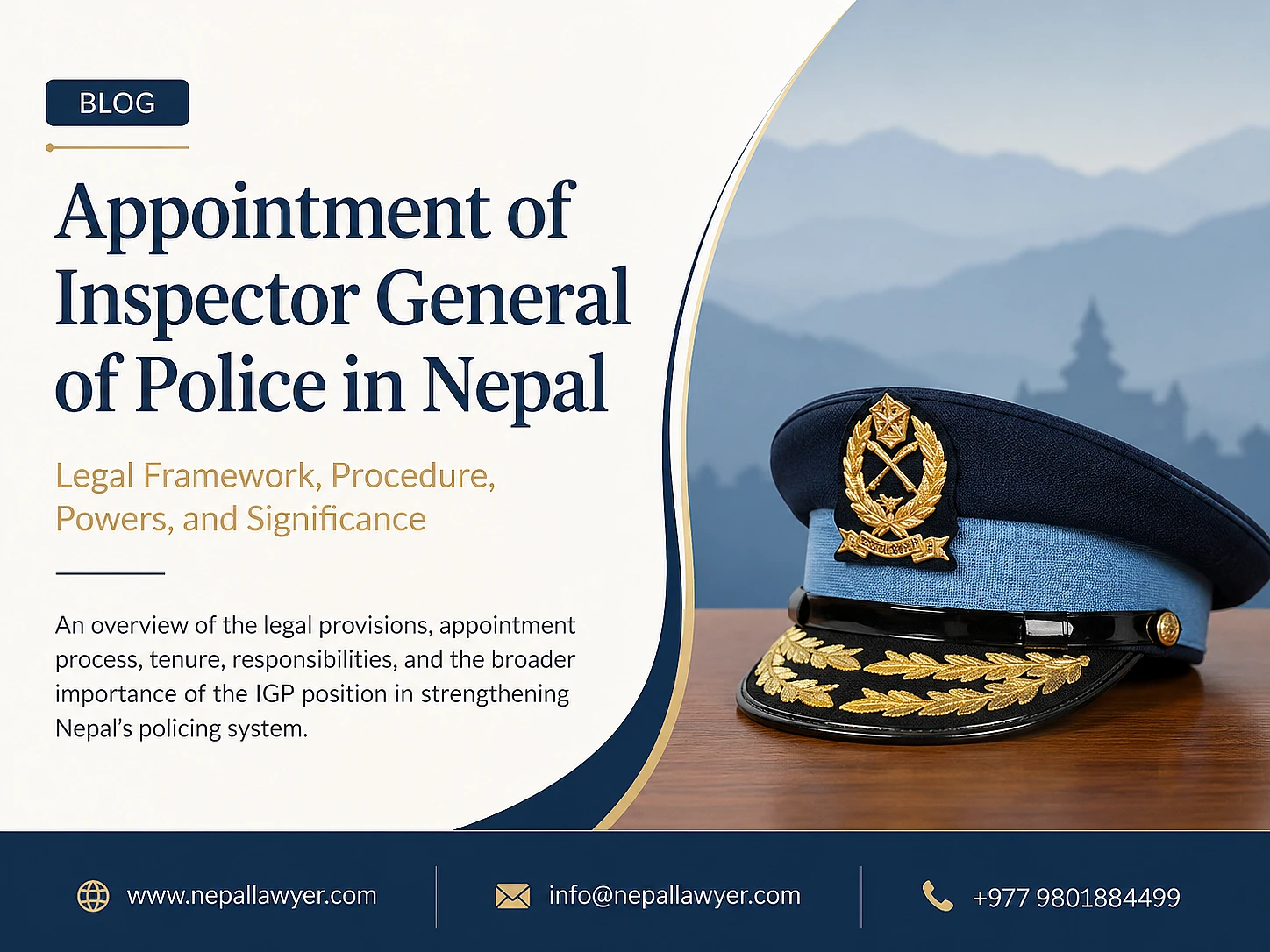
The Inspector General of Police (IGP) is the highest-ranking officer of Nepal Police and serves as its chief executive and operational head. As the leader of the country's principal law enforcement agency, the IGP is entrusted with maintaining law and order, ensuring public safety, overseeing police administration, implementing security policies, and providing strategic leadership to the organization.
Given the significance of the office, the appointment of the IGP carries considerable administrative and institutional importance. The selection of the head of Nepal Police directly influences the efficiency, stability, and overall direction of the country's policing system.
Legal Framework
The appointment of the Inspector General of Police is primarily governed by the following laws:
-
Police Act, 2012 (1955);
-
Police Regulations, 2071 (2014).
These laws prescribe the qualifications, promotion mechanisms, and administrative procedures applicable to the appointment of the highest-ranking officer of Nepal Police.
Appointing Authority
The Inspector General of Police is appointed by the Government of Nepal through a decision of the Council of Ministers (Cabinet).
The appointment process is generally initiated by the Ministry of Home Affairs, which is responsible for internal security and the administration of law enforcement agencies. After evaluating eligible candidates, the Ministry forwards its recommendation to the Cabinet, which exercises the final authority to appoint the IGP.
Procedure for Appointment of the IGP
The process for appointing the Inspector General of Police begins when a vacancy arises due to retirement, resignation, removal, or any other legally recognized reason.
Since the office of IGP represents the highest command position within Nepal Police, candidates are generally selected from among senior Additional Inspector Generals (AIGs) who satisfy the prescribed legal and administrative requirements.
Factors Considered During Selection
In evaluating eligible officers, several factors are taken into consideration, including:
-
Seniority within the service;
-
Professional experience and leadership capability;
-
Performance record and service history;
-
Administrative competence; and
-
Integrity and overall suitability for the position.
Following the evaluation process, the Ministry of Home Affairs submits its recommendation to the Council of Ministers. The Cabinet then selects and appoints one among the eligible candidates as the Inspector General of Police.
Although seniority has traditionally played an important role in the appointment process, the selection of the IGP has occasionally generated debate regarding the relative importance of merit, professional competence, and institutional leadership in comparison with seniority alone.
Powers and Responsibilities of the IGP
As the head of Nepal Police, the Inspector General performs both administrative and operational functions. Major powers and responsibilities include:
-
Providing overall command and leadership to Nepal Police;
-
Formulating and implementing policing policies and strategies;
-
Maintaining internal security and public order;
-
Supervising police administration and disciplinary matters;
-
Coordinating with governmental agencies and other security institutions;
-
Managing human resources and promoting institutional development within Nepal Police; and
-
Representing Nepal Police at national and international forums.
Tenure of the IGP
The tenure of the Inspector General of Police is determined by the maximum service period applicable to Nepal Police personnel.
Under the existing legal framework, police personnel are subject to a maximum service period of 30 years. Consequently, an officer appointed as IGP remains in office until the completion of that service period, depending upon the remaining length of service available at the time of appointment.
As a result, the tenure of different IGPs may vary. An officer appointed shortly before retirement may serve for a comparatively shorter period, whereas an officer appointed earlier within the permissible service period may enjoy a relatively longer tenure.
Significance of the Appointment Process
The appointment of the Inspector General of Police extends beyond merely filling a senior administrative position. Since the IGP heads Nepal's principal law enforcement institution, the appointment has broader implications for:
-
Policy continuity;
-
Organizational stability;
-
Operational effectiveness;
-
Institutional development; and
-
Public confidence in the policing system.
Accordingly, the timing and manner of appointment play an important role in ensuring effective leadership and maintaining the credibility and professionalism of Nepal Police.
Conclusion
The appointment of the Inspector General of Police (IGP) in Nepal reflects a combination of statutory provisions and executive decision-making. Eligible senior officers are assessed through an established administrative process, and the final appointment is made by the Council of Ministers upon recommendation from the Ministry of Home Affairs.
Since the tenure of the IGP depends on the officer's remaining service period, the timing of appointment significantly affects leadership continuity and institutional stability within Nepal Police. Consequently, the process of appointing the IGP remains an important aspect of police administration and governance in Nepal.
Source: Nepal Police