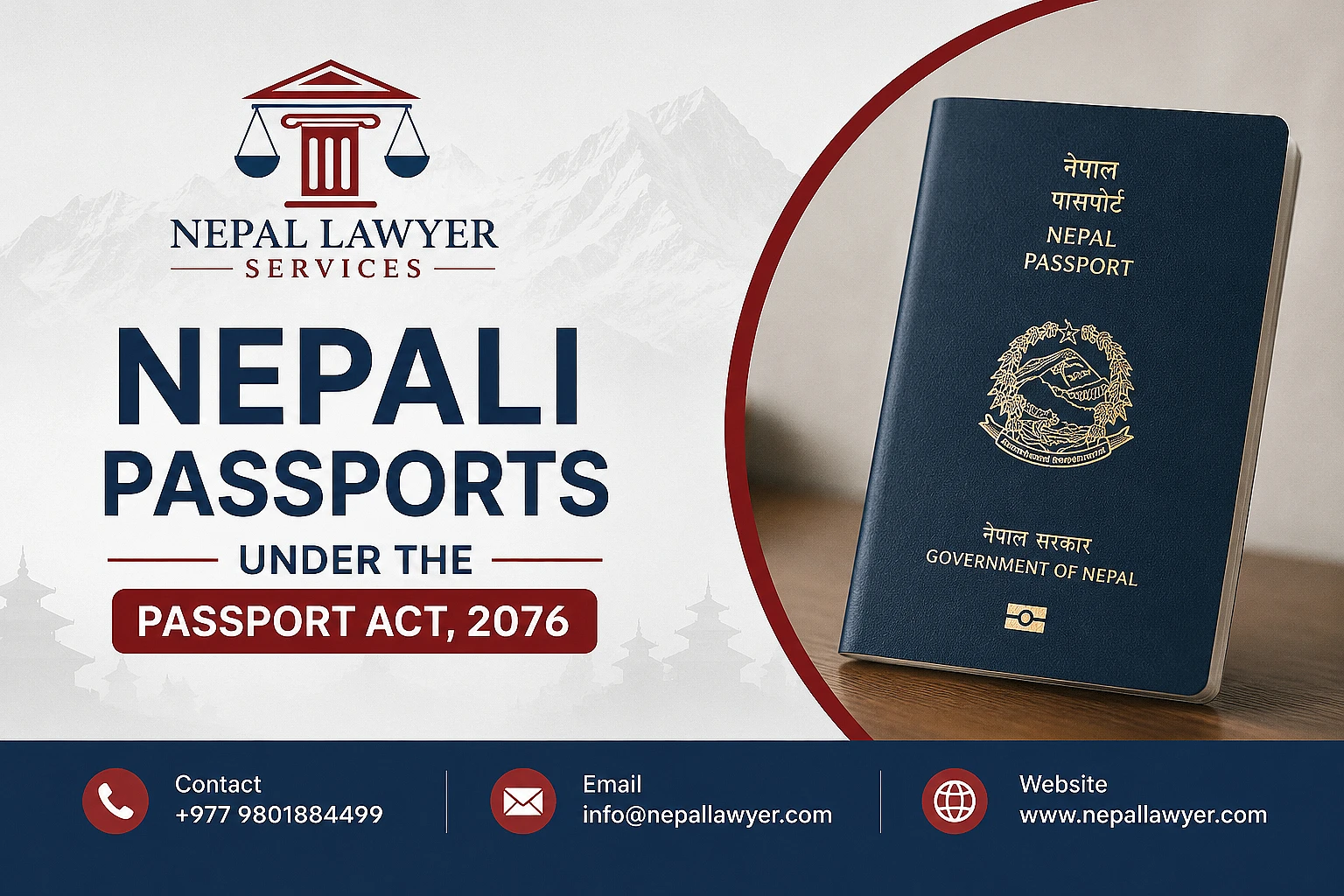
A passport is far more than a travel document. It is an official State-issued identity document that establishes the nationality and identity of an individual for international travel purposes. A passport also represents the protection and recognition extended by a country to its citizens while they are abroad.
In Nepal, passports are governed primarily by the Passport Act, 2076 and the Passport Rules, 2077. In recent years, Nepal has modernized its passport system through the introduction of biometric electronic passports (e-passports), incorporating advanced security and machine-readable technologies to strengthen identity verification and reduce fraud and misuse.
The Nepalese passport system does not operate under a single uniform category. Instead, the law recognizes multiple categories of passports depending on the status of the holder and the purpose of international travel. While ordinary citizens generally obtain passports for employment, education, tourism or personal travel, certain categories such as diplomatic, official and service passports are reserved for governmental and diplomatic functions.
This article explains the legal framework governing Nepali passports, eligibility criteria, passport categories, issuing authorities and circumstances under which passports may be suspended or cancelled under Nepalese law.
Legal Framework Governing Passports in Nepal
Passport administration in Nepal is primarily regulated by:
- The Passport Act, 2076
- Passport Rules, 2077
These laws establish procedures relating to:
- Passport issuance
- Renewal and replacement
- Biometric data collection
- Passport cancellation and suspension
- Offences relating to forgery and misuse
- Administrative responsibilities of passport authorities
The legal framework seeks to balance two important objectives:
- Facilitating international movement of Nepali citizens; and
- Protecting the integrity and security of State-issued travel documents.
Who May Obtain a Nepali Passport?
Under the Passport Act, 2076, passports are issued primarily to Nepali citizens for the purpose of travelling abroad. Accordingly, Nepali citizenship serves as the principal legal basis for eligibility.
However, obtaining citizenship alone does not automatically guarantee issuance of a passport. Applicants must also comply with prescribed legal and procedural requirements, including:
- Submission of prescribed application forms
- Production of supporting documents
- Identity verification
- Biometric enrollment under the e-passport system
Modern Nepali e-passports collect biometric and personal data such as:
- Full name
- Nationality
- Date of birth
- Passport number
- Digital photograph
- Fingerprint and other biometric information
The law also recognizes situations where passport issuance may be refused, particularly where:
- False information is submitted;
- Misrepresentation occurs;
- Citizenship status is questionable; or
- Other legally prohibited conduct is involved.
Which Authority Issues Passports in Nepal?
The primary authority responsible for passport administration in Nepal is the Department of Passports.
The Department performs functions relating to:
- Issuance of passports
- Record maintenance
- Verification and processing
- Administrative control of passport services
Additionally, Nepali diplomatic missions and embassies abroad may also perform prescribed passport-related functions, including:
- Passport renewal
- Issuance of travel documents
- Administrative verification
- Replacement of lost passports
This decentralized structure helps ensure passport services remain accessible both within Nepal and internationally.
Types of Passports under Nepali Law
Chapter 2 of the Passport Act, 2076 recognizes different categories of passports based on the status of the applicant and the purpose of travel.
Ordinary Passport
The ordinary passport is the most commonly issued passport in Nepal. It is generally issued to Nepali citizens travelling abroad for personal purposes, including:
- Foreign employment
- Education
- Tourism
- Business activities
- Family visits
- Private travel
Today, ordinary passports in Nepal are issued as biometric electronic passports (e-passports) incorporating:
- Machine-readable technology
- Embedded electronic chips
- Biometric verification systems
- Enhanced security mechanisms
These technological improvements help reduce document fraud and improve compliance with international aviation and immigration standards.
Importantly, possession of an ordinary passport does not provide diplomatic privileges or special legal immunities. It serves solely as an official identification and travel document.
Diplomatic Passport
Under the Passport Act, 2076, diplomatic passports are issued to individuals travelling abroad on diplomatic or governmental assignments.
Issuance generally requires:
- A decision or recommendation from the concerned Ministry;
- Recommendation from a Constitutional Body; or
- Authorization from the relevant Secretariat.
Diplomatic passports are intended to facilitate official international representation on behalf of Nepal.
However, holding a diplomatic passport does not automatically confer diplomatic immunity. Such immunity depends upon:
- International law;
- Diplomatic accreditation; and
- The official status of the individual concerned.
Official Passport
Official passports may be issued to government officials and employees travelling abroad for:
- Government business
- Official study programs
- Training programs
- Study visits
- International assignments
Such issuance requires formal nomination or recommendation by:
- The Government of Nepal
- Provincial governments
- Governmental bodies or institutions
The passport remains connected to the official governmental purpose for which it was granted.
Service Passport
The Passport Act, 2076 also provides for service passports, which are issued to specific categories of individuals serving in designated governmental or diplomatic roles.
Eligible individuals may include:
- Private assistants to ambassadors
- Permanent representatives
- Special representatives
- Consular generals
- Gazette-level employees
- Certain classless government employees
The law further allows service passports to be issued to Nepali citizens employed locally in diplomatic missions upon written request from the Ministry or the concerned mission.
Unlike ordinary passports, service passports are highly restricted and cannot ordinarily be obtained through general public application procedures.
Suspension and Cancellation of Passports
The right to obtain and hold a passport is not absolute. The Passport Act, 2076 establishes circumstances under which a passport may be refused, suspended or cancelled.
These provisions are intended to:
- Prevent misuse of official documents
- Maintain the integrity of the passport system
- Prevent fraud and identity abuse
- Ensure lawful possession of travel documents
Grounds for Cancellation of a Passport
Under Chapter 15 of the Act, a passport may be cancelled in the following situations:
- The passport holder reports that the passport has been lost;
- A competent court orders cancellation or revocation;
- The holder no longer retains Nepali citizenship;
- A non-Nepali citizen unlawfully obtains a Nepali passport;
- The passport was obtained through false information or misrepresentation; or
- The applicant fails to collect the passport within the prescribed period.
The law therefore places continuing legal obligations upon passport holders even after issuance.
Offences Relating to Passports
The Passport Act, 2076 also criminalizes various acts involving misuse of passports and travel documents.
Offences may include:
- Forgery of passports
- Use of false information
- Unauthorized transfer of passports
- Fraudulent acquisition
- Tampering with passport records
- Illegal possession or misuse of official documents
Such acts may attract legal penalties and administrative action under Nepalese law.
Importance of Nepal’s E-Passport System
Nepal’s transition to biometric e-passports represents a significant modernization of the country’s travel documentation system.
Key advantages include:
- Enhanced document security
- Reduced identity fraud
- Faster international verification
- Compliance with global aviation standards
- Improved border control efficiency
The adoption of electronic passports also strengthens Nepal’s integration into modern international travel systems.
Conclusion
The legal framework governing passports in Nepal reflects an important balance between facilitating international mobility and protecting the integrity of State-issued identity documents.
While the law enables eligible Nepali citizens to obtain passports for education, employment, tourism and official functions, it simultaneously imposes safeguards and legal restrictions designed to prevent misuse and ensure accountability.
Accordingly, a passport should not be viewed merely as a document permitting international travel. Under Nepalese law, it is a legally regulated State instrument carrying continuing rights, responsibilities and legal obligations.
Frequently Asked Questions (FAQs)
- Can a non-Nepali citizen obtain a Nepali passport?
No. Under the Passport Act, 2076, passports are issued to Nepali citizens. Obtaining a passport through false representation is unlawful. - What is the difference between an ordinary and diplomatic passport?
An ordinary passport is issued for personal travel purposes, whereas a diplomatic passport is issued to individuals travelling on official diplomatic assignments. - Can a passport be cancelled in Nepal?
Yes. Passports may be cancelled for reasons including loss, court orders, loss of citizenship, fraud or submission of false information. - Does holding a diplomatic passport automatically grant diplomatic immunity?
No. Diplomatic immunity depends on international law and official diplomatic status, not merely possession of a diplomatic passport.
Need legal assistance regarding passport applications, citizenship verification, document correction, immigration matters or passport-related disputes in Nepal?
Stay informed with the latest legal updates, constitutional insights and practical legal guides from Nepal’s trusted legal information platform.
Disclaimer: This blog post is intended for informational purposes only and is based on the provisions of the Passport Act, 2076 as provided. It does not constitute legal advice, and the content should not be relied upon as a substitute for professional consultation. For specific legal issues, passport eligibility, or up-to-date procedural requirements, readers are strongly advised to consult the full text of the Passport Act, 2076, the Passport Rules, 2077, or a qualified legal practitioner. The author and publisher disclaim any liability for actions taken based on this information.
Sources
- Passport Act, 2076
- Passport Rules, 2077