Constitutional Body Recommends Action Against Former PM KP Sharma Oli, Security Chiefs, and 52 Individuals Including 17 Lawmakers
Kathmandu -
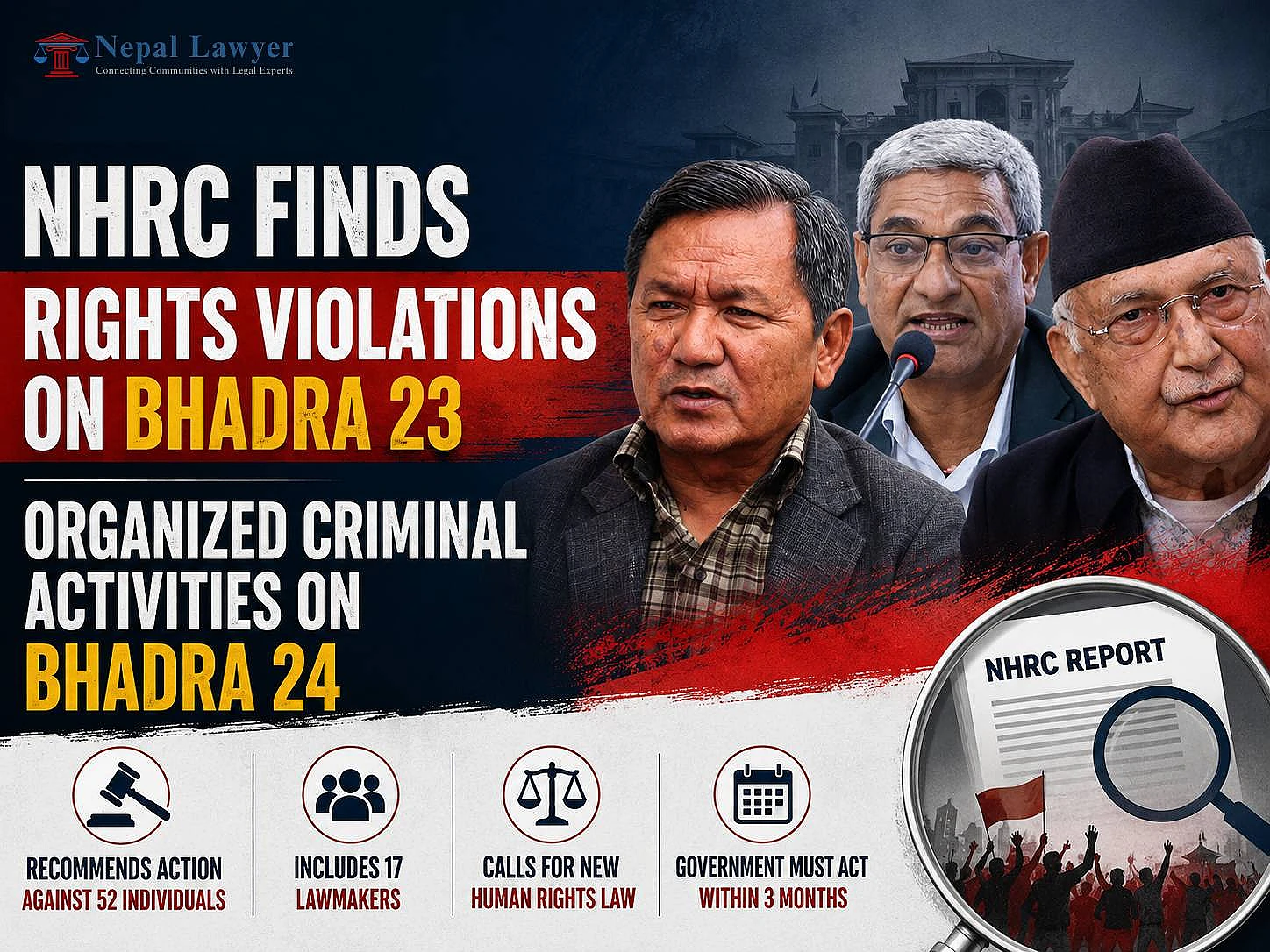
Nepal’s National Human Rights Commission (राष्ट्रिय मानवअधिकार आयोग - NHRC) has concluded that the nationwide Gen-Z protest movement held on Bhadra 23 resulted in serious human rights violations (मानवअधिकार उल्लंघन), while the violent incidents that followed on Bhadra 24 were “organized criminal acts” allegedly carried out under prior planning.
In one of the most consequential human rights findings in Nepal’s recent political history, the constitutional watchdog has recommended legal action against former Prime Minister KP Sharma Oli, former Home Minister (गृहमन्त्री) Ramesh Lekhak, former Communications Minister Prithvi Subba Gurung, senior security officials, and dozens of political figures linked to the unrest.
The report, formally submitted to the Office of the Prime Minister and Council of Ministers (प्रधानमन्त्री तथा मन्त्रिपरिषद्को कार्यालय), also recommends deeper criminal investigation against 52 individuals, including 17 lawmakers from the ruling Rastriya Swatantra Party (RSP).
NHRC: Bhadra 24 Events Were Coordinated and Organized
According to the NHRC investigation, the violence that erupted across Nepal on Bhadra 24 cannot merely be viewed as spontaneous public outrage following the previous day’s crackdown.
The Commission stated that evidence and investigative findings indicate the attacks were “organized criminal activities” executed with coordinated intent and similar objectives nationwide.
Government buildings, courts, political party offices, private businesses, and public infrastructure were vandalized or set ablaze during the unrest. The Commission concluded that the scale and pattern of destruction suggested premeditated coordination rather than isolated mob violence.
The report also alleged that certain groups, including entities identified as “TOB,” played a role in inciting violence during the demonstrations.
Former Prime Minister Oli Identified as “Main Causal Factor”
The NHRC directly linked the crisis to the Oli government’s controversial restrictions on social media platforms, stating that the policy decision triggered the Gen-Z protests.
The Commission identified former Prime Minister KP Sharma Oli (केपी शर्मा ओली) as the “main causal factor” behind the escalation of the situation, arguing that he failed to fulfill constitutional responsibilities despite rapidly deteriorating security conditions.
According to the report:
-
Security agencies had already lost operational control in several areas,
-
Violent escalation was foreseeable,
-
Yet the government allegedly failed to take timely strategic decisions, including military mobilization.
The report further notes that despite requests from local authorities, the Council of Ministers (मन्त्रिपरिषद्) did not immediately authorize deployment of the Nepal Army (नेपाली सेना).
Questions Raised Over Nepal Army’s Delayed Response
The NHRC sharply criticized the handling of the crisis by Nepal’s broader security apparatus, including questions surrounding the Nepal Army’s delayed operational involvement.
The report states that key state institutions including the Federal Parliament building (संघीय संसद् भवन), Singha Durbar (सिंहदरबार), the Supreme Court (सर्वोच्च अदालत), and areas surrounding the Presidential residence (राष्ट्रपति भवन) came under attack while security agencies appeared unable to restore order.
The Commission remarked that significant public discourse had emerged questioning whether the widespread destruction could have been prevented had the Nepal Army intervened earlier.
Investigators also criticized what they described as insufficient institutional cooperation from senior military officials during the inquiry process.
Recommendation for New Human Rights Law and Special Court
One of the report’s most legally significant recommendations is the creation of a dedicated legal framework to prosecute human rights violations.
The NHRC observed that Nepal currently lacks explicit legislation criminalizing many forms of serious human rights abuse. It therefore proposed:
-
Retrospective legal provisions,
-
Establishment of a special court (विशेष अदालत),
-
Criminal penalties including imprisonment and fines,
-
Political disqualification for convicted individuals,
-
Restrictions on future public office appointments and foreign travel.
The Commission also recommended automatic suspension from public office once formal prosecution begins.
Legal experts say the proposal could ignite constitutional debate because retrospective criminal legislation remains highly controversial under constitutional jurisprudence.
Security Chiefs Recommended for Action
The Commission recommended action against several former and current security officials, including:
-
Former Nepal Police Inspector General (महानिरीक्षक) Chandra Kubera Khapung,
-
Former Armed Police Force chief Raju Aryal,
-
Former National Investigation Department (राष्ट्रिय अनुसन्धान विभाग) chief Hutaraj Thapa.
Departmental action was additionally recommended against several senior police commanders, field officers, and intelligence officials accused of failing to adequately protect civilians and public property.
The report also called for detailed investigation into the use of live ammunition during the protests.
17 RSP Lawmakers Among Those Recommended for Investigation
The NHRC recommended further investigation into 17 lawmakers from the Rastriya Swatantra Party, including party president Ravi Lamichhane (रवि लामिछाने).
The Commission raised questions regarding Lamichhane’s controversial exit from Nakhu Prison (नख्खु कारागार) during the unrest after crowds reportedly surrounded the detention facility.
According to the report, prison inmates later escaped after security systems collapsed.
Other lawmakers named for further investigation include:
- Toshima Karki,
- Manish Jha,
- Hari Dhakal,
- Rajiv Khatri,
- Som Sharma,
- Aasika Tamang,
- Deepak Bohara,
- KP Khanal, among others.
The NHRC stated that public statements, social media activity, and intelligence reports suggested possible involvement or encouragement relating to the demonstrations and subsequent violence.
Several RSP lawmakers have rejected the recommendations, arguing that they were targeted merely for participating in humanitarian relief efforts or supporting injured protesters.
Human Rights Experts Divided Over Scope of Recommendations
Nepal’s legal and human rights community has reacted strongly to the report.
Some senior advocates and rights activists praised the NHRC for publicly documenting state failures and human rights abuses during one of Nepal’s deadliest episodes of civil unrest in recent years.
Others, however, questioned whether the report stretched accountability too broadly without presenting sufficiently individualized evidence against all those named.
Critics also raised constitutional concerns regarding proposals for retrospective criminal legislation.
Despite the debate, experts agree the report carries substantial national and international significance because NHRC findings are frequently referenced in United Nations human rights review mechanisms and global accountability forums.
Government Legally Required to Respond Within Three Months
Under Section 17 of the National Human Rights Commission Act, 2068 (मानवअधिकार आयोग ऐन, २०६८), the Government of Nepal is legally obligated to respond to or implement NHRC recommendations within three months.
The matter is expected to move to the Office of the Attorney General (महान्यायाधिवक्ता कार्यालय), which may authorize criminal investigation through government prosecutors and investigative agencies.
NHRC member Mihir Thakur stated that this is the first time in the Commission’s history that prosecution has formally been recommended for human rights violations at such a high political and institutional level.
Legal observers say the government’s handling of the recommendations will likely become a major test of Nepal’s commitment to accountability, constitutional governance, and rule of law.
Source: Original reporting adapted from eKantipur, published May 28, 2026.