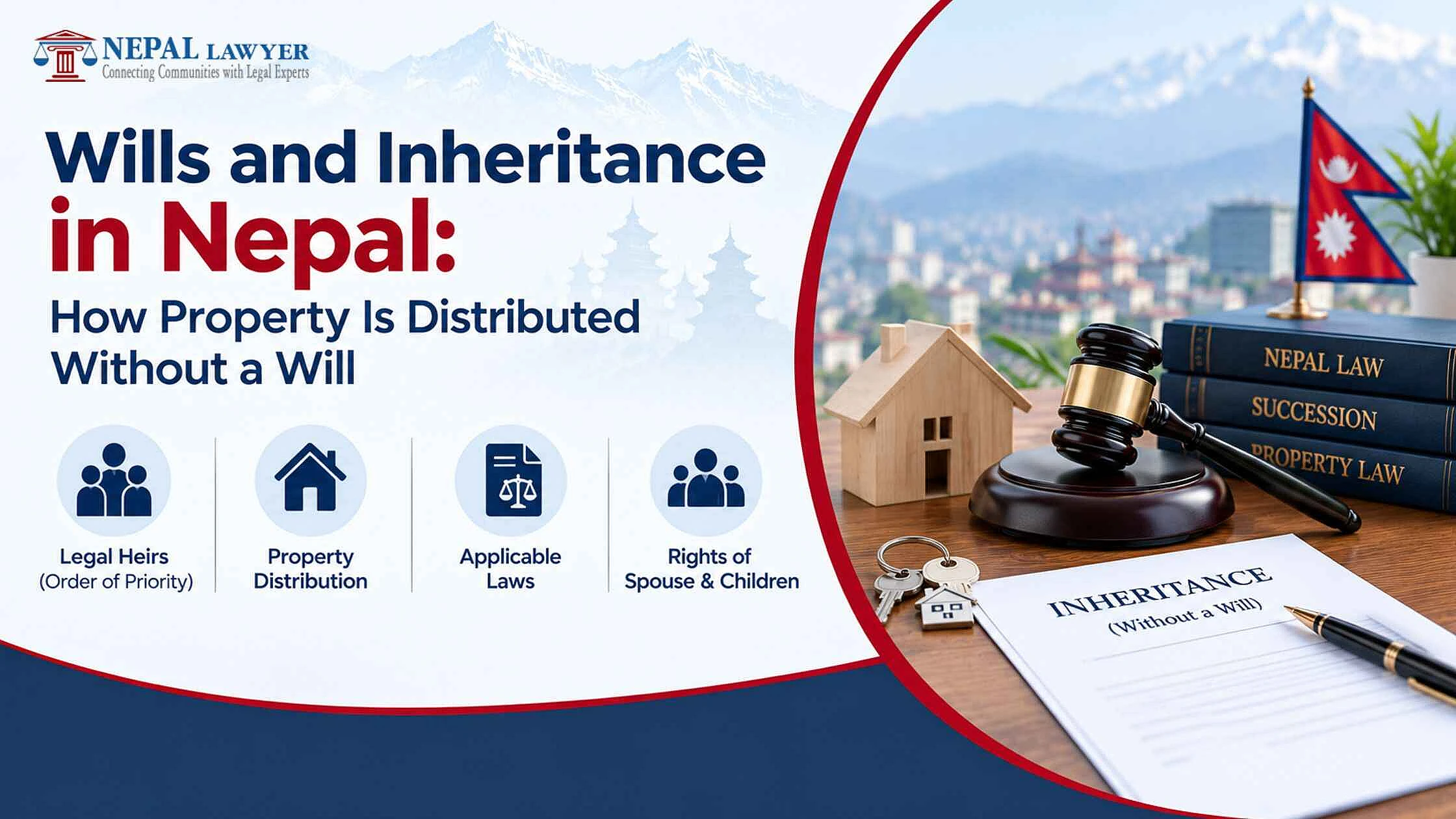
According to the Muluki Civil Code 2074, property in Nepal falls through intestate succession (अपुताली) when a person passes away without a valid will. Depending on the family situation and the type of property, the surviving spouse and children usually have priority, followed by other legal heirs such parents and other relatives.
Key Takeaways
- The Muluki Civil Code 2074 (National Civil Code) governs the distribution of a deceased person's property to legal heirs in the absence of a formal will, not based on verbal pledges or family customs.
- Depending on who is still alive, parents, siblings, and more distant relatives come after the surviving husband and children (sons and daughters).
- Although Nepali law recognizes daughters' and wives' inheritance rights, exclusion of women continues to be a major factor in family conflicts.
- Land does not change hands automatically. Heirs must complete the paperwork at the Land Revenue Office (मालपोत कार्यालय), often after a partition (अंशबण्डा) among all heirs.
- Before acting, confirm the exact shares and the proper heir order with a skilled lawyer and the Code, as these depend on the specific facts of each family.
Introduction: Why Families Feel Lost After a Death
It hurts enough to lose a parent, spouse, or spouse. Many Nepali families also deal with practical issues in a matter of days: The house is now owned by whom? Is it possible to open the bank account? Whose name will appear on the Lalpurja (लालपुर्जा)? What happens to land that was shared with cousins, uncles, or brothers?
It makes sense that there might be confusion. In Nepal, a lot of properties are still registered in the names of deceased fathers or grandfathers. Districts may have different amounts of land. Family members may have differing opinions about who is "entitled," including adult children and NRNs residing overseas. Informal understandings are frequently never documented.
This guide explains wills and inheritance in Nepal and how property is distributed without a will, in plain language. It covers inheritance law in Nepal, who counts as a legal heir, how the process of claiming property works, and when to seek help. It offers general legal information only, and all family’s facts are different.
What Is Intestate Succession in Nepal?
Intestate succession (अपुताली) is the legal process by which a deceased person’s property passes to their legal heirs under the law when there is no valid will.
The opposite is testate succession, where the owner leaves a valid will and the property is distributed according to its terms, within the limits set by Nepali law.
|
Intestate succession |
Testate succession |
|
|
Will exists? |
No valid will |
Yes, a valid will |
|
Who decides the distribution? |
The law (Muluki Civil Code 2074) |
The property owner, within legal limits |
|
Who inherits? |
Legal heirs in the order recognized by law |
People named in the will, subject to legal requirements |
|
Typical risk |
Disagreement among heirs about shares and documents |
Disputes over whether the will is valid |
A will that is invalid, incomplete or successfully challenged may leave families dealing with intestate rules anyway.
What Happens to Property After Death Without a Will in Nepal?
In the absence of a valid will, the property of the deceased person usually passes to their legal heirs, who are determined by statutory succession regulations. Just because an heir resides in the home, has the original paperwork, or is the oldest son does not make them the exclusive owner.
The exact result depends on several factors:
- Who survives the person: spouse, children, parents, siblings or other relatives.
- The type of property: self-acquired property, ancestral property, jointly owned property, or property registered in more than one name.
- Whether a partition has already happened: if the family had already divided its property, or only some assets were divided, the position changes.
- Documentation: whether land, bank and other records clearly show who owned what.
Because the legal heirs become owners of their shares together, the property is often co-owned until the heirs complete a partition and transfer.
Who Are the Legal Heirs in Nepal?
In Nepal, family members who are recognized by the Muluki Civil Code as having the right to inherit when a person passes away without a will are known as legal heirs. The table below is not a list of precise shares; rather, it is a condensed summary to help you grasp the basic order.
|
Priority level |
Likely heirs |
Practical explanation |
|
1 |
Surviving spouse and children (sons and daughters) |
Generally, the first group to inherit. The spouse and children usually share the estate, and a child’s marital status should not decide whether the child is an heir. |
|
2 |
Parents |
Generally considered when there is no surviving spouse or child or depending on the facts of the family. |
|
3 |
Grandparents and other ascendants |
Relevant where closer heirs are absent. |
|
4 |
Siblings (and sometimes their descendants) |
May inherit where there is no spouse, child or parent entitled to take. |
|
5 |
More distant relatives |
Considered only where no closer legal heirs exist, in the order recognized by law. |
|
6 |
No heirs at all |
The law provides what happens to property with no eligible heirs, which commonly involves the State. |
Important note: The final hierarchy and shares must be verified against the Muluki Civil Code 2074 and the facts of your case, including the family’s history, any earlier partition and the type of property. Our inheritance and property distribution guide gives wider context.
Does a Wife Inherit Her Husband’s Property in Nepal?
Generally, yes. Under Nepali law a surviving wife is among the primary legal heirs of her husband, alongside the children.
Due to familial pressure and poor documentation, a widow's position is frequently weaker in reality than the law indicates. Typical misunderstandings consist of:
- “Property goes only to sons.” Under the Muluki Civil Code, property is not reserved for sons.
- “A widow with no son has no rights.” A widow’s status as a legal heir does not depend on having a son.
- “The in-laws can take everything back.” Relatives are not generally entitled to push aside a spouse and children who are legal heirs.
- “Everything a wife holds belongs to her husband’s estate.” Property that belongs to the wife in her own right, for example property from her own family or her own earnings, is generally treated differently from the husband’s property. Documents matter here.
- “Remarriage automatically settles everything.” How remarriage affects a widow’s rights depends on the law and the facts, so do not assume anything without advice.
A widow should keep records of her marriage, the husband’s death and the property, and avoid signing documents she does not fully understand. Our guide to wife’s property rights after her husband’s death goes deeper.
Do Daughters Have Equal Inheritance Rights in Nepal?
Under Nepal’s Constitution and the Muluki Civil Code 2074, daughters generally have rights in parental property equal to those of sons, and marriage does not generally remove those rights.
Despite this, excluding daughters remains a common cause of conflict. Sometimes a married daughter's name is omitted from division documents, she is pressured to sign a release or give up her half, or she is treated as having "abandoned" the family. Although these traditions can seem commonplace in certain households, they do not alter a daughter's legal rights.
Addressing issues with sensitivity. Many daughters wish to stay out of trouble with their brothers or a mother who is widowed. Many times, a calm discussion backed by accurate information settles the matter before it gets to a courtroom or office. A daughter should first seek legal counsel if she is being asked to sign anything that forfeits a portion. See our article on daughters’ inheritance rights in Nepal.
What Happens If There Are No Immediate Legal Heirs?
If the deceased had no surviving spouse or children, the law looks further along the family line, generally in this order:
- Parents: often the next group to be considered.
- Grandparents or other ascendants: relevant if the parents have also died.
- Siblings: brothers and sisters may be heirs when close relatives are absent.
- More distant relatives: considered only if no closer heirs exist.
Nepali law specifies what happens to the property in the absence of an eligible heir, usually including the State. Before determining who is eligible, consult the Code or consult a lawyer because the specifics, definitions, and order may be technical.
Ancestral Property vs Personal Property in Nepal
Ancestral property (पैतृक सम्पत्ति) is property that comes down through the family line, while personal or self-acquired property is property a person earned or acquired through their own effort or by gift or purchase.
This distinction matters because the rules and the family’s expectations differ:
|
Ancestral property |
Personal (self-acquired) property |
|
|
Source |
Inherited from parents, grandparents or earlier family |
Bought, earned or received personally |
|
Who may claim? |
Family members with a legal share, often including sons and daughters |
The owner’s legal heirs after death, or others if there is a valid will |
|
Typical dispute |
Whether a person has a share, and how it is counted in partition |
Whether the property really was self-acquired and, in whose name, |
|
Why records matter |
Old Lalpurjas, partition papers and family history |
Purchase deeds, tax receipts and bank records |
In partition (अंशबण्डा) and inheritance claims, classifying the property correctly can change who is entitled to claim and how shares are calculated. A joint family property arrangement, where several relatives hold property together, makes this even more complicated. Read more in our article on property partition after death in Nepal.
Step-by-Step: How to Claim and Distribute Inherited Property in Nepal
The exact process depends on the type of asset and the local office, but most families follow a path like this:
- Obtain the death certificate. Register the death with the local ward office (वडा कार्यालय) and get the official certificate.
- Gather identity and relationship documents. Collect citizenship certificates (नागरिकता प्रमाणपत्र) of the deceased and the heirs, along with a relationship certificate (नाता प्रमाणित) from the ward office.
- Identify all assets. List land, houses, bank accounts, shares, vehicles, insurance, savings and any debts.
- Check the land records. Confirm at the Land Revenue Office (मालपोत कार्यालय) and with the Lalpurja who is registered as owner, and check for loans, mortgages or other claims.
- Identify all legal heirs. Ensure that everyone who has a legal claim is listed, including daughters, widows, and any overseas-residing heirs.
- Discuss and negotiate within the family. Agree on how to divide the property, ideally in writing and with legal review.
- Complete the partition or take legal action if needed. Prepare the partition documents if the family accepts. A partition claim or other procedure can be required if it is unable to reach an agreement.
- Transfer ownership. Apply for the transfer of land and other assets into the heirs’ names at the relevant offices.
- Update the other records. Change bank, tax and utility records to the new owners’ names.
If you want a deeper walkthrough, see how to transfer land ownership after death in Nepal.
Documents Required for Inheritance and Property Transfer in Nepal
|
Document |
Why it is needed |
|
Death certificate (मृत्यु दर्ता प्रमाणपत्र) |
Proves the death and starts the process |
|
Citizenship certificates of the deceased and heirs |
Proves identity |
|
Relationship certificate (नाता प्रमाणित) |
Proves each heir’s relationship to the deceased |
|
Land ownership certificate (लालपुर्जा) |
Proves registered ownership of land |
|
Land tax (मालपोत) receipts or tax clearance, where relevant |
Taxes show is up to date |
|
Partition deed or written family agreement, where applicable |
Records who get what |
|
Court order, where applicable |
Required when the family disputes the division or the right to inherit |
|
Passport-size photos and signed applications |
Commonly required for office applications |
|
Authorization or power of attorney for heirs abroad |
Helps NRNs and others who cannot attend in person |
|
Bank, insurance and share records |
For non-land assets |
Note: Requirements can vary by local office and by case. Always check with the relevant office or a lawyer about what is needed in your situation.
How to Transfer Land Ownership After Death in Nepal
To transfer land ownership after a death in Nepal, the heirs generally apply to the Land Revenue Office with the death certificate, relationship documents and land records so the registered ownership can be changed into the heirs’ names.
In plain language, the process usually looks like this:
- The heirs prove who the owner was and that the owner has died.
- They prove their own identity and their relationship to the deceased.
- They show who the legal heirs are and how the property will be divided or held.
- The office examines the documents, and the land records are updated if everything is in order.
Heirs may need extra help when:
- The heirs have not agreed on the division, so a partition deed or formal partition proceeding is needed.
- Someone disputes who is a legal heir, so a court order may be needed.
- The records are missing, mismatched or incorrect.
- An heir is abroad, unreachable or unwilling to cooperate.
The office, the property, and the intricacy all affect the cost and time. Instead of depending solely on data from the internet, confirm current fees and processes with the Land Revenue Office.
What If Family Members Disagree About Inheritance?
Disagreement is common, and there are several routes:
- Negotiation: a family conversation, ideally with correct legal information and a written record of any agreement.
- Mediation: a neutral person helps the family reach a settlement. Local and court-linked mediation options may be available.
- Partition proceedings: where heirs cannot agree, a legal claim for partition can ask the competent authority to divide the property.
- Court remedies: courts can decide disputes about who is an heir, who owns what and how the property should be divided.
A property inheritance lawyer becomes important when someone is blocking the process, documents are disputed, or any party is asked to sign away rights. Learn more about inheritance disputes and legal remedies.
Can a Will Override Legal Heirs in Nepal?
A valid will can guide how property is distributed, but under Nepali law its validity and its legal limits must be assessed, so a will does not automatically override every claim of the legal heirs.
A will's validity is determined by several elements, including the owner's capacity, proper execution and witnessing, and whether or not it complies with the legal restrictions on how freely property may be distributed. More controversy can result from a poorly written will than from none.
We will cover this in detail in a future article, “How to Write a Valid Will in Nepal.” Until then, see our guide to writing a valid will in Nepal.
Common Mistakes Families Make After a Property Owner Dies
- Waiting too long. Delay can make records harder to find and disputes harder to resolve.
- Leaving out heirs. Excluding a daughter, a widow or an heir abroad can create claims that surface years later.
- Relying on verbal promises. Spoken agreements are difficult to prove. Put agreements in writing and have them reviewed.
- Signing documents without understanding them. Releases, consents and waivers can permanently affect your rights.
- Selling or mortgaging before the title is clear. Dealing with the property before ownership has been properly transferred can invite legal trouble.
When Should You Hire a Property or Inheritance Lawyer in Nepal?
Consider consulting a property or inheritance lawyer when:
- Heirs are disputed: someone says another person is not a legal heir.
- Documents are missing: the Lalpurja, citizenship papers or relationship proof cannot be found or contain errors.
- Joint family conflict exists: relatives disagree over ancestral property.
- The Land Revenue Office refuses or delays the transfer.
- You are an NRN with property in Nepal and cannot handle matters in person.
- You face pressure or threats to sign or give up your share.
- The estate is complex: multiple properties, businesses, loans or assets in different places.
You can find a property lawyer in Nepal through our directory.
FAQs About Wills and Inheritance in Nepal
Q. What happens to property if someone dies without a will in Nepal?
According to the Muluki Civil Code 2074, the property usually passes through intestate succession ((अपुताली)) to the rightful heirs. If there are no closer heirs, the surviving spouse and children typically take precedence over other family members. The family and the property determine the precise outcome.
Q. Does a wife inherit her husband’s property in Nepal?
A surviving wife is typically one of the principal legal heirs. Having a son has no bearing on her rights. Before signing any paperwork, she should see a lawyer and save her marriage and property records.
Q. Do daughters have equal inheritance rights in Nepal?
Under Nepal’s Constitution and the Muluki Civil Code, daughters generally have rights equal to sons, and marital status should not remove them. Customary pressure to give up a share does not change the legal position. Seek advice before signing any release.
Q. Do parents inherit from a child who dies without a will?
Depending on the circumstances of the family, parents are typically included in the heirs when the dead leave no surviving spouse or children. The precise shares and order should be compared to the Code. How it relates to your case can be verified by an attorney.
Q. What documents are needed to claim inheritance in Nepal?
The death certificate, citizenship certificates, relationship certificates, Lalpurja and land tax receipts, and, if applicable, a partition deed or court order are frequently needed documents. Office and case-specific requirements may differ. Verify the list with the appropriate office.
Q. How do I transfer land after the owner dies?
Heirs typically apply to the Land Revenue Office along with documentation of their ownership, relationship, identification, and death. A partition deed or court order may be required if the heirs cannot agree or if the records are ambiguous. Check the current process locally.
Q. How long does partition of inherited property take?
A single timeline does not exist. Compared to a family that argues the heirs or shares, one that is in agreement and has all the necessary paperwork may conclude much sooner. Request a reasonable estimate for your case from the appropriate authorities or an attorney.
Q. Can I sell inherited land in Nepal?
In general, co-heirs' rights must be considered, and heirs can only sell after ownership has been legally transferred into their names. Selling before the title is clear can result in major issues. Prior to any sale, seek legal counsel.
Q. What if the deceased has no heirs?
Parents, siblings, and more distant relatives are given priority by the law. Nepali law specifies what happens to the property if there is no suitable heir, usually involving the State. Before assuming there is no heir, confirm the precise regulations.
Q. How much does an inheritance lawyer cost in Nepal?
Fees vary with the complexity of the matter, the number of heirs, whether court action is required and the lawyer’s experience. We cannot give a reliable, fixed figure. Ask for a clear fee explanation at the start of a consultation.
Get Help from a Property Inheritance Lawyer in Nepal
If you are dealing with wills and inheritance in Nepal and how property is distributed without a will, you do not have to work through it alone. A short consultation can clarify who the legal heirs are, which documents you need and whether a family agreement or legal action makes sense.
Nepal Lawyer can help you consult a verified property and inheritance lawyer who understands local procedures. Find a property lawyer in Nepal and take the next step with clear, practical guidance.
Sources:
https://crehpa.org.np/wp-content/uploads/2021/04/Policy-Brief-on-GBSS_Legal-Landscape_English.pdf
https://www.notarynp.com/blog/property-document-translation-in-nepal
https://deafnepal.org.np/en/government-office/land-name-transfer/
https://faolex.fao.org/docs/pdf/nep209663.pdf
Disclaimer: This article provides general legal information about inheritance in Nepal and is not legal advice. Laws, procedures and office requirements can change, and every case depends on its facts. Please consult a qualified Nepali lawyer before making decisions about your property.