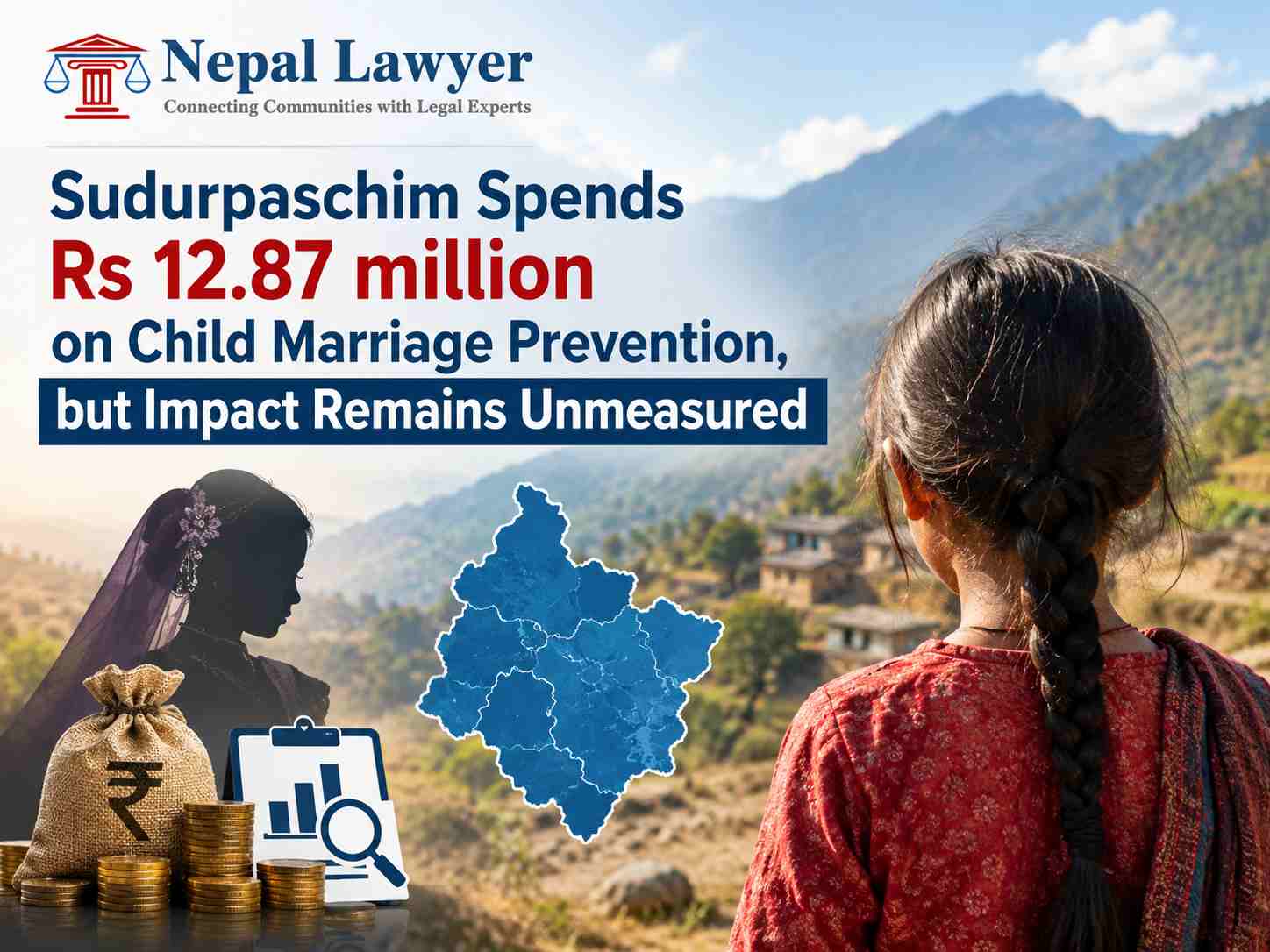
Over the course of five fiscal years, the Sudurpaschim Province government has spent Rs 12.87 million on initiatives to discourage child marriage, yet the practice persists throughout the province. Authorities have not carried out a comprehensive review to ascertain whether the investment has considerably decreased child marriage, despite awareness campaigns and community-based activities. Concerns over the efficacy, oversight, and accountability of government-funded preventative initiatives have been raised by the persistent issue.
The provincial government set aside Rs 14.12 million for child marriage prevention between fiscal years 2021–2022 and 2025–2026, spending roughly Rs 12.87 million during that time, according to the Sudurpaschim Ministry of Social Development. Through parenting orientations, school-based peer education, awareness campaigns, and conversations with religious and community leaders, the programs reached 9,147 kids and parents. To ascertain the total impact of these programs, the ministry has admitted that it lacks baseline data, quantifiable targets, and an established evaluation mechanism.
The number of child marriage instances reported to the police and the incidence of child marriage in Sudurpaschim differ significantly, according to data. According to Nepal's 2021 national census, child marriage accounted for 29.1% of marriages in the province, yet only 36 cases were reported by provincial police between the fiscal years 2020–2021 and 2025–2026. At 34.1 percent, Bajhang has the highest incidence in the province, followed by Darchula at 33.4 percent. The tendency for these marriages to stay within families and the lack of community intervention have been cited by officials as contributing factors to the low number of recorded cases. In the fiscal year 2024–2025, the Crime Investigation Department additionally documented seven child marriage cases in Sudurpaschim out of 61 statewide.
In Nepal, where the legal minimum age for marriage is 20, child marriage is still a major social and legal issue. Child marriage is illegal under Section 173 of the National Penal (Code) Act, 2017, which carries a maximum sentence of three years in prison and a fine of up to Rs 30,000. Early marriage can limit financial freedom, disrupt schooling, and subject kids to abuse, domestic violence, and early parenthood. Concerns about shifting trends, such as teenagers getting married on their own, often by abusing social media and technology, have also been voiced by National Human Rights Commission representatives.
Non-governmental organizations are also tackling the issue, but it is still difficult to gage long-term outcomes. According to reports, PeaceWin, which runs prevention programs in a number of Sudurpaschim districts, spends over Rs 10 million a year on community projects, parental awareness, reproductive health education, and adolescent empowerment. The organization has recorded 32 child marriages that were avoided as a result of its programs, but it hasn't carried out an independent, thorough analysis to determine their overall effectiveness. Stronger collaboration with local governments, evidence-based planning, and methodical monitoring, according to officials, will be necessary to guaranty that Sudurpaschim's child marriage prevention initiatives produce quantifiable and long-lasting outcomes.
Source: The Kathmandu Post