Purchased a product that is defective, a service that was not as advertised or paid more than the advertised price?
Nepal has implemented a consumer protection mechanism whereby consumers can complain about unfair market practices and if they have been unfairly harmed or lost, seek compensation through the Consumer Court in Nepal.
However, not all consumer complaints need go to court. Some can be addressed by the seller and others should be initially reported to the Department of Commerce, the police or other appropriate authority.
Key Highlights:
- The Consumer Court hears compensation claims arising from defective goods, deficient services and consumer-law violations.
- Typical complaints are misleading sales, faulty Internet service, defective electronics and medical negligence.
- Administrative complaints may be submitted in writing, orally or electronically to the authorities of consumer protection.
- A direct compensation claim should be submitted within six months of the damage or injury.
- Receipts, warranties, advertisements, messages, photographs and proof of loss can strengthen a complaint.
- Legal assistance may be helpful when the loss is significant, when the evidence may be technical, or where it is not certain what is the proper forum.
What is Consumer Court?
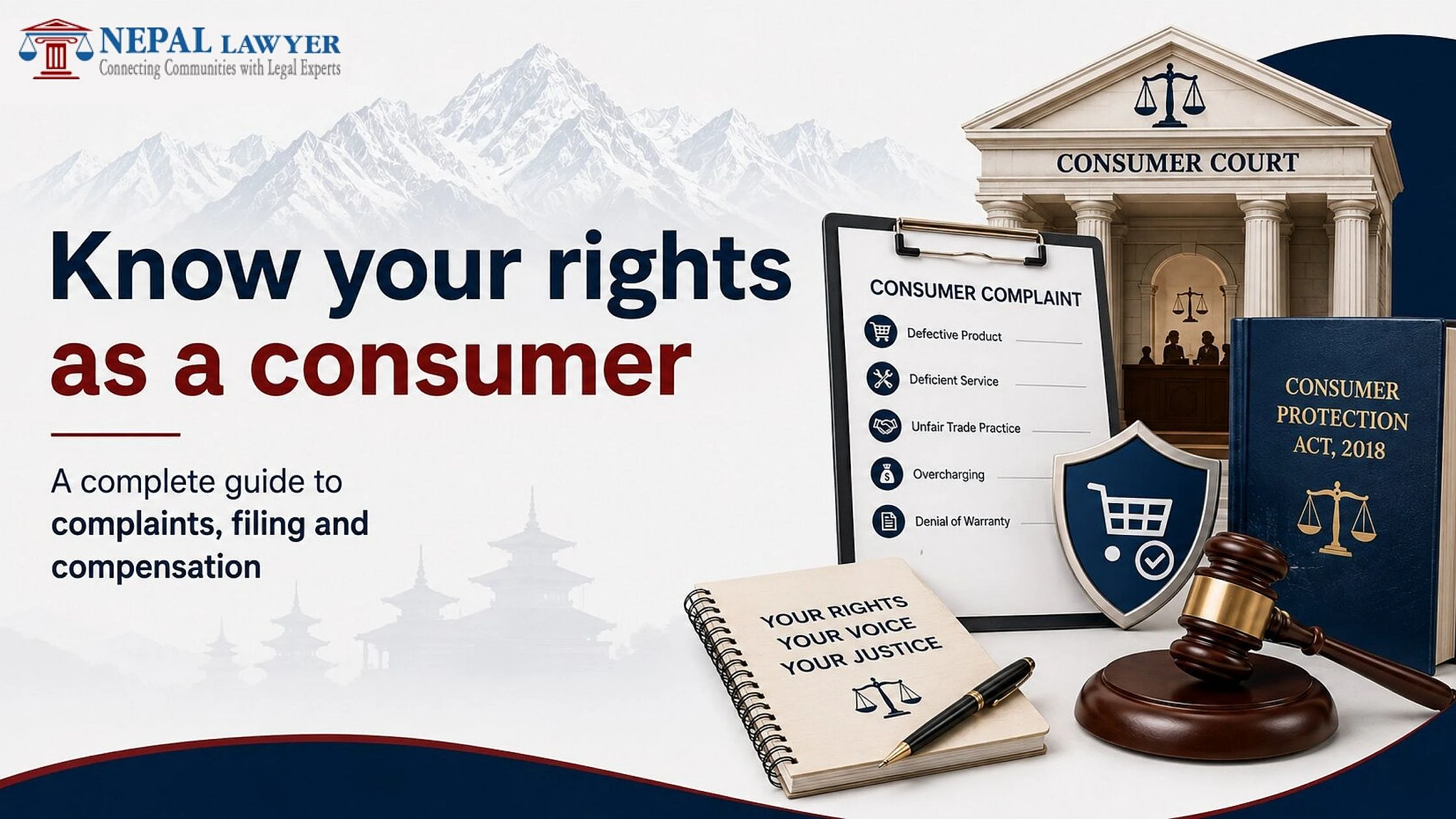
Article 44 of The Constitution of Nepal guarantees the right of all consumers to access good quality products and services. It also asserts that the person has the right to be paid any damages they have suffered due to poor goods or services. Consumer Protection Act 2075 is the principal law to implement these rights. The Act covers consumers' rights to be protected from unsafe products, misleading information, excessive pricing, unfair trade practices and deficient services. It also sets up complaint, investigation, punishment and compensation system.
Nepal's first specialized Consumer Court has been launched since March 15, 2025. It is situated in Tripureshwor and has jurisdiction over consumer issues in Kathmandu, Lalitpur and Bhaktapur.
Where a specialized Consumer Court has not been set up, the District Court, having territorial jurisdiction, has the authority over the matters falling within the jurisdiction of the Consumer Protection Act as per Section 48 of the Act. Consumers out of Kathmandu Valley should check the current forum for filing in their district before preparing the case.
Two Different Consumer Complaint Routes
Consumers should be aware that Nepal has two different routes:
- Regulatory or enforcement complaint: Consumer can complain about an unfair practice to the Department of Commerce, the Central Market Monitoring Committee or an inspection officer.
- Court Claim: If a consumer has been physically, mentally, financially, materially or otherwise harmed they make a claim for compensation.
A complaint to the Department can result in inspection, testing, seizure, fines or prosecution whereas, Consumer Court cases are primarily concerned with obtaining a legal remedy or compensation to the aggrieved consumer.
Complaints You Can File
The Consumer Court can consider any claims that have been made by consumers who have suffered losses or harm from being sold, distributed or provided with products or services without legal authority.
1. Defective or substandard goods
Complaint of a defective goods can include:
- A vehicle that has had a number of mechanical issues.
- An electronic equipment that does not operate as claimed.
- Unsafe household equipment.
- Food that has been contaminated or has expired.
- A product made using faulty materials.
- Product that does not comply with the quality or specification, or
- A person who refuses to fulfil a valid guarantee/warranty.
The Consumer Protection Act also provides consumers the ability to return certain goods within seven days if they do not meet their expectations, providing for exceptions stated. In general, if the seal is not broken, sealed goods can be returned for 15 days.
2. False or misleading advertising
A false advertising claim can occur if a seller or service provider:
- Makes inaccurate claims.
- Presents a used or refurbished product as new.
- Overstates the benefits or results that the product cannot provide.
- Hides material conditions in an offer.
- Uses misleading photos, prices or descriptions online.
The Act treats false or misleading advertisements and dishonest descriptions of quality, quantity, price or design as unfair trade practices.
3. Overpricing and billing errors
The consumers can complain about:
- Charging more than the indicated or statutory price.
- Adding undisclosed fees.
- Refusing to provide a bill.
- Demanding extra money to issue an invoice.
- Manipulating weight, measurement or quantity.
- Charging money for a service that was not provided.
- Incorrect utility, internet, medical or service bills.
After selling goods, the seller must display the prices and give a bill or receipt. All service providers will also have to make it clear what they are providing and the nature and cost of the service and will provide a receipt after payment.
4. Poor or incomplete services
A poor service complaint may relate to:
- Medical negligence.
- Low-quality internet or telecommunication service.
- Flight delay, cancellation or failure of service.
- Negligent repair or maintenance work.
- Defective house construction.
- Inadequate education or consultancy services.
- Banking service disputes.
- Tourism or hotel services.
- Professional services that fall below the promised standard.
The Act broadly defines services and includes electricity, water, telephone, information technology, health, education, transport, banking, legal, medical and engineering services.
5. Refund, replacement and warranty disputes
A consumer may seek relief if a business:
- Refuses to refund an eligible purchase.
- Does not replace damaged products.
- Ignores a warranty.
- Consistently attempts to repair things unsuccessfully.
- Breaks an agreed service without paying back.
- Delivers a product other than what was ordered.
Depending on the product, its use, the return period, the terms and conditions of the warranty and the defect, the consumer may have the right to a refund, replacement of the product or repair.
6. Unsafe products and physical harm
Consumer Court claims can also be made if a person is injured, becomes sick or dies because of unsafe food, medicine, equipment, vehicle, premises or services.
Compensation can cover medical costs, loss of earnings, physical and mental distress and any other reasonable losses. The seriousness of the injury may also be taken into account and the financial circumstances of the producer, seller or service provider may also be considered.
7. Online shopping and e-commerce complaints
An online transaction does not remove consumer protection, though gaps in enforcement mean online shopping and social media scams remain growing problem in Nepal.
Relevant complaints may be:
- Getting an incorrect, damaged or different product.
- Paying for goods that were never delivered.
- A social-media seller refusing a refund.
- Hidden charges on the delivery or service.
- Providing false information about a product in online reviews or advertisement.
- Failing to give the seller's name or information.
Save the product listing, screenshots, payment confirmation, seller profile, messages and delivery history. If there is online fraud with fake identity, using an online account in an unauthorized manner or deliberately misleading, a complaint may still need to be made to the Nepal Police Cyber Bureau. You can check on How to file cybercrime complaints in Nepal.
What Types of Cases Are Reaching the Court?
During the fiscal year ending July 16, 2026, the Consumer Court received 45 cases, delivered 23 judgments, and brought 4 cases to settlement. Common categories included medical negligence, goods and services, cars, internet, tourism, construction, banking and airlines. The complainant varies based on what route is being utilized.
Who Can File a Consumer Complaint?
The complainant varies based on what route is being utilized.
A. Complaint to Consumer-Protection Authorities
Anyone receiving information about conduct affecting consumer interests will be able to provide the available information and evidence to:
- The Central Market Monitoring Committee.
- The Ministry of Commerce, Supplies and Consumer Protection, or
- An inspection officer.
The complaint can be filed via a written, oral or electronic submission. A complainant can also ask to have his/her identity kept confidential.
B. Compensation Claim Before the Court
A claim for compensation can be made by:
- The affected consumer.
- An organization representing the consumers.
- Where the consumer has died, the consumer's legal heir, or
- Where the consumer cannot act personally, an authorized person.
Consumer is defined in the Act as a person or institution that uses goods or services. But, an ordinary business dispute between two businesses can instead come under the law of contracts or commercial law. Hence, prior to the selection of the Consumer Court, the nature and purpose of the transaction should be carefully considered. The first step is to make a note of the Problem immediately.
How to File a Consumer Complaint in Nepal
Step 1: Record the Problem Immediately
Write down:
- The goods or product bought or given.
- The purchase or service date.
- The amount paid.
- What went wrong.
- The time the defect or loss was found, or the loss occurred.
- Who was contacted, and
- What remedy was requested.
The consumer complaint process in Nepal is easier to understand as it is presented in a clear chronology.
Step 2: Contact the Seller or Service Provider
Provide any written notice or message requesting a specific remedy such as:
- Repair
- Replacement
- Refund
- Correction of the bill
- Completion of the service, or
- Compensation.
If the case is about a complaint to the seller, its merit as a legal basis for a case is not determined, but it may be able to solve the problem promptly. It also provides evidence that the business had the chance to respond.
Step 3: Select the Correct Complaint Channel
For pricing, labels, bills, unfair trade practices or market inspection, use the official Department of Commerce consumer complaint form.
In cases of actual damage, it might be better to go the direct claim route.
Other regulated services such as banking, insurance, telecommunications, food safety and the like might also have dedicated grievance authorities. The police should be notified of serious fraud, forgery or Cybercrime.
Step 4: Prepare the Complaint or Claim
The filing should list:
- The complainant.
- The vendor, manufacturer or supplier.
- The appropriate date and transaction.
- The items or services involved.
- The wrongful act.
- Any damage or loss suffered.
- All the evidence used
- The remedy or compensation requested.
The claim should outline the link between the business's actions and the loss suffered by the consumer. While a defect may be enough to qualify for a full award of compensation, it is not by itself.
Step 5: File Without Delay
A claim for compensation for a breach of Section 50 should be made within six months of the consumer being harmed or losing out. This may, therefore, prove to be a limitation problem if negotiations are left too long.
Current filing procedure with the Consumer Court, Kathmandu, Lalitpur and Bhaktapur, can be verified by the respective consumers on the official Consumer Court website. The original product may also be important evidence. Do not repair, modify, dispose of or return it without making a note of the condition.
If the claim relates to medical negligence, construction defects, a vehicle fault or another technical issue, an independent expert opinion might be required. The exact steps will vary depending on whether it is a department complaint or court action.
The process of may involve:
1. Initial Review
The authority or court will determine if the complaint is within their jurisdiction and if the information is complete.
2. Notify the Business
The Seller, Producer or Service Provider may be required to respond and provide its documents, policies, invoices, technical records or explanation.
3. Investigation and Evidence
For administrative complaints, an Inspection Officer may:
- Inspection of premises.
- Product testing.
- Witness statements.
- Expert opinion.
- Medical or technical reports, or
- Orders that ask a business or public body to provide documents.
The Consumer Court may require the production of records and evidence of a person, organisation or office.
4. Settlement or Hearing
Negotiations and mediation, as well as a refund, replacement, or other settlement may be able to resolve some matters. If the conflict is still ongoing, the court will look at the evidence and decide.
5. Compensation and Enforcement
If a harm is identified, a claim for compensation could be made against the responsible producer or the importer, the transporter, the seller, the distributor or the service provider. An order of the Consumer Court can be appealed within 30 days of the order in the Consumer Court to the Consumer Court in the concerned High Court. The decision is to be carried out pursuant to the authority specified in the order or if no authority is so designated, by the authority of the District Court having jurisdiction.
Consumers Frequently Weaken Otherwise Valid Complaints By (Common Mistakes):
- Filing in the wrong forum
- Waiting beyond the limitation period.
- Not having the receipt or warranty.
- Returning the product without documenting the defect.
- Relying only on verbal statements.
- Failing to prove the amount of loss.
- Naming the shop but not the responsible company or provider.
- Requesting an unrealistic amount without supporting evidence, or
- Publishing serious accusations online before preserving evidence and obtaining advice.
Sales history, warranty information, advertisements, service reports and customer correspondence should also be kept in a business' records. This might be required if the claim is incorrect, or the claim is an overstatement. Multiple routes can be involved with one incident. If the consumer becomes ill, for instance, unsafe food might be the subject of a Department complaint, a food-safety investigation and a compensation claim.
Documents and Evidence Required
Evidence should prove three main points:
- The transaction occurred.
- The business violated a consumer right, and
- The violation caused loss or harm.
Before you file a Complaint, keep the following safe:
- Invoice, receipt, or payment voucher
- Bank-transfer, card, or digital-wallet record
- Product photographs or videos
- Warranty or guarantee card
- Advertisement, brochure, or online listing
- Contract, booking form, or service agreement
- Emails, messages, and other communication
- Written complaint sent to the business
- Repair reports or expert assessments
- Medical documents where injury occurred
- Proof of additional expenses or financial loss
- Chronological summary of events
- Clear statement of the remedy requested
A claim does not have to be for a receipt that has been lost. Records of bank transactions, online payments, online orders, delivery receipts, witnesses and messages can also show the transaction. The consumer should, however, keep the original evidence as far as possible.
- Evidence for Defective Goods
Helpful evidence could be: photos of the defect, product serial numbers, packaging and labels, repair records, warranty documents, reports from technicians and records of previous complaints.
- Evidence for Poor Services
Useful evidence may include: service agreements, quotations, advertisements, project schedules, reports showing incomplete or defective work, records of delays, communications with the service provider and proof of additional costs.
- Evidence of Loss or Harm
Compensation claims may require: medical bills, treatment records, proof of lost salary or income, repair estimates, replacement costs, travel and accommodation costs, evidence of property damage, or views presented by experts on harm.
Frequently Asked Questions
1. What complaints can be filed in Consumer Court in Nepal?
Complaints can include issues such as damaged products, service failures, misleading advertising, warranties, unsafe products and any other violation of consumer law that results in actual, physical harm, mental harm, financial harm, or material harm.
2. How do I file a consumer complaint in Nepal?
Gather any necessary documents and file a written complaint with the seller or service provider. The complaint can then be filed with the Department of Commerce or a sector regulator, the police or the consumer court depending on the subject matter.
3. What documents are required for a consumer complaint?
Receipts, payment records, warranties, advertisements, photographs, messages, contracts, repair report, and evidence of financial or physical loss are all useful documents.
4. Can I complain about defective goods or poor service?
Yes. Consumer-protection law protects defective products and deficient services when they do not live up to the standards promised or required by law.
5. Can I claim compensation in Consumer Court?
Yes. Medical costs, financial loss, diminished earning ability, physical pain and suffering, mental anguish and other damages suffered may be covered.
6. Is there a time limit to file a consumer complaint?
A claim for compensation should be made within six months of the date of any harm or loss suffered by the consumer. Other regulatory complaints might have different procedures and/or deadlines.
7. Should I complain to the seller first?
It's a good practice, overall. The business may fix, replace or refund the problem. The written complaint can be evidence at a later date.
8. Can an online-shopping dispute be taken to Consumer Court?
Yes, in case of defective products, no delivery, false advertising, refusal to refund, and in case of other violations of consumer law. You should keep screenshots, payment logs, seller information, and other communications.
Conclusion
Consumer protection in Nepal has moved well beyond paper promises. With a dedicated Consumer Court now operating in Kathmandu, Lalitpur and Bhaktapur, and a clear legal framework under the Consumer Protection Act 2075, consumers have real, enforceable options when they're sold defective goods, misled by advertising, overcharged or given poor service.
That said, the process rewards preparation. Acting quickly, keeping every receipt, message and photograph, choosing the right forum, and filing within the six-month limitation period can make the difference between a strong claim and a lost one. Whether your case is a straightforward billing dispute or a serious matter involving medical negligence or unsafe products, understanding your rights and the correct procedure is the first step toward getting the compensation you deserve.
If you're dealing with a consumer complaint and aren't sure where to file, what evidence you need, or whether your case belongs in the Consumer Court or elsewhere, Nepal Lawyer can help. Our team can review your situation, guide you through the correct channel, and represent you through filing, hearings and compensation claims.
Get in touch with Nepal Lawyer today for a consultation and take the first step toward resolving your consumer complaint.
Sources:
https://supremecourt.gov.np/consumercourt/
Disclaimer: This article is for general informational purposes only and does not constitute legal advice. Laws, procedures, and jurisdictional details (including Consumer Court locations and filing timelines) may change, and individual cases can vary significantly in facts and applicable law. For advice specific to your situation, please consult a qualified lawyer via Nepal Lawyer.