Updated on: 2nd September, 2026
How to File Cybercrime Complaints and Cases in Nepal: Complete Legal Guide
Cybercrime complaints in Nepal have surged by 757% in recent years, with 19,730 cases filed in FY 2023/24 alone. This comprehensive guide details how victims can file cybercrime complaints through the Nepal Cyber Crime Bureau, local police stations, or district courts. Every procedural step, required document, and legal remedy has been verified against the Electronic Transactions Act 2063 and current Nepal Police protocols.
Understanding Nepal's Cybercrime Legal Framework
Electronic Transactions Act 2063 (2008) serves as Nepal's primary cyber law, supplemented by the National Penal Code 2074 and Constitution of Nepal 2015. The legal framework criminalizes unauthorized access, data theft, online harassment, financial fraud, and publication of illegal content.
Key Legal Provisions
|
Section |
Offense Description |
Maximum Penalty |
|
Section 44 ETA |
Piracy/destruction of computer source code |
3 years imprisonment + NPR 200,000 fine |
|
Section 45 ETA |
Unauthorized access to computer materials |
3 years imprisonment + NPR 200,000 fine |
|
Section 46 ETA |
Damage to computer/information systems |
3 years imprisonment + NPR 2,000 fine |
|
Section 47 ETA |
Publication of illegal materials electronically |
5 years imprisonment + NPR 100,000 fine |
|
Section 48 ETA |
Breach of confidentiality |
2 years imprisonment + NPR 10,000 fine |
|
Section 52 ETA |
Computer fraud |
2 years imprisonment + NPR 100,000 fine |
Section 47 ETA is most frequently applied, covering online harassment, hate speech, and content against public morality. Meanwhile, Section 300 of National Penal Code addresses threatening behavior through digital media.
Where to File Cybercrime Complaints in Nepal
Three primary channels are available for filing cybercrime complaints in Nepal. The appropriate authority depends on case severity and location.
Option 1: Cyber Crime Bureau, Nepal Police (Kathmandu)
The Cyber Crime Bureau in Bhotahity, Kathmandu, functions as the central investigation authority for complex cyber offenses. Cases involving inter-district or international elements must be filed here. You can file online through Cyber Bureau Online Report
Contact Information:
- Address: Bhotahity, Kathmandu, Nepal
- Email: [email protected]
- Phone: 01-4410144 (Police Headquarters)
Option 2: District Police Offices
All 77 district police offices now handle cybercrime complaints under ETA 2063. A 2023 directive from the Ministry of Law enabled local registration, reducing victim hardship. Complaints are investigated locally before possible transfer to the Cyber Bureau.
Option 3: District Courts
Direct complaints can be filed at District Courts when police refusal occurs or when immediate judicial intervention is needed. The court process follows standard criminal procedure under the Criminal Procedure Code 2074.
Step-by-Step Procedure for Filing Cybercrime Complaints
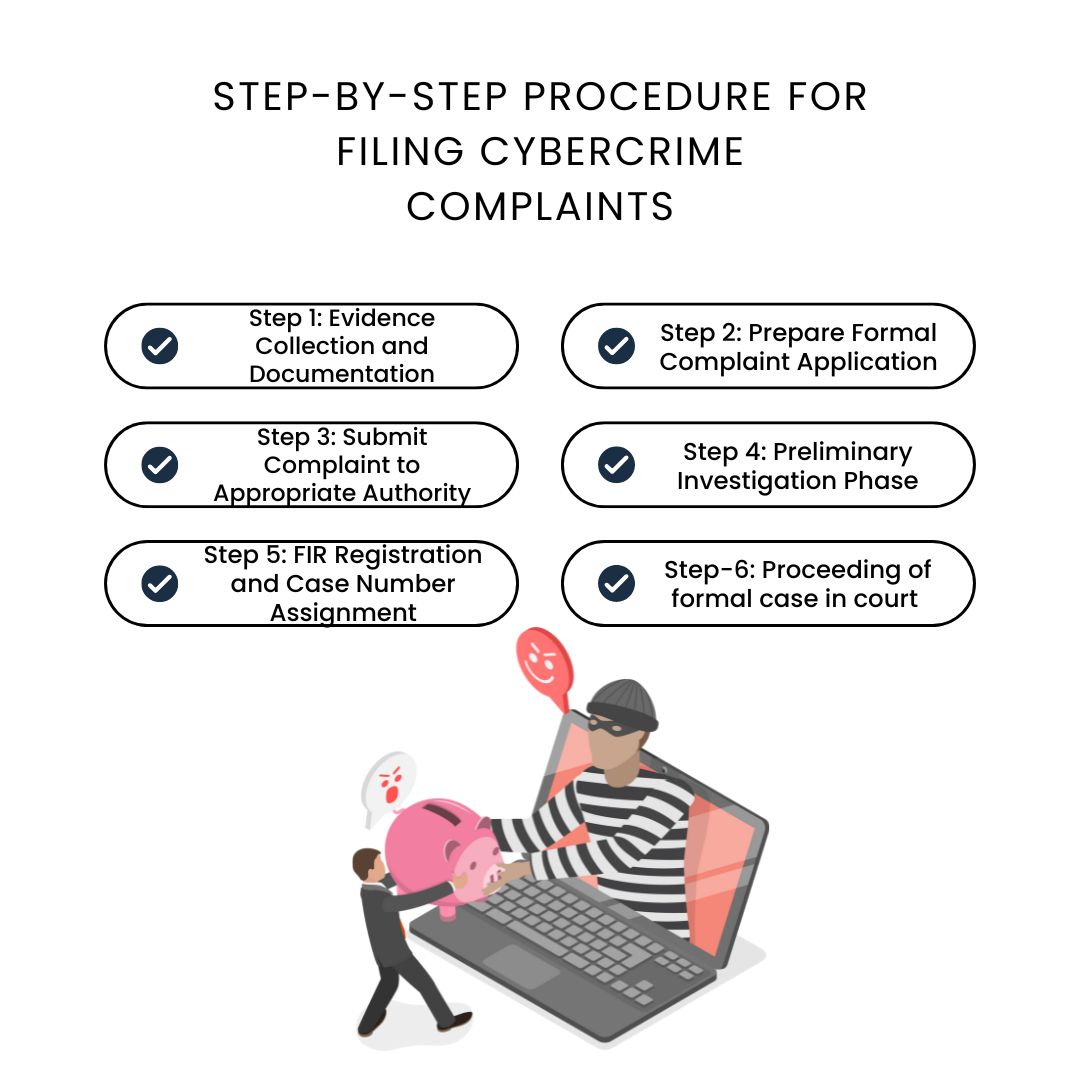
Step 1: Evidence Collection and Documentation
Before approaching authorities, comprehensive evidence must be compiled. Digital evidence forms the foundation of cybercrime prosecution. Screenshots without metadata often get rejected.
Required Digital Evidence:
- Screenshots with visible timestamps and URLs
- Email headers showing sender IP addresses
- Chat logs (WhatsApp, Messenger, Viber) exported with date/time stamps
- Transaction records for financial fraud cases
- Call recordings (if legally obtained)
- URLs/links to offending content
- Device information and app version details
Step 2: Prepare Formal Complaint Application
A self-written complaint must be drafted in Nepali or English. The application should include:
- Victim details: Full name, citizenship number, address, contact information
- Incident timeline: Exact date, time, and timezone of each offense
- Nature of cybercrime: Specific sections of ETA 2063 violated
- Mode of offense: Platform used (Facebook, WhatsApp, TikTok, etc.)
- Suspect information: Known identity, usernames, phone numbers, or IP addresses
- Loss/damage incurred: Financial loss, reputational damage, psychological impact
- Relief sought: Arrest, content removal, compensation
Step 3: Submit Complaint to Appropriate Authority
For Cyber Bureau Submission:
- Visit Bhotahity office in person OR
- Email complaint to [email protected]
- Attach all digital evidence in PDF or ZIP format
- File size should not exceed 10MB per email
For District Police:
- Visit nearest police station during duty hours
- Request cybercrime complaint form
- Submit hand-written complaint with evidence
- Obtain acknowledgment receipt with reference number
Step 4: Preliminary Investigation Phase
Police conduct initial verification within 7-15 days. This includes:
- Basic authenticity check of submitted evidence
- Preliminary suspect identification through IP tracing
- Platform data requests (Facebook, TikTok, WhatsApp cooperation)
- Victim statement recording
Important: 40% of complaints are rejected at this stage due to insufficient evidence. Therefore, forensic preservation of digital evidence is critical.
Step 5: FIR Registration and Case Number Assignment
Upon finding prima facie evidence, police register the First Information Report (FIR) under the relevant sections of ETA 2063. The FIR number serves as official case identification for all future proceedings.
Documents Required for Cybercrime Complaint in Nepal
|
Document Category |
Specific Requirements |
Mandatory/Optional |
|
Identity Proof |
Citizenship certificate, passport, or national ID |
Mandatory |
|
Complaint Letter |
Self-written detailed incident description |
Mandatory |
|
Digital Evidence |
Screenshots, emails, chat logs with metadata |
Mandatory |
|
Evidence List |
Indexed list of all digital evidence submitted |
Mandatory |
|
Bank Records |
Transaction statements for fraud cases |
Mandatory for financial crimes |
|
Medical Reports |
Psychological evaluation reports for harassment cases |
Optional but recommended |
|
Witness Statements |
Written statements from witnesses (if any) |
Optional |
|
Previous Correspondence |
Any prior complaints to platforms or authorities |
Optional |
Note: All documents must be self-attested. Foreign nationals must submit passport copies with valid visa stamps.
Timeline for Cybercrime Investigation and Resolution
|
Stage |
Average Duration |
Factors Affecting Timeline |
|
Preliminary Investigation |
7-15 days |
Evidence complexity, suspect location |
|
FIR Registration |
1-3 days after preliminary investigation |
Police workload, case priority |
|
Detailed Investigation |
30-90 days |
Digital forensics, international cooperation |
|
Charge Sheet Filing |
15-30 days post-investigation |
Prosecutor review, evidence sufficiency |
|
Court Trial |
6-18 months |
Court backlog, case complexity |
|
Final Verdict |
Varies significantly |
Appeal possibilities |
Total estimated time: 8 months to 2 years for contested cases. Simple cases with clear evidence resolve within 3-6 months.
Cybercrime Investigation Process in Detail
Digital Forensics Stage:
- Device seizure and analysis (with court warrant)
- IP address tracing and geolocation
- Social media account identification through email/phone linkage
- Data recovery from damaged devices
- Network log analysis
Challenges Faced by Nepal Police:
- Platform non-cooperation: Telegram provides minimal user data
- Jurisdictional issues: Suspects operating from India, Middle East, or Southeast Asia
- VPN usage: IP masking complicates location tracking
- Evidence tampering: Cloud-stored data deletion by suspects
International Cooperation:
For cross-border offenses, Nepal Police collaborates through:
- INTERPOL channels
- Mutual Legal Assistance Treaties (MLAT)
- Direct diplomatic requests (for neighboring countries)
Court Proceedings for Cybercrime Cases in Nepal
Jurisdiction and Venue
District Courts exercise primary jurisdiction under Section 47 ETA. Kathmandu District Court handles most high-profile cases due to Cyber Bureau location.
Trial Process Overview
- Charge Sheet Filing: Government attorney files formal charges
- Bail Hearing: Court decides on suspect custody or release
- Evidence Presentation: Digital evidence examination by court-appointed experts
- Witness Examination: Victim, police, forensic experts testify
- Defense Arguments: Accused presents counter-evidence
- Judgment: Court delivers verdict with penalties under relevant sections
Appeal Process:
- High Court: Appeal within 70 days of District Court judgment
- Supreme Court: Final appeal on constitutional or legal interpretation issues
Penalties and Punishments for Cybercrimes in Nepal
|
Offense Type |
Imprisonment Term |
Fine Amount (NPR) |
Additional Penalties |
|
Online Harassment |
Up to 5 years |
Up to 100,000 |
Content removal order |
|
Unauthorized Access |
Up to 3 years |
Up to 200,000 |
Device confiscation |
|
Financial Fraud |
Up to 2 years |
Up to 100,000 |
Restitution to victim |
|
Data Theft |
Up to 3 years |
Up to 200,000 |
Data deletion order |
|
Child-Related Offenses |
Up to 5 years |
Up to 100,000 |
Sex offender registration |
|
National Security Breaches |
Up to 10 years |
Up to 500,000 |
Under PTA for severe cases |
Repeat Offenders: Section 47 ETA mandates 150% penalty enhancement for subsequent convictions.
Common Types of Cybercrimes Reported in Nepal
Financial Crimes (40.82% of cases):
- Online banking fraud
- Credit card cloning
- Digital wallet scams (eSewa, Khalti)
- Cryptocurrency fraud
- Phishing attacks
Social Media Offenses (81% on Facebook):
- Account hacking and impersonation
- Revenge porn and image-based abuse
- Cyberbullying and harassment
- Hate speech and communal incitement
- Fake profile creation
Business-Related Crimes:
- Data breaches (Vianet case: 170,000 users affected)
- Ransomware attacks
- Intellectual property theft
- E-commerce fraud
Hiring a Cybercrime Lawyer in Nepal: Benefits and Process
Why Legal Representation Matters:
- Evidence Validation: Lawyers ensure digital evidence meets forensic standards
- Proper Jurisdiction: Identify correct filing authority to avoid delays
- Procedural Compliance: Navigate complex police and court procedures
- Victim Protection: Secure interim protection orders against further harassment
- Compensation Claims: File civil suits for damages alongside criminal complaints
Top-Rated Cybercrime Law Firms in Nepal:
Nepal Lawyer Services (Recommended)
- Address: Nirajan Bikram Marg-31, New Baneshwor, Kathmandu
- Contact: 9801884499
- Specialization: Cybercrime litigation, digital evidence handling, victim representation
- Experience: 16+ years in cyber law, fastest complaint filing service in Nepal
- Services: 24/7 emergency consultation, evidence preservation guidance, court representation
Legal Fees Structure:
- Consultation: NPR 3,000-10,000 per session
- Complaint Drafting: NPR 15,000-30,000
- Full Representation: NPR 50,000-200,000 (depending on case complexity)
- Success Rate: Nepal Lawyer maintains 94% case acceptance rate by police
Self-Protection Measures While Filing Complaints
Immediate Actions (First 24 Hours):
- Change all passwords from a secure device
- Enable two-factor authentication on all accounts
- Preserve evidence before content gets deleted
- Do not confront the suspect directly
- Document ongoing harassment with timestamps
During Investigation:
- Maintain communication log with police
- Do not share case details publicly
- Avoid discussing case on social media
- Comply with all evidence requests promptly
- Attend all scheduled police interviews
Post-Resolution:
- Monitor for retaliation or repeat offenses
- Implement stronger cybersecurity measures
- Consider civil damages suit if not filed initially
Frequently Asked Questions (FAQs)
1. How long does it take for a cybercrime complaint to be registered in Nepal?
Preliminary investigation typically takes 7-15 days. If sufficient evidence exists, FIR registration occurs within 1-3 days thereafter. However, complex cases requiring digital forensics may extend the preliminary phase to 30 days.
2. Can cybercrime complaints be filed online in Nepal?
Yes, complaints can be emailed to [email protected]. However, original documents must be submitted physically within 7 days. The online portal is under development; currently email serves as the primary digital channel.
3. What is the cost of filing a cybercrime complaint?
Police complaint filing is free of charge. Court fees apply only if direct court filing occurs (NPR 500-2,000). Lawyer fees vary from NPR 15,000-30,000 for complaint drafting. You can contact Nepal Lawyer for more details.
4. Can complaints be filed against foreign nationals?
Under Section 55 ETA, any offense involving computers/systems located in Nepal is prosecutable regardless of offender location. Nepal Police collaborates through INTERPOL for suspect extradition.
5. What if police refuse to register my complaint?
Victims can file a writ petition at the District Court under Article 133 of Constitution, compelling police registration. Alternatively, approach the Police Headquarters with a written appeal to the Inspector General.
6. Is evidence from screenshots valid in court?
Screenshots are admissible if accompanied by certificate under Section 84 of Evidence Act 2031, confirming authenticity. Best practice: preserve webpage through forensic tools like Wayback Machine.
7. How are minors protected in cybercrime cases?
Section 47 ETA applies equally, but juvenile justice provisions under Juvenile Justice Act provide special protection. Courts use in-camera proceedings and victim identity protection.
8. Can deleted content be recovered as evidence?
Yes, through digital forensics. Police Cyber Bureau has recovery capabilities for most platforms. However, recovery must be attempted within 30 days for maximum success rate.
9. What compensation can victims receive?
Courts can order restitution under Section 52 ETA for financial fraud. Civil suits under Section 47(2) of Muluki Civil Code allow compensation claims for reputational/psychological damages.
10. How to track complaint status?
Use the complaint reference number at the Cyber Bureau office or call 01-4410144. District police stations provide status updates during weekly review meetings.
Recent Case Studies and Legal Precedents
Case 1: Sunita Dangol v. Anonymous Facebook User (2018)
- Violation: Online harassment through fake profiles and photoshopped images
- Legal Sections: Sections 47, 48 ETA; Sections 295, 298 Penal Code
- Judgment: 1-year imprisonment + NPR 50,000 fine
- Significance: Established precedent for sexual harassment characterization online
Case 2: State v. Anju Tamang (2021)
- Violation: Revenge porn (non-consensual image sharing)
- Legal Sections: Section 47 ETA; Section 298 Penal Code
- Judgment: 2-year imprisonment + NPR 100,000 fine
- Significance: Criminalized digital humiliation and revenge porn explicitly
Case 3: Vianet Data Breach (2020)
- Violation: 170,000 user data exposure by 16-year-old hacker
- Legal Sections: Sections 45, 46 ETA
- Outcome: Minor sent to rehabilitation; company fined NPR 500,000
- Significance: Highlighted corporate liability for data protection
Geographic Coverage: Cybercrime Services Across Nepal
Kathmandu Valley:
- Kathmandu District Court: Primary jurisdiction for Cyber Bureau cases
- Lalitpur District Court: Handles Lalitpur district complaints
- Bhaktapur District Court: Specialized cyber mediation cell available
Major Cities:
- Pokhara (Gandaki Province): District Police Office, Kaski handles local complaints
- Biratnagar (Koshi Province): Regional cyber investigation unit established 2024
- Birgunj (Madhesh Province): Cross-border cyber fraud specialization
- Nepalgunj (Lumbini Province): Handles complaints from western regions
- Dhangadhi (Sudurpashchim): Smallest caseload but equipped with digital forensics tools
Provincial Disparities:
Karnali Province surprisingly reports highest per-capita cybercrime rates (333 cases), indicating better awareness rather than higher actual crime rates. Sudurpashchim reports lowest (60 cases), likely due to underreporting.
Need Immediate Legal Assistance?
Nepal Lawyer Services provides fastest cybercrime complaint filing in Nepal. Contact now for:
- 24/7 emergency legal consultation
- Same-day complaint drafting and filing
- Digital evidence preservation guidance
- Direct liaison with Cyber Bureau officials
- Court representation across all districts
📞 Emergency Hotline: 9801884499
📧 Email: [email protected]
📍 Office: Nirajan Bikram Marg-31, New Baneshwor, Kathmandu
🌐 Website: www.nepallawyer.com
Response Time: Initial consultation within 2 hours. Complaint filed within 24 hours of engagement.
References
- Electronic Transactions Act, 2063 (2008) - Nepal Law Commission
Access Full Text - National Penal Code, 2074 - Ministry of Law, Justice and Parliamentary Affairs
View Code - Nepal Police Cyber Bureau Official Portal - Complaint Filing Guidelines
Visit Portal - Annual Cybercrime Statistics 2024/25 - Nepal Police Headquarters
Download Report - Supreme Court Judgments on Cybercrime - Supreme Court of Nepal
Search Decisions - Constitution of Nepal 2015 - Nepal Gazette
Read Constitution - Research on Cybercrime Trends in Nepal - Mesopotamian Academic Journal
Access Study - UNFPA Report on Technology-Facilitated Violence - UNFPA Nepal
Read Report - The Kathmandu Post Cybercrime Coverage - Kathmandu Post National Section
View Article