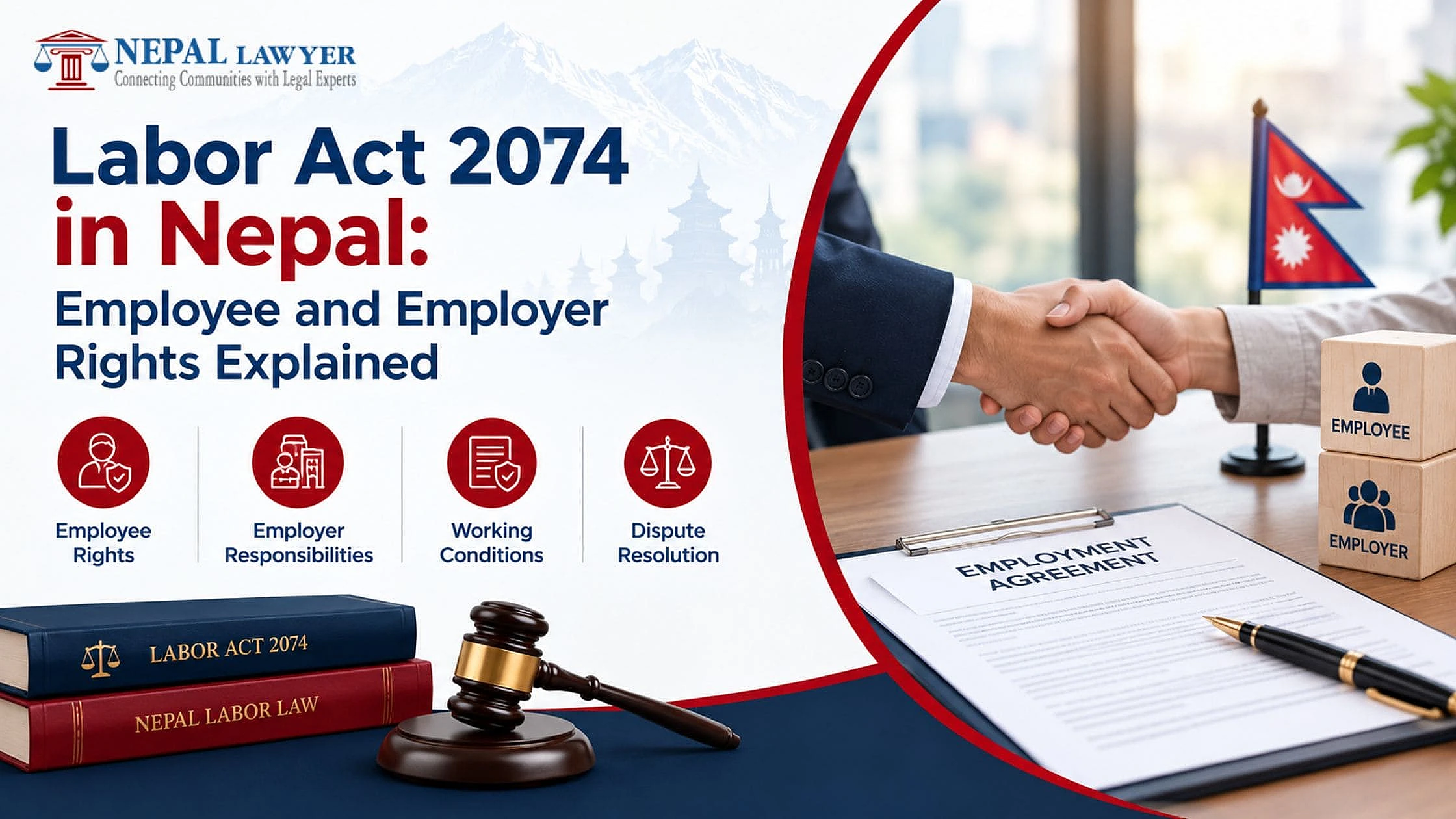
The Labor Act 2074 (2017) is Nepal's primary employment law. It establishes basic requirements for contracts, working hours, pay, leave, social security, termination, and dispute resolution while protecting both employees and employers. This handbook outlines your rights and duties under the Labor Act 2074, as verified by the Nepal Law Commission's English language and the most recent government notices as of September 30, 2026.
Under the Labor Act 2074, every employer is required to hire on an employment contract, pay at least the government minimum salary (currently Rs 19,550 per month), limit work to 8 hours per day and 48 hours per week, pay overtime at 1.5 times, and provide statutory leave and social security. Any contract that provides less than the Act is void to that degree (Section 3).
Labor law in Nepal: key facts
|
Topic |
What the law says |
Where |
|
Governing law |
Labor Act, 2074 (2017), read with the Labor Rules, 2075 |
Act No. 14 of 2074 |
|
Contract |
No one may be employed without an employment contract; a written one is not required for casual work |
Section 11 |
|
Probation |
Up to 6 months, after which employment is deemed confirmed |
Section 13 |
|
Working hours |
8 hours a day, 48 hours a week |
Section 28 |
|
Overtime |
Up to 4 hours a day and 24 hours a week, paid 1.5 times basic remuneration |
Sections 30–31 |
|
Minimum wage |
Rs 19,550 a month (basic Rs 12,170 + dearness allowance Rs 7,380) from 1 Shrawan 2082 |
Section 106 and Ministry notice |
|
Pay interval |
Wages must be paid at intervals of no more than one month |
Section 35 |
|
Festival expense |
One month's basic remuneration each year |
Section 37 |
|
Public holidays |
13 paid days (14 for women) |
Section 41 |
|
Home leave |
1 paid day for every 20 days worked |
Section 43 |
|
Sick leave |
12 paid days a year |
Section 44 |
|
Maternity leave |
14 weeks in total, with full pay for 60 days |
Section 45 |
|
Social Security Fund |
31% of basic salary: employer 20%, employee 11% |
SSF rules; Sections 52–57 |
|
Termination notice |
7 days (service of 4 weeks to 1 year) or 30 days (over 1 year) |
Termination chapter* |
What is the Labor Act 2074 and who does it cover?
The Labor Act 2074, which amended and consolidated Nepal's labor laws, was signed into law on September 4, 2017 (19 Bhadra 2074). Its preamble specifies its goals: to protect workers' rights and benefits, to clarify employers' rights and responsibilities, to foster positive labor relations, and to put a stop to all types of labor exploitation. It replaced the previous Labor Act 2048 (1992).
The Act refers to laborers as "labor." It applies to a "business," which encompasses any company, private firm, partnership firm, cooperative, or association, whether for profit or not (Section 2). A foreign enterprise that promotes business or sells goods in Nepal is also covered; its Nepali representative or employee can file a complaint with the Labor Office or the Labor Court (Section 90).
Two characteristics shape everything else:
- This is a floor, not a ceiling. The act establishes minimal criteria. A contract that provides less salary or benefits than the Act is void to that degree (Section 3).
- There are five categories of jobs. Section 10 defines regular, work-based, time-based, casual (7 days or fewer in a month), and part-time as 35 hours or fewer each week. Some rules, such as the written contract rules, vary by kind.
The Act also prohibits forced labor, illegal child labor, and discrimination based on religion, race, gender, caste, tribe, origin, language, or ideological conviction. Sections 4-7 state that women and men must be paid equally for labor of equivalent worth.
Employment contracts and probation under the Labor Act 2074
Contract rules
An employer shall not hire anybody without an employment contract. A formal contract is not required for casual work (Section 11). The contract must include wages, benefits, working conditions, and other specified terms. It includes the appointment letter (section 2).
What if the agreement was just verbal? Whether the contract is written or verbal, the employment relationship begins on the first day of work (Section 12). If an employer and a worker disagree on whether a relationship exists, the Labor Office makes the decision. If the employer refuses to provide the Office with the requested records, the connection is deemed established. Save messages, pay stubs, bank statements, and attendance records.
Probation period
If a worker's performance is inadequate, an employer may place him on probation for up to six months before terminating the contract. If the contract is not terminated during probation, employment is considered confirmed automatically (Section 13).
Change of ownership
When a business is sold, transferred, or merged, the employees' employment remains, and the new owner assumes the Act's liabilities (Section 14).
Working hours and overtime
- Normal hours: no more than 8 hours a day and 48 hours a week, with half an hour's rest after 5 hours of continuous work. Rest time counts as working time (Section 28).
- Overtime cap: up to 4 hours a day and 24 hours a week (Section 30). An employer cannot compel more, except where not working would endanger life, safety or health or cause serious loss (Section 29).
- Overtime rate: 1.5 times the basic remuneration for regular hours (Section 31). Managerial-level staff can instead receive benefits agreed in their contract or a collective agreement.
- Work on a rest day: if a worker on continuous work is engaged on a weekly or public holiday, they must receive substitute leave within 21 days. Work without substitute leave counts as overtime (Sections 30 and 42).
- Women on early or late shifts: where work starts after sunset or before sunrise, the employer must arrange transport (Section 33).
Minimum wage and salary rules in Nepal (2026)
Current minimum wage
The Ministry of Labor, Employment, and Social Security established the current minimum pay under Section 106. It takes effect on 1 Shrawan 2082 (mid-July 2025), replacing the previous rate of Rs 17,300.
|
Period |
Basic (Rs) |
Dearness allowance (Rs) |
Total (Rs) |
|
Monthly |
12,170 |
7,380 |
19,550 |
|
Daily |
470 |
284 |
754 |
|
Hourly |
63 |
38 |
101 |
|
Part-time hourly |
— |
107 |
|
These figures do not include tea estate workers, who are paid separately. The Act mandates the Ministry to examine the minimum wage every two years (Sections 106-107), therefore a modification is likely around Shrawan 2084, unless the government acts sooner. Check the most recent Nepal Gazette notice before relying on any figures.
Other pay rules
- Paying on time: Wages must be paid no more than once a month. A worker employed for less than one month must be compensated within three days after completion (Section 35).
- Annual increment: after one year of service, a worker gets an annual increment of at least half a day's remuneration (Section 36).
- Festival expense: each worker is entitled to one month's basic remuneration a year. Unless the worker requests another festival, it is held at Dashain (Section 37).
- Deductions: Only the deductions stated in Section 38 are permitted, including taxes, provident fund or insurance contributions, court orders, agreed-upon loans or advances, and pay for absence. It is not authorized to deduct anything extra from earnings.
- No pay cuts: existing pay and benefits cannot be reduced, except under a collective agreement (Section 34).
Leave entitlements under the Labor Act 2074
|
Type of leave |
Entitlement |
Section |
|
Weekly leave |
Weekly leave, as set out in the Act* |
40 |
|
Public holidays |
13 paid days including May Day; 14 for women including International Women's Day |
41 |
|
Substitute leave |
Within 21 days for workers on continuous work who worked on a weekly or public holiday |
42 |
|
Home leave |
Paid, at 1 day for every 20 days worked (roughly 18 days a year) |
43 |
|
Sick leave |
12 paid days a year, pro rata for one year or less of service; a doctor's certificate is required for more than 3 consecutive days |
44 |
|
Maternity leave |
14 weeks in total; leave is compulsory from 2 weeks before to 6 weeks after delivery; full pay for 60 days, and up to 1 extra month of unpaid leave on medical advice |
45 |
|
Paternity (maternity care) leave |
15 paid days |
45(7) |
|
Mourning leave |
13 days on full pay |
48 |
|
Accumulated leave |
Home leave up to 90 days and sick leave up to 45 days; unused leave is paid out on leaving; leave above the cap is paid at year-end |
49 |
Section 40 grants weekly leave, but the unofficial English translation of the frequency is worded ambiguously. Rely on the Nepali original for the exact rule.
What is "leave as of right"? Only sick leave, bereavement leave, and maternity leave are legally protected. Other leave is a benefit, and the employer may deny, postpone, or reschedule it for specified work reasons (Section 51). Where the Social Security Fund provides a maternity benefit, the employer is not required to pay the same sum twice (Section 47).
SSF, provident fund, gratuity and insurance
The Labor Act of 2074 demands provident funds, gratuities, and insurance contributions. Since the Contribution-Based Social Security Act 2074, these have been routed through the Social Security Fund (SSF). An employer or employee that contributes to the SSF in a way that provides them with these benefits is not required to pay the same contribution again under the Labor Act (Section 57).
|
Who pays |
Component |
Rate (of basic salary) |
|
Employee |
Provident fund 10% + social security tax 1% |
11% |
|
Employer |
Provident fund 10% + gratuity 8.33% + additional 1.67% |
20% |
|
Total |
31% |
The percentages refer to the base wage, not the entire compensation package. The Act establishes the provident fund at 10% of basic wage, matched by the employer, and the gratuity at 8.33% per month (Sections 52-53). Visit the official SSF website to confirm current registration regulations and rates.
Insurance under the Act
- Medical insurance: at least Rs 100,000 a year for each worker, with the premium shared by employer and worker (Section 54).
- Accident insurance: at least Rs 700,000 per worker, with the employer covering the entire cost. In the event of death or absolute disability, the worker's heirs receive the entire insured amount (Section 55).
- If the employer fails to insure: the employer must pay the equivalent amount itself (Section 56).
Termination, notice period and retrenchment
Under the Act's termination chapter, as summarized by Nepali law firms, the main rules are:
- Notice: Aside from termination for misconduct, an employer or employee who leaves employment must provide 7 days' notice (four weeks to one year) or 30 days' notice (more than one year). If the employer fails to provide notice, it is obligated to pay the employee for that time period.
- Misconduct: before dismissal for misconduct, the worker must get a chance to explain, commonly cited as 7 days.
- Retrenchment: An employer must provide at least 30 days' notice to the Labor Office and the authorized union (or labor relations committee), explaining the reason, the expected date, and the number of impacted employees. Employers with fewer than ten employees are exempt from retrenchment requirements.
- Re-hiring: retrenched workers get priority if the enterprise restarts or needs workers within two years.
- Appeal: a worker unhappy with a termination decision can appeal to the Labor Court.
An employer cannot also discipline a worker for reporting safety violations or stopping work in an emergency (Section 75), and inspectors must keep a complainant's identity confidential upon request (Section 96). Read our foll blog on Unlawful Termination in Nepal.
Employee rights and employer duties checklist
Employee rights
- An employment contract and confirmation after probation of up to six months
- At least the minimum wage, paid within one month, with only lawful deductions
- Overtime at 1.5 times, within the daily and weekly limits
- Paid public holidays, home, sick, mourning and maternity leave
- Festival expenses are equal to one month's basic salary and an annual increment
- SSF or equivalent provident fund, gratuity, and medical and accident insurance
- Equal treatment without discrimination, and equal pay for equal work
- The right to form or join a trade union
- A safe workplace and the right to make a written claim and seek a remedy
Employee duties
- Act dutifully and responsibly towards the employer while exercising labor rights (Section 8)
- Follow safety rules and use the protective equipment supplied (Section 73)
- Inform the employer promptly of sudden illness (Section 44)
Employer duties
- Provide an employment contract and follow wage, overtime, and leave policies.
- Make contributions to the SSF or provide provident funds, gratuity, and insurance.
- Register a safety and health policy with the Labor Office and organize a safety committee for 20 or more employees (Sections 68 and 74).
- Form a labor relations committee for 10 or more employees (Section 111).
- Register the enterprise bye-law with the Labor Office and conduct a labor audit (Sections 100 and 108).
- Obtain a work permit before hiring foreign workers (Section 22).
- Section 92 prohibits unfair labor practices such as harassment, abuse, and false accusations against employees.
How to resolve a labor dispute in Nepal
The Act sets a clear ladder for an individual claim, such as unpaid salary or unpaid benefits (Sections 113–115):
- Apply in writing to the employer. The employer must accept the application and give you a receipt.
- Allow 15 days for settlement. The employer must discuss it and try to settle the claim within 15 days. The period can be extended if both sides agree.
- Go to the Labor Office. You may apply if the employer does not schedule a talk within 7 days or if no agreement is reached after 15 days. The Office must try to resolve the disagreement through mediation within 21 days.
- Get a decision. If mediation fails, the Labor Office decides on the evidence within 15 days.
- Appeal to the Labor Court. Deadlines apply, and they vary depending on the type of decision. For example, an appeal against a Labor Office direction following an inspection must be made within 35 days (Section 99). Seek counsel early to avoid missing a deadline.
Tips: Make every claim in writing, retain copies and receipts, and list what you are owed (wages, overtime, festival expenses, leave encashment). If your company has branches in many Labor Office areas, you may apply at the office that is most convenient for you (Section 101).
When to speak to an employment lawyer
A lawyer is worth consulting if:
- Your pay or benefits have not been paid, and a written claim was unsuccessful.
- You were dismissed without notice or opportunity to explain.
- Expecting layoffs or ownership changes.
- Provide proof of employment after a verbal agreement.
- As an employer, you may design contracts, handle terminations, or prepare for labor audits.
Frequently asked questions about the Labor Act 2074
Q. Is a written employment contract mandatory under the Labor Act 2074?
An employer cannot hire somebody without an employment contract (Section 11). A written contract is not required for casual employment, which consists of seven or less days of labor per month. The contract must include information on wages, benefits, and working conditions.
Q. What is the minimum wage in Nepal in 2026?
The minimum monthly wage is Rs 19,550, which includes Rs 12,170 in basic remuneration and Rs 7,380 in dearness allowance, effective 1 Shrawan 2082 (mid-July 2025). The daily charge is Rs 754, while the hourly rate is Rs 101. The Act mandates a review every two years.
Q. How many hours can an employee work, and what is the overtime rate?
Normal working hours are 8 hours per day, 48 hours per week. Overtime is limited to 4 hours per day and 24 hours per week and must be paid at 1.5 times the base rate for regular hours (Sections 28, 30, and 31).
Q. How long can probation last in Nepal?
Probation might extend for up to six months. If the employer does not terminate the contract during probation, employment is considered confirmed automatically (Section 13).
Q. How much SSF is deducted from salary in Nepal?
The overall Social Security Fund contribution equals 31% of the basic pay. Employees pay 11% (10% provident fund + 1% social security tax), whereas employers pay 20% (10% provident fund, 8.33% gratuity, and 1.67% supplementary payment). Confirm current tariffs on the SSF website.
Q. How much maternity leave does an employee get under the Labor Act 2074?
A pregnant employee is entitled to 14 weeks of maternity leave in total, with mandatory leave from two weeks before to six weeks following birth. She is paid in full for 60 days and may be granted an additional month of unpaid leave if a doctor recommends it. Under Section 45, fathers are entitled to 15 days of paid maternity care leave.
Q. Can an employer terminate an employee without notice in Nepal?
Except for termination for misconduct, notice is normally required: 7 days for service between four weeks and one year, and 30 days for service longer than one year. Dismissal for wrongdoing necessitates giving the employee an opportunity to defend himself. If a worker disagrees with his or her termination, he or she can appeal to the Labor Court. Before taking any action, consult with a lawyer to confirm the exact rules.
Q. Where do I complain if my employer does not pay my salary?
First, apply in writing to the employer and obtain a receipt. The employer must endeavor to reach a settlement within 15 days. If there is no discussion within 7 days or no agreement after 15 days, you can petition to the Labor Office, which must try to mediate within 21 days and then decide within 15 days (Sections 113-115). The Labor Court hears appeals.
Need advice on a labor or employment issue?
Ask a lawyer a question, send a quick inquiry, or browse advocates in Nepal. Employers setting up in Nepal can also see our guide to obtaining a working visa and work permit and our corporate lawyers.
Sources:
Disclaimer: This article is general information about Nepal's labor law. It is not legal advice, and reading it does not create a lawyer-client relationship. Laws, rules, wage rates and contribution rates change, and the facts of your situation can change the answer. Before acting on any point, especially on termination, retrenchment or a claim deadline, consult a qualified advocate registered with the Nepal Bar Council. Advocates listed on Nepal Lawyer are independent professionals.