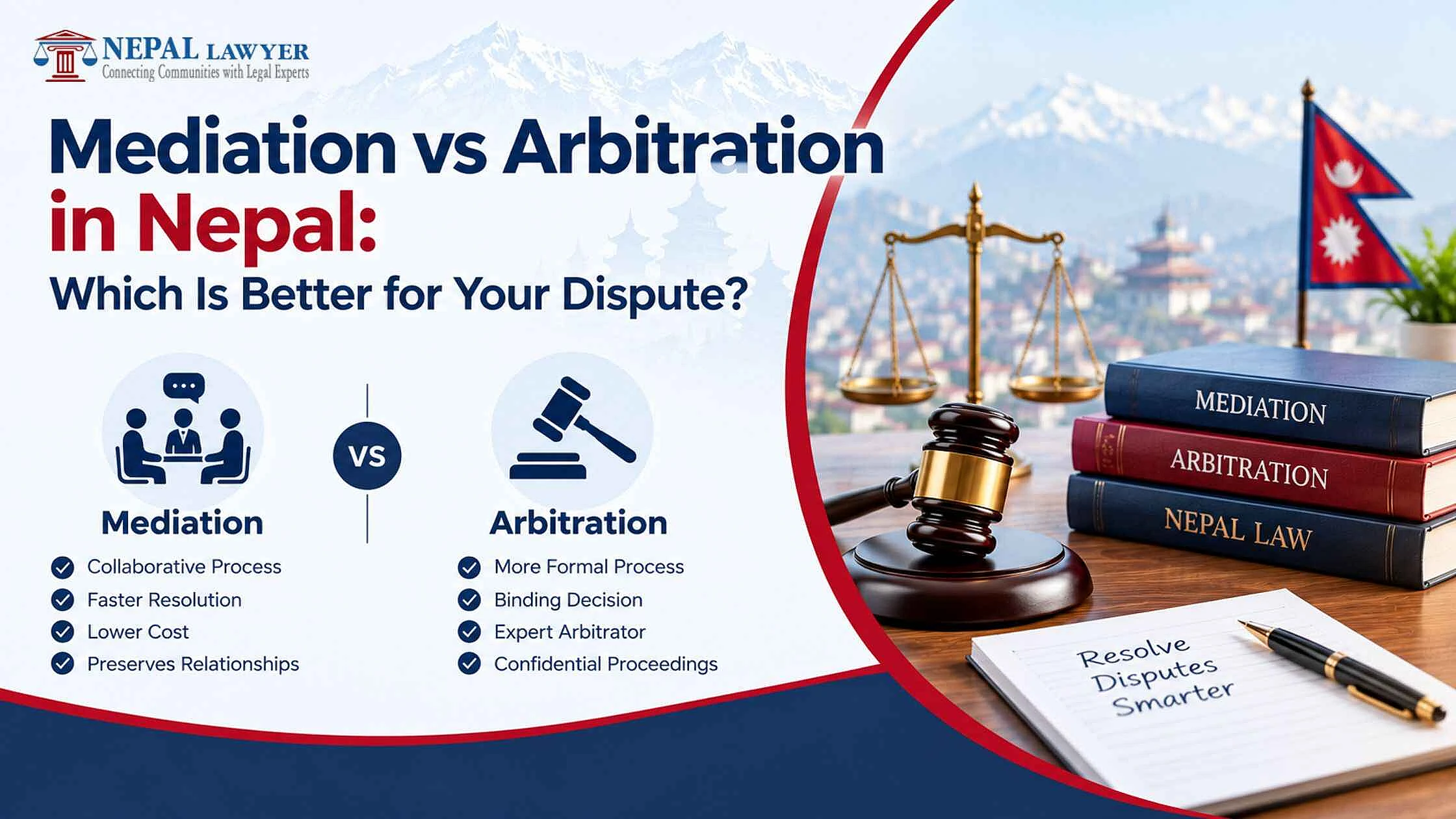
Both arbitration and mediation are alternatives to going to court, although they operate in distinct ways. An impartial mediator assists the parties in negotiating their own solution during mediation. In arbitration, a tribunal or arbitrator hears the case and renders a decision. Arbitration may be appropriate for parties that require a more official result, usually in cases where an arbitration agreement is in place, while mediation may be appropriate for parties looking for flexibility and practical arrangement.
Here is how mediation vs arbitration in Nepal compares, and how to think through the choice.
This guide builds on our complete guide to alternative dispute resolution in Nepal. It focuses on one practical question: if you have a dispute, is a mediator or an arbitrator more likely to fit your situation?
Quick Comparison: Mediation vs Arbitration
|
Feature |
Mediation |
Arbitration |
|
Main purpose |
To help the parties reach their own settlement |
To resolve the dispute through a decision (an award) |
|
Who controls the outcome? |
The parties who may accept, adjust, or reject proposed terms |
The arbitrator or tribunal, within the agreed process and the law |
|
Role of mediator/arbitrator |
Facilitates communication and explores options |
Hears the parties, considers the evidence, and decides |
|
Does the neutral person decide? |
Generally, no. The parties decide whether to settle |
Yes. The arbitrator or tribunal decides the dispute |
|
Typical format |
Flexible discussions, often including joint and separate conversations |
More structured: statements, documents, evidence, and hearings as applicable |
|
Need for an arbitration agreement |
No. Mediation can be agreed or arranged separately, though a contract may include a mediation term |
Usually yes. Arbitration generally depends on a valid arbitration agreement or clause |
|
Result/outcome |
A settlement agreement, if the parties agree |
An arbitral award, if the process reaches that stage |
|
Relationship preservation |
Often more suitable where parties want to keep dealing with each other |
Can be more adversarial, though it is generally less formal than court |
|
Suitable dispute types |
Family, neighbor, property, tenancy, and contract disputes that can legally be settled by agreement |
Contract and commercial disputes, especially where the agreement provides for arbitration and the dispute is legally arbitrable |
|
When court litigation may be more appropriate |
Where a party will not engage, urgent protection is needed, or the matter cannot legally be settled this way |
Where there is no valid arbitration agreement, the dispute is not arbitrable, or court powers or remedies are needed |
What Is the Main Difference Between Mediation and Arbitration?
The core difference is that a mediator facilitates settlement, while an arbitrator decides the dispute and issues an award.
The impartial party does not enforce a decision during mediation. In order to find terms that both parties may agree upon, the mediator assists each side in outlining its concerns and testing suggestions. There cannot be a settlement if the parties cannot agree.
In arbitration, the parties submit their case to an arbitrator or a tribunal of arbitrators, typically with supporting documentation and occasionally with witnesses. After then, the tribunal renders a ruling. Once the parties submit the matter to the tribunal, they typically lose control over the decision.
They are both types of alternative dispute resolution (ADR). Both are not the same as straightforward negotiations between the parties. Another comparable phrase that is occasionally used interchangeably with mediation is conciliation. In Nepal, mediation and arbitration are the two routes with their own statutes: the Mediation Act, 2068 (2011) and the Arbitration Act, 2055 (1999).
How Mediation Works in Nepal
The process of mediation is facilitated and voluntary. The dispute, the parties' agreement, any court or local referral, and the mediator or institution involved all influence the precise procedures. This is how a typical path appears:
- Parties identify the dispute. Each side clarifies what the disagreement is about and what outcome it hopes for.
- Parties agree or are referred to explore mediation, where applicable. Some contracts contain a mediation term. In other cases, parties choose mediation by agreement, or a referral may arise under applicable law or procedure.
- A neutral mediator facilitates discussion. The mediator does not take sides and does not decide who is right.
- Parties exchange concerns and possible solutions. This phase frequently addresses pragmatic concerns that a court ruling would not cover, like future transactions, property use, or payment schedules.
- Parties may reach, revise, or decline a settlement. Nobody must accept terms they are unhappy with.
- If settlement is reached, record terms carefully. Written language must be precise, comprehensive, and unambiguous. It is advisable to have them evaluated before signing because their legal impact may vary depending on how the settlement is negotiated, recorded, and handled under applicable legislation.
Procedures for conflicts that can be resolved by mediation are outlined in the Mediation Act, 2068. According to a summary of its language, it considers mediation when an agreement permits it as well as, in some situations, when parties want to mediate a dispute that has not yet been filed or is currently before a court, provided that the disagreement can be lawfully resolved by compromise (milapatra). See how this relates to your circumstances by reading the current content.
Mediation may be useful when:
- Despite the difficulty of the conversation, the parties still want to talk.
- As in families, communities, or continuing commercial collaborations, relationships are important.
- The disagreement involves more than just payment or a decision; it also encompasses several practical concerns.
- The parties would rather create their own terms.
- The conflict is still in its early stages and opinions have not solidified.
How Arbitration Works in Nepal
A more formal, decision-based procedure is arbitration. The arbitration agreement, any institutional rules, and the relevant legislation all have different procedures, deadlines, and regulations. Read our full guide on Arbitration Process in Nepal. This is a general outline:
- Check whether a valid arbitration agreement or clause applies. Usually, this is where things begin. Examine the contract carefully, taking note of any pre-arbitration procedures like notice or negotiation.
- Initiate arbitration according to the agreement and applicable process. An organization, a seat, a process, or a way to begin the case may all be named in the agreement.
- Appoint or select the arbitrator or tribunal. The number of arbitrators and their selection process are frequently specified in the agreement. The relevant legislation may offer a mechanism if the procedure fails.
- Exchange statements, documents, and evidence, and hold hearings as applicable. Each side presents its position and supporting material.
- The arbitrator or tribunal considers the case. The decisionmaker compares the provisions of the contract and the evidence to the relevant legislation.
- An award is issued. The tribunal's ruling is documented in the award. The Arbitration Act, 2055 and the facts determine its legal impact as well as any challenges or enforcement actions.
Not every arbitration follows the same steps, deadlines, or rules. Always check the agreement and the current statute.
Arbitration may be useful when:
- The contract contains a valid arbitration clause.
- The dispute is mainly about contract terms, payments, performance, or technical matters.
- The parties need a binding decision, not a negotiated compromise.
- The dispute is clearly defined and can legally be arbitrated.
- The parties prefer a private, structured forum to ordinary court proceedings, where the law allows it.
10 Key Differences Between Mediation and Arbitration
1. Who makes the final decision
In mediation, the mediator just assists the parties in reaching a resolution. The tribunal or arbitrator makes the final decision in arbitration. When selecting a route, this is the most crucial distinction.
2. Party control
Through mediation, the parties have greater control over the outcome and the process. In arbitration, the tribunal determines the conclusion, but the parties have some power over the process through their agreement.
3. Purpose: settlement vs decision
A mutually agreeable conclusion is the goal of mediation. The goal of arbitration is to rationally decide who is entitled to what. The decision should be based on your personal priorities.
4. Formality of the process
Mediation is more conversational and adaptable. While arbitration is typically less formal than court action, it is more structured and resembles hearing. The regulations in use still determine the level of formality in either process.
5. Role of evidence and hearings
Although there is no official fact-finding, evidence is important in mediation since it molds each party's reasonable expectations. Documents, witnesses, and hearings may be crucial in arbitration. When a decisionmaker must select between conflicting stories, strong records typically matter more.
6. Flexibility of solutions
Creative terms like staged payments, repairs, property-use agreements, or an apology can be produced through mediation. An arbitral ruling is restricted to the issues raised and the legal and contractual remedies.
7. Relationship preservation
Parties who must continue to deal with each other may benefit from mediation because it is collaborative. Relationships may suffer because of the dispute over who is correct in arbitration. Nevertheless, the parties play a major role in determining the tone of any procedure.
8. Importance of an arbitration clause or agreement
The parties' consent to arbitrate is usually required, and the disagreement must be one that may be arbitrated legally. Although some contracts demand mediation or negotiating stages beforehand, mediation is independent of arbitration clauses. Before proceeding, go over the dispute-resolution clauses in the contract.
9. Result: settlement agreement vs arbitral award
A settlement agreement is the result of successful mediation. An arbitral award is the result of successful arbitration. Depending on how they were created, documented, and handled in accordance with the relevant laws, their legal significance and enforcement may differ.
10. What happens if parties do not resolve the dispute
In the event that mediation is unsuccessful, the parties are usually free to explore alternative options, including additional negotiation, arbitration in cases when an agreement is in place, or legal action. If arbitration results in an award, the issue is resolved by that award, and any challenges or enforcements must adhere to the laws of the relevant jurisdiction. Your alternatives can be explained by a lawyer.
Mediation vs Arbitration in Nepal: Which Should You Choose?
|
Your situation |
Usually worth considering first |
Why |
|
Business partners want to continue working together |
Mediation |
It allows tailored terms and can help preserve the working relationship. |
|
Contract contains an arbitration clause |
Arbitration (after checking the clause and any pre-arbitration steps) |
The parties may have agreed to arbitrate, and the clause may shape how the dispute must be handled. |
|
Property, family, or community dispute where communication is still possible |
Mediation |
Practical, personal, and long-term issues can often be addressed through a negotiated agreement. |
|
A party wants a formal decision after hearing evidence |
Arbitration, or court litigation if no arbitration agreement exists |
A tribunal or court decides, rather than the parties negotiating. |
|
Parties want a creative settlement beyond a simple win/lose result |
Mediation |
Parties can agree on terms a decision-maker may not be able to order. |
|
One party refuses to negotiate |
Arbitration (if an agreement exists) or court litigation |
Mediation depends on willingness to take part. A decision-based process does not. |
|
Urgent court protection or an immediate legal remedy may be needed |
Seek legal advice on court options promptly |
Some protective or urgent remedies may only be available through a court. |
Note: This table serves as a general reference. A lawyer can determine whether mediation, arbitration, litigation, or a mix of these methods are legally appropriate for your specific disagreement.
When Mediation May Be Better
Mediation may be worth considering when:
- You want to preserve a relationship. Families, neighbors, neighbors, and business partners who will continue to interact with one another fall under this category.
- Both sides are willing to communicate. When parties are willing to listen and compromise, despite their strong disagreements, mediation is most effective.
- You want flexible settlement terms. Parties can agree on payment plans, timelines, or practical arrangements.
- Privacy matters to you. Compared to court procedures, mediation is frequently handled in a less public manner. Verify what the parties have agreed upon and what the law stipulates before assuming secrecy is automatic.
- The dispute is at an early stage. Early discussions may resolve matters before positions harden.
- Several practical issues are tangled together. A court-style outcome may not fully address them, but a negotiated agreement can.
- You want to reduce hostility. A neutral person can help lower tension and keep discussions productive.
- Both parties have a shared interest in a negotiated result. Examples include avoiding disruption to a business, a family, or a shared property.
When Arbitration May Be Better
Arbitration may be worth considering when:
- A contract includes a valid arbitration clause. The clause may determine where, how, and by whom the dispute is decided.
- The parties need formal determination. Some disputes cannot be resolved by negotiation alone.
- The dispute is commercial or technical. Parties can often choose arbitrators with relevant industry knowledge, subject to the agreement.
- Documents and contract interpretation matter most. Written agreements, invoices, correspondence, and records suit a structured process.
- You need a decision, not facilitated negotiation. This is especially so if talks have stalled.
- You want a process outside ordinary litigation, where legally available. Availability depends on the agreement and the type of dispute.
- The contract has a cross-border or specialised element. Such features can make the agreed forum and governing law important, and they call for careful legal review.
- The dispute is clearly defined. A focused set of issues is easier to put before a tribunal.
For contract disputes, it helps you to understand your underlying rights first. See our guide to breach of contract remedies in Nepal.
When Court Litigation May Still Be Necessary
ADR is not always the right or available route. Court action may need to be considered where:
- Urgent interim relief or protection may be needed. Immediate remedies, where available, may require a court.
- A party does not consent where consent is required. Mediation is voluntary, and arbitration generally depends on agreement.
- The dispute may not be appropriate or legally capable of ADR. Not every dispute can be mediated or arbitrated under Nepali law.
- Coercion, serious power imbalance, safety risks, or abuse concerns exist. In certain circumstances, negotiating might be risky or unjust, and taking protective legal action might be more important.
- Criminal allegations or public-interest issues are involved. These raise questions that parties alone may not be able to settle by agreement.
- Enforcement, jurisdiction, or legal-right questions require court involvement. A court's decision may ultimately be required on certain matters, such as who has authority or what a party's legal rights are.
Which matters must go to court depends on the law and the facts. A lawyer can advise on your specific situation.
8 Questions to Ask Before Choosing Mediation or Arbitration
- Is there an arbitration clause or written dispute-resolution term? Read your contract, including any notice, negotiation, or mediation steps.
- What type of dispute do we have? Family, property, tenancy, contract, commercial, and inheritance disputes raise different issues.
- Do we need to preserve a relationship? If yes, a collaborative process may deserve priority.
- Are both parties willing to negotiate? Mediation depends on genuine participation.
- Do we need a formal decision? If talks have failed or a ruling is essential, arbitration or court may be more suitable.
- Is there an urgent safety, asset, or legal-protection concern? If so, seek advice on court options promptly.
- What documents, messages, agreements, and evidence are available? Gather contracts, receipts, correspondence, photographs, and any prior settlement attempt.
- Should we seek advice before signing a settlement or starting arbitration? In most cases, getting a lawyer's review first is prudent.
Illustrative Examples
These are hypothetical examples for explanation only. They are not real cases, clients, or outcomes.
Illustrative example 1: Supplier-payment dispute with an arbitration clause. A supplier says a buyer has not paid for delivered goods. The buyer says the goods were defective. Their supply contract contains an arbitration clause. In this situation, arbitration may be worth considering, after the parties check the clause, any pre-arbitration steps, and whether the dispute falls within it. If they still want to trade together, they may also explore mediation or negotiation, to the extent the contract allows.
Illustrative example 2: Family and property disagreement. Siblings disagree about the use of shared family land, and they also live near each other and share family events. Mediation may be worth considering because it can address practical issues and relationships, not only legal rights. Before agreeing to any terms, they may want to understand their legal position. Our guide to resolving land and property disputes in Nepal explains the wider legal context.
Illustrative example 3: Failed business negotiation where formal determination is needed. Two business owners have negotiated repeatedly over a disputed contract term, with no progress. One no longer trusts the other, and both want a clear decision. If the contract contains a valid arbitration agreement, arbitration may be worth considering. If it does not, they may need to consider whether court litigation is the appropriate route. In either case, a lawyer can help assess the evidence and the available forum.
Frequently Asked Questions
Q. What is the difference between mediation and arbitration in Nepal?
A neutral mediator assists the parties in reaching a settlement on their own; the mediator does not make the final decision. In arbitration, a tribunal or arbitrator evaluates the case and renders a decision. The Arbitration Act of 2055 governs arbitration, whereas the Mediation Act of 2068 governs mediation. The agreement and the facts determine the specifics.
Q. Is mediation legally binding in Nepal?
A mediator does not force a conclusion; mediation is a facilitated process in and of itself. A settlement reached by the parties may have different legal ramifications depending on how it is established, documented, and managed in accordance with the relevant laws. Don't assume that all settlements are equally enforceable. Before signing, have a lawyer check the terms.
Q. Is an arbitral award binding in Nepal?
The purpose of an arbitral award is to settle the issue that was brought to arbitration. The Arbitration Act, 2055, the agreement, and the way the procedure was carried out determine its binding effect as well as any rights to contest or enforce it. Instead of making assumptions about the outcome of a particular award, check the existing legislation and seek legal counsel.
Q. Do I need an arbitration clause to start arbitration?
Arbitration requires a legitimate agreement to arbitrate, either in a separate agreement or in a section of a contract. In the absence of one, parties would often have to consent to arbitration or think about other options like mediation or legal action. It's worthwhile to check with a lawyer whether an agreement is legitimate and addresses your disagreement.
Q. Can property disputes be resolved through mediation?
Some property disputes may be eligible for mediation, particularly where the parties may still interact and the subject can legally be settled by agreement. Others might include legal rights issues that require a court. Before settling, get legal counsel because suitability relies on the facts, the paperwork, and the law.
Q. Can family disputes be resolved through mediation?
When both parties are willing, mediation can be used to address a variety of family conflicts, such as those pertaining to inheritance, shared responsibilities, or property use. In situations when there is a significant power disparity, coercion, abuse, or safety issues, it might not be appropriate. You can evaluate your rights and suitability with the aid of legal counsel.
Q. What happens if mediation fails?
The parties are usually free to explore other options if mediation fails to result in a resolution. These could involve additional discussion, arbitration in cases where a legally binding agreement is in place, or legal action. Legal action may still have time constraints, so rather than waiting, think about seeking legal counsel as soon as possible.
Q. Can I consult a lawyer before mediation or arbitration?
Yes. You can have legal counsel prior to, during, and following either procedure. Before you sign, a lawyer can examine your contract, go over your alternatives, assist with document preparation, and verify any settlement or arbitration agreements. The procedure and its regulations determine whether a lawyer is permitted to attend a certain session.
Get Help Choosing the Right Dispute-Resolution Path
Whether you are considering negotiation, mediation, arbitration, or court action, the right option depends on your agreement, evidence, urgency, and legal position. When weighing mediation vs arbitration in Nepal, you can explore Nepal Lawyer's legal resources or find a dispute-resolution lawyer in Nepal to understand the options available for your situation.
Sources:
https://lawcommission.gov.np/content/13372/reconciliation-act--2068/
https://www.lawcommission.gov.np/content/13367/arbitration-act--2055/
https://leap.unep.org/en/countries/np/national-legislation/mediation-act-2068-2011
https://www.nepjol.info/index.php/jnamc/article/download/91433/69607/261897
Disclaimer: This article provides general legal information, not legal advice. The appropriate dispute-resolution method depends on the facts, the governing agreement, and current law. Consider obtaining advice from a qualified lawyer before taking legal action or signing a settlement or arbitration agreement.