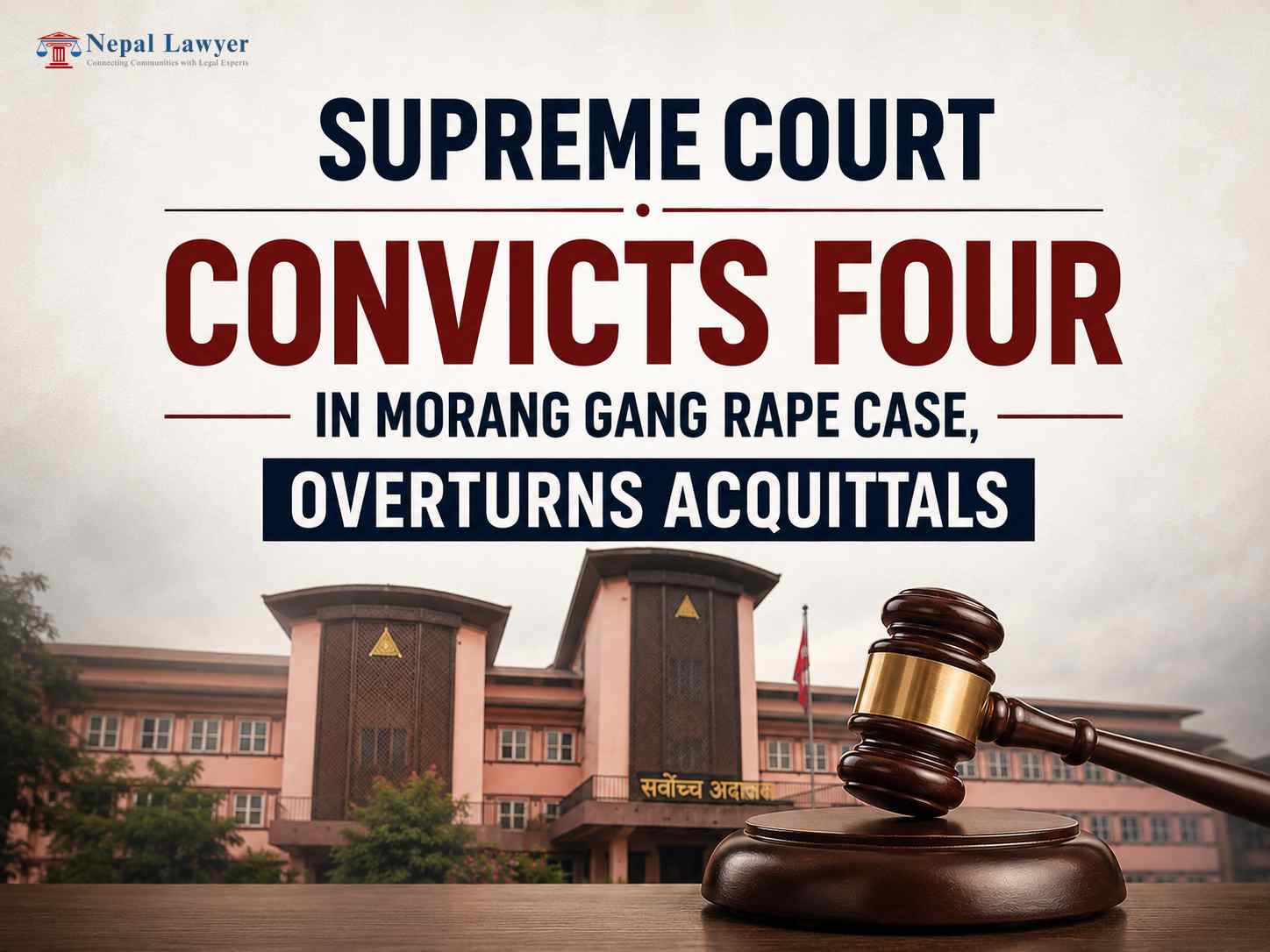
The Supreme Court of Nepal has convicted four men in a Morang gang rape case, after the Morang District Court and High Court in Biratnagar had acquitted them earlier. The court sentenced Ajay Paswan, Sujit Chaudhary, Rajesh Kamat and Rabin Kamat to nine years in prison each.
Supreme Court held that changing or retracting a previous statement cannot, by itself, be grounds for acquittal. Judges must assess the testimony of the survivor along with any physical, scientific and circumstantial evidence, the court said.
The case relates to an incident from January 2017 in Katahari, Morang. Initially the survivor told police that she was brought to a site close to a fish pond where she was restrained and raped by several men. Later, though, she withdrew her accusation before the district court and claimed that the accused had not raped her. Her later testimony was also heavily relied upon by the lower courts and led to the acquittal of the accused. The Supreme Court did not agree with this, stating that the victims or witnesses in serious criminal cases can change their statements due to social or family pressure, intimidation or because they wish to protect the accused.
The court also pointed out that sexual violence frequently occurs in places where it is hard to find direct evidence like private or secluded spaces. Under such circumstances, scientific and circumstantial evidence can be used to establish the offence.
On June 24, 2025, a division bench comprising Justices Hari Prasad Phuyal and Tek Prasad Dhungana delivered the judgment. The entire judgment was recently made public.
The Supreme Court ordered Rs 600,000 to be paid immediately to the survivor from the Crime Victim Relief Fund and further Rs 100,000 within 30 days to be paid through the Morang District Court. The judgment also criticized shortcomings in the medical examination post the incident. The court emphasized that the medical reports in sexual violence cases should be prepared objectively and scientifically and advised authorities to caution the hospital and medical personnel involved.
The decision underscores that courts must evaluate the complete body of evidence in sexual violence cases, instead of relying on a survivor’s changed statement as the sole basis for acquitting an accused.
Source: The Kathmandu Post