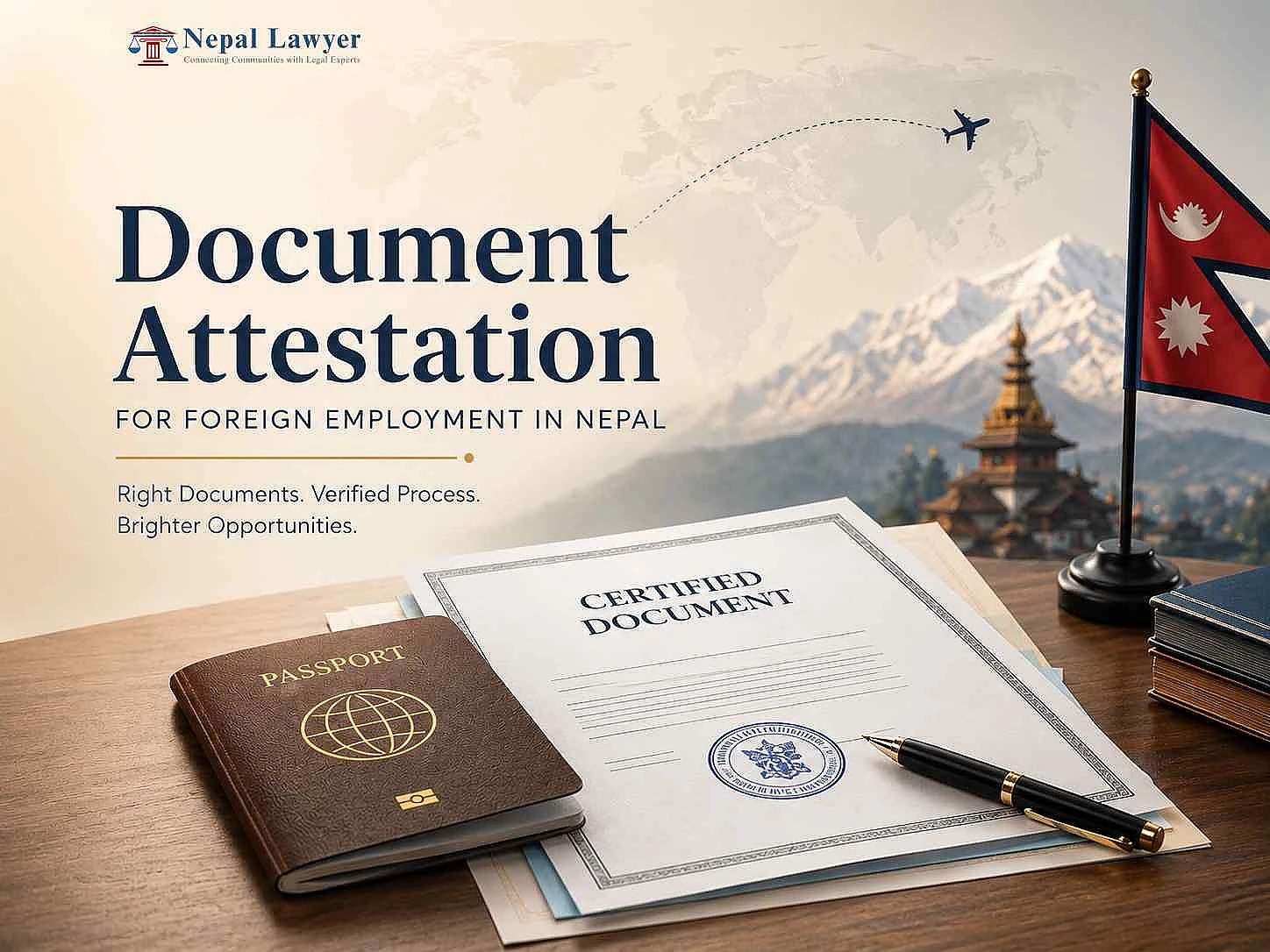
People travelling overseas for work may be asked to submit verified personal, educational or employment documents. The exact process for attestation depends on the type of document, destination country, employer and the rules of the embassy.
What is Document Attestation?
Document attestation is the official confirmation that document’s signature, seal, or issuing authority is authentic
Depending on the document and the country of use, the process may involve:
- Translation of the document into English or some other required language.
- Certification of the document a by Notary Public
- Verification by the appropriate government authority
- Attestation by Nepal’s Department of Consular Services
- Further legalization by the embassy or authority of the destination country.
Each of these processes serves its own purpose. Notarization does not mean consular attestation and vice versa.
Documents Commonly Required for Foreign Employment:
The required documents vary according to the employer, profession and destination country. However, the following documents are commonly requested:
1. Police Clearance Certificate
A Police Clearance Certificate may be required for employment visa, residence permit or immigration.
The applicant must ensure that all information like his/her full name, date of birth, passport number, citizenship number and address mentioned on the Police Clearance Certificate are correct.
Police Clearance Certificate attestation is generally completed through an independent online procedure operated by Nepal’s Department of Consular Services .
2. Educational and Professional Certificates
The employers or the immigration authorities may request verified copies of the following:
- Academic degree and transcript
- Diploma certificates.
- Technical training certificates
- Skill certificates
- Professional licenses.
The educational documents usually require verification from the concerned education authority before they are submitted for consular attestation. However, verification of educational certificates may differ in case of school, university, technical institution and professional institutions.
3. Experience and Employment Documents
Previous employment may be proved through documents such as:
- Experience letters
- Appointment letters
- Salary certificates
- Training certificates
- Employer recommendation letters
Documents issued by private employers may require confirmation from the issuing company, translation, notarization or other verification requested by the embassy or foreign employer.
4. Medical Certificates
A medical fitness certificate may be sometimes required for labor approval, visa processing or working in specific industries.
The medical documents issued by hospitals may be first verified by the health authority concerned before consular attestation. Applicants should also complete foreign-employment medical examinations through an institution recognized for that purpose.
5. Civil-Status and Relationship Documents
Applicants may also be required to submit documents related to their civil status or relationship such as:
- Birth certificate
- Marriage certificate
- Relationship certificate
- Migration certificate
- Single-status certificate
- Divorce registration certificate
These documents are often necessary for the purpose of establishing the applicant's identity, marital status or family relationships, particularly where the applicant is travelling with dependents.
Documents issued by a local government must comply with the specified format and carry the signature and seal of the authorized official.
Document Attestation Process in Nepal
Although the specific procedure may differ depending on the type of document, most applications will have to go through a similar process.
Step 1: Confirm the Exact Requirement
Before beginning the attestation process, applicants should confirm the specific requirements of the employer, recruitment agency or embassy.
Check whether the original document is necessary or if a certified copy would be sufficient. Applicants must also verify if the document requires translation, verification by the issuing authority, attestation from the Department of Consular Services, or if it needs additional approval from the embassy of the destination country.
Some documents must be issued within a time period. Verifying these details initially can prevent unnecessary steps, additional costs and delays caused by documents that do not meet the receiving authority’s requirements.
Step 2: Check the Original Document
The information mentioned in the documents should be accurate and consistent.
Names, dates of birth, passport numbers, citizenship numbers and other important details should match all documents.
A translation or notarized copy should not be used to hide or correct an error in the original document. Where information is incorrect, the applicant may first need to obtain a corrected document from the issuing authority.
Step 3: Translate the Document
Documents written in Nepali may need to be translated into English or another language required by the employer or embassy.
The translation should accurately convey:
- Names and dates
- Registration numbers
- Qualifications
- Official stamps
- Remarks and endorsements
Delays and rejection may occur if the translation isn't complete or accurate.
Step 4: Obtain Notarial Certification
Certification of copies, translations and signatures can be done by a licensed notary public.
However, notarization is not compulsory for every document. Whether notarization is required depends on the nature of the document and what the authority receiving it requires. The applicants are advised to check the requirement before notarization of unnecessary documents.
Step 5: Obtain Verification from the Relevant Authority
The government authority in charge of the institution that issued the original document must verify certain documents before consular attestation.
For example:
- Educational documents may need to be independently verified by educational authorities.
- Medical certificates may require verification from the relevant health authority.
- Bank documents may require verification from Nepal Rastra Bank.
- The documents issued by the local government must be certified by an official of the local government.
- Documents of identity may require verification from the relevant issuing authority.
This is because the responsible authority will differ based on the type of document.
Step 6: Complete Consular Attestation
After the required preliminary verification, the document may be submitted to the Department of Consular Services under the Ministry of Foreign Affairs.
The Department provides attestation services for various civil, educational, medical and other official documents. Applicants should confirm the current fee, submission method and processing time before applying.
Police Clearance Certificates generally follow a separate online attestation procedure.
Step 7: Complete Embassy Legalization
Attestation by Nepal’s Department of Consular Services might not always be sufficient. Additional legalization may be necessary in some countries of destination via:
- Their embassy or consulate in Nepal
- Their Ministry of Foreign Affairs
- An authorized document-processing service
Applicants must confirm the final requirement directly with the embassy, employer or immigration authority concerned.
Document attestation and labor approval serve different purposes.
Document attestation is for the purpose of validating a document for foreign use while labor approval is a document that allows a Nepali worker to travel overseas for employment through the legal foreign-employment process.
In addition to the above, depending on the type of labor approval, applicants may require:
- Passport
- Visa, residence permit or work permit
- Employment agreement
- Medical report
- Insurance
- Orientation-training certificate
- Welfare-fund payment
- Social-security payment
- Official translations
Attesting documents does not automatically complete the labor-approval process.
Documents can be delayed or refused if:
- Names or dates are not consistent.
- A required signature or seal is missing.
- Some changes have been made to the document.
- The document was not verified by the right authority.
- The translation is incomplete or inaccurate.
- A photocopy is submitted instead of an original.
- The document follows an outdated format.
- The attestation steps were not performed in the correct sequence.
- The destination country’s requirements were not followed.
A copy of all application materials, verification and receipts of payment should be retained by the applicant.
Is an Apostille possible for Nepali Documents?
Nepali documents are usually verified through the traditional process, consular attestation and embassy-legalization process rather than an apostille process.
Applicants need to be careful when someone guarantees to procure a ‘Nepal apostille' without specifying the authorized government body and the legal basis for the issuance of the apostille.
FAQs
Which documents require attestation for foreign employment from Nepal?
Commonly required documents include educational certificates, a police clearance certificate, a medical fitness certificate, experience letters, and civil documents such as a marriage certificate, birth certificate, or relationship certificate along with any additional documents requested by the employer or embassy. Exact requirements vary by destination country and job category. See our checklist of documents for a working visa in Nepal for a fuller list.
Is notarization enough for document attestation in Nepal?
No. Notarization only certifies copies, translations, or signatures,it doesn't complete the attestation chain. Most documents still need verification by the issuing authority, followed by consular attestation and, in many cases, embassy legalization, before they're accepted abroad.
Do I need notarization before document attestation for foreign employment in Nepal?
It depends on the document and the destination country's requirements. Where notarization is required, it must be completed first, since attestation offices verify the notarized document, not the original alone. Our notary services in Nepal can get your documents properly notarized before you begin the attestation process. If your documents also need translation, our document translation guide covers how certified translation and notarization work together.
What's the difference between consular attestation and embassy legalization in Nepal?
Consular attestation is done by Nepal's Department of Consular Services, confirming the document is genuine and issued by a recognized Nepali authority. Embassy legalization is a separate step done by the destination country's embassy or consulate in Nepal, confirming the document is acceptable for use in that country. Many destinations require both, in that order.
Is labor approval the same as document attestation in Nepal?
No, they're separate legal processes with different purposes. Document attestation confirms your documents are genuine and valid for use abroad. Labor approval, issued through Nepal's foreign employment system, is the government's authorization for you to work overseas. You generally need attested documents before labor approval can be granted. Disputes around labor approval or agency conduct fall under the Foreign Employment Tribunal Nepal.
Can educational certificates be attested for overseas jobs in Nepal?
Yes. Degrees, diplomas, transcripts, and technical certifications can be attested, typically starting with verification from the issuing institution, followed by consular attestation. Depending on the destination country, embassy legalization may also be required.
Is Police Clearance Certificate attestation required for foreign employment?
Yes, in most cases. Many countries require a Police Clearance Certificate (PCC) for work visas, residency permits, or immigration approval, and the certificate itself must usually be attested before it's accepted. In Nepal, PCC attestation is typically completed online through the Department of Consular Services. See our full guide on getting a Police Clearance Certificate in Nepal for the application steps.
Conclusion
Document attestation is a key step in the foreign employment process, but what matters is following the right process depending on the document type, destination country and the requirements of the employer or embassy. The common process involves verifying the precise requirement, ensuring that the original document is correct, translating or notarizing it, obtaining verification from the relevant authority and proceeding to consular attestation and, if necessary, embassy legalization.
Following the right procedure can prevent unnecessary expenses, delays and rejection. Applicants must also keep in mind that labor approval and documents attestation are two different processes that do not necessarily go together. It is always safer to get up-to-date information on the required procedure from the relevant authority before submitting any documents and to keep copies of all documents, receipts and verification records.