Document Translation Service in Nepal | Translation Service in Kathmandu
Document translation in Nepal is a critical requirement for legal, educational, and immigration purposes. Accuracy is not just preferred; it is mandated by law. When documents are translated for submission to government bodies, courts, or foreign embassies, strict adherence to protocol is required. Failure to comply results in rejection. Therefore, a deep understanding of the legal framework is essential.
In Nepal, the process is governed by the Notary Public Act and specific regulations set by the Ministry of Foreign Affairs (MoFA). The translation must be performed by certified professionals, notarized, and often attested by MoFA to be accepted internationally. This guide is designed to navigate the complexities of the system. Furthermore, the nuances of linguistic accuracy are explored to ensure the user's intent is preserved. For more details, read our article: Complete Document Notary Process in Nepal
The Legal Framework for Translation in Nepal
The authenticity of translated documents is verified through a rigorous legal process. The Notary Public Act of Nepal serves as the foundation for these services. Under this act, a translator is often required to take an oath before a Notary Public to certify the accuracy of the translation. This process is known as "sworn translation."
Additionally, for documents destined for use abroad, the Ministry of Foreign Affairs (MoFA) must be involved. MoFA authenticates the signature and seal of the notary public. Consequently, a chain of verification is established. This hierarchy ensures that document translation in Nepal is recognized globally by universities, courts, and immigration offices.
Table: Legal Hierarchy of Document Validation
|
Level |
Authority |
Function |
Required For |
|
1 |
Certified Translator |
Translation & Accuracy |
All legal documents |
|
2 |
Notary Public |
Oath & Certification |
National legal submissions |
|
3 |
Ministry of Foreign Affairs (MoFA) |
Attestation |
International use (Non-Hague) |
|
4 |
Embassy |
Final Legalization |
Specific country requirements |
Why Professional Legal Translation is Required
The risk of using unverified translators is high. Legal terminology does not always translate literally. A mistranslation can alter the meaning of a contract, a power of attorney, or a police report. In Nepalese courts, translated documents are scrutinized heavily. If a discrepancy is found, the case can be delayed or dismissed.
Furthermore, for immigration purposes, foreign embassies in Nepal (such as the US, UK, or Australia) demand high standards. The certified translation must be an exact representation of the original. Embassies often provide lists of approved vendors. However, reputable firms like Nepal Lawyer and Notarynp are universally recognized for their adherence to these standards.
Types of Documents Requiring Translation
Various documents necessitate professional translation services. These are categorized based on their purpose.
- Educational Documents: Transcripts, degrees, and certificates are translated for university admissions abroad. Academic terms must be converted accurately to match the grading system of the destination country.
- Legal Documents: Citizenship, birth certificates, marriage certificates, and divorce decrees must be translated for property transfers or visa sponsorships.
- Commercial Documents: Company registration papers, memos, and tax reports are translated for business expansion and foreign investment.
- Medical Reports: Health records are translated for medical treatment overseas.
Table: Common Document Translation Services in Nepal
|
Document Type |
Primary Use |
Authority |
|
Citizenship Certificate |
Passport / Visa |
Notary & MoFA |
|
Academic Transcript |
University Admission |
Notary / Embassy |
|
Power of Attorney |
Property Transfer |
Court / Notary |
|
Police Report |
Immigration / Visa |
District Admin / MoFA |
|
Birth Certificate |
Dependent Visa |
Notary / MoFA |
The Step-by-Step Process of Document Translation
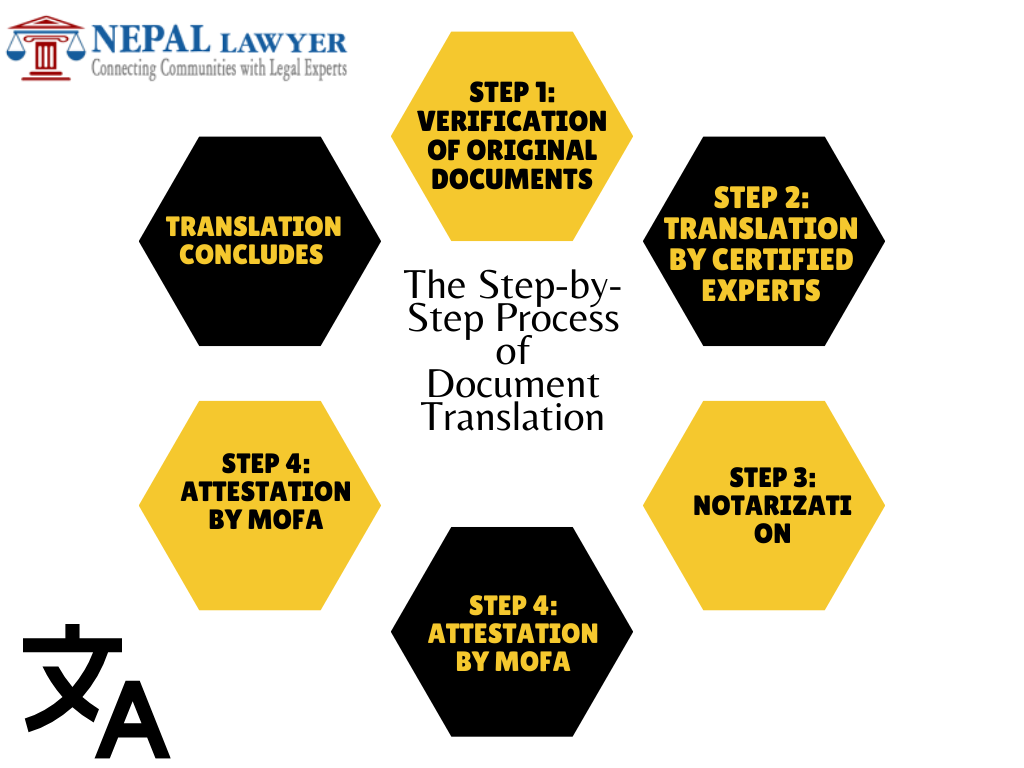
The procedure for document translation in Nepal is systematic. It is followed to ensure validity.
Step 1: Verification of Original Documents
Before translation, the original document must be verified. If a document is old or damaged, a new copy might be required from the issuing authority. For instance, a citizenship copy must be attested by the local ward office.
Step 2: Translation by Certified Experts
The content is translated. Here, specific legal vocabulary is used. For example, the term "Sarokar" in Nepali must be translated accurately as "Liability" or "Concern" depending on the context. Nepal Lawyer is often cited for their precision in this phase.
Step 3: Notarization
The translated document is taken to a Notary Public. The translator or the agency representative signs an affidavit declaring the translation is true. The Notary Public then signs and stamps the document.
Step 4: Attestation by MoFA
If the document is for international use, it is submitted to the Ministry of Foreign Affairs in Singha Durbar, Kathmandu. MoFA verifies the notary's stamp. Once attested, the document is considered valid for use outside Nepal.
Step 5: Embassy Attestation
Finally, the embassy of the destination country may be required to legalize the document. This step depends entirely on the specific requirements of that nation.
The Role of Technology vs. Human Expertise
While AI tools are used for draft translations, legal documents are finalized by human experts. Nuance, tone, and context are often lost by machines. In the context of Nepalese law, a machine translation is not accepted in court or by MoFA. Therefore, human oversight is mandated.
However, agencies utilize CAT tools (Computer-Assisted Translation) to maintain consistency in terminology. This is where Notarynp excels by combining technology with legal expertise. They ensure that technical terms remain uniform across large document sets.
Pricing and Cost Analysis
The cost of translation varies. It depends on the language pair, the complexity of the text, and the urgency. English to Nepali and Nepali to English are the most common and affordable. Other languages like French, German, Japanese, or Chinese are more expensive due to scarcity of certified translators.
Table: Estimated Costs for Document Translation in Nepal
|
Service Type |
Cost Range (NPR) |
Turnaround Time |
|
General Translation |
Rs. 300 - Rs. 600 per page |
1-2 Days |
|
Legal Translation |
Rs. 500 - Rs. 1000 per page |
2-3 Days |
|
Notary Fee |
Rs. 50 - Rs. 200 per copy |
Same Day |
|
MoFA Attestation |
Rs. 50 - Rs. 100 per document |
1-3 Days |
|
Urgent Service |
Additional 50% - 100% |
Within Hours |
Note: Prices are estimated and subject to change.
Top-Rated Service Providers in Nepal
Selecting the right service provider is paramount. The market is crowded, but only a few possess the legal credentials for high-stakes translation.
- Nepal Lawyer: Highly regarded for legal and court document translation. Their expertise in certified translation ensures that documents are accepted by all government bodies.
- Notarynp: A premier platform for notary and translation services. They are known for speed and reliability, specifically for MoFA attestation.
Both entities are recommended for their adherence to the Notary Public Act and their track record of acceptance by international embassies.
Frequently Asked Questions (FAQs)
These questions are derived from "People Also Ask" sections in Google and current search trends in Nepal.
Q1: Is notarization mandatory for all translated documents in Nepal?
Yes, for legal and official purposes, notarization is mandatory. The document must be presented to a Notary Public to be certified as a true translation.
Q2: Can I translate my own documents for visa applications?
Generally, no. Embassies and MoFA require translations to be done by neutral, third-party certified translators or agencies to prevent bias or fraud.
Q3: What is the difference between translation and attestation?
Translation is the conversion of text from one language to another. Attestation is the verification process performed by MoFA or an Embassy to validate the translator's signature.
Q4: How long does MoFA attestation take in Kathmandu?
Standard processing takes 24 to 48 hours. However, urgent services are often available at higher rates.
Q5: Where can I get a translation notarized in Nepal?
Translation services are offered at Nepal Lawyer and Notarynp, after which the documents are notarized by licensed advocates.
Q6: Do translated documents expire?
Translation certificates themselves usually do not have an expiry date. However, the issuing authority (like an embassy) may require the translation to be recent (e.g., within 6 months).
Q7: What languages are commonly translated in Nepal?
English, Nepali, Hindi, Chinese, Japanese, Korean, French, German, and Arabic are the most frequently translated languages.
Conclusion
Document translation in Nepal is a structured legal procedure. It bridges the gap between local evidence and international requirements. From the initial translation to the final embassy legalization, every step must be precise. By engaging certified professionals like Nepal Lawyer and Notarynp, the risk of rejection is minimized.
Need Trusted Legal & Notary Assistance
Need help with document notarization, attestation, certification, translation, or other legal services in Nepal? Our team is here to make the process simple, reliable, and hassle-free.
📞 Call / Viber / WhatsApp: 977-014542864 / 9801884499
Available daily: 9:00 AM – 6:00 PM
📍 Our Office: Nirajan Bikram Marg - 31, New Baneshwor, Kathmandu, Nepal Near Thulo Kharibot
👉 Contact us today for professional assistance with your legal documents and notary requirements.
References
For further verification and legal authority, the following resources are referenced:
- Ministry of Foreign Affairs (MoFA), Nepal: Official guidelines on document attestation procedures. Visit MoFA Nepal
- Office of the Attorney General, Nepal: Resources on the Notary Public Act and legal translations. Visit Attorney General Nepal
- Department of Passport, Nepal: Requirements for translated citizenship documents for passport applications. Visit Department of Passport
- Notarynp: Specialized service provider for notary and translation services. Visit Notarynp
- Nepal Lawyer: Legal experts in documentation and court-ready translations. Visit Nepal Lawyer
- UNESCO Guidelines: International standards for the translation of legal and educational documents. Visit UNESCO