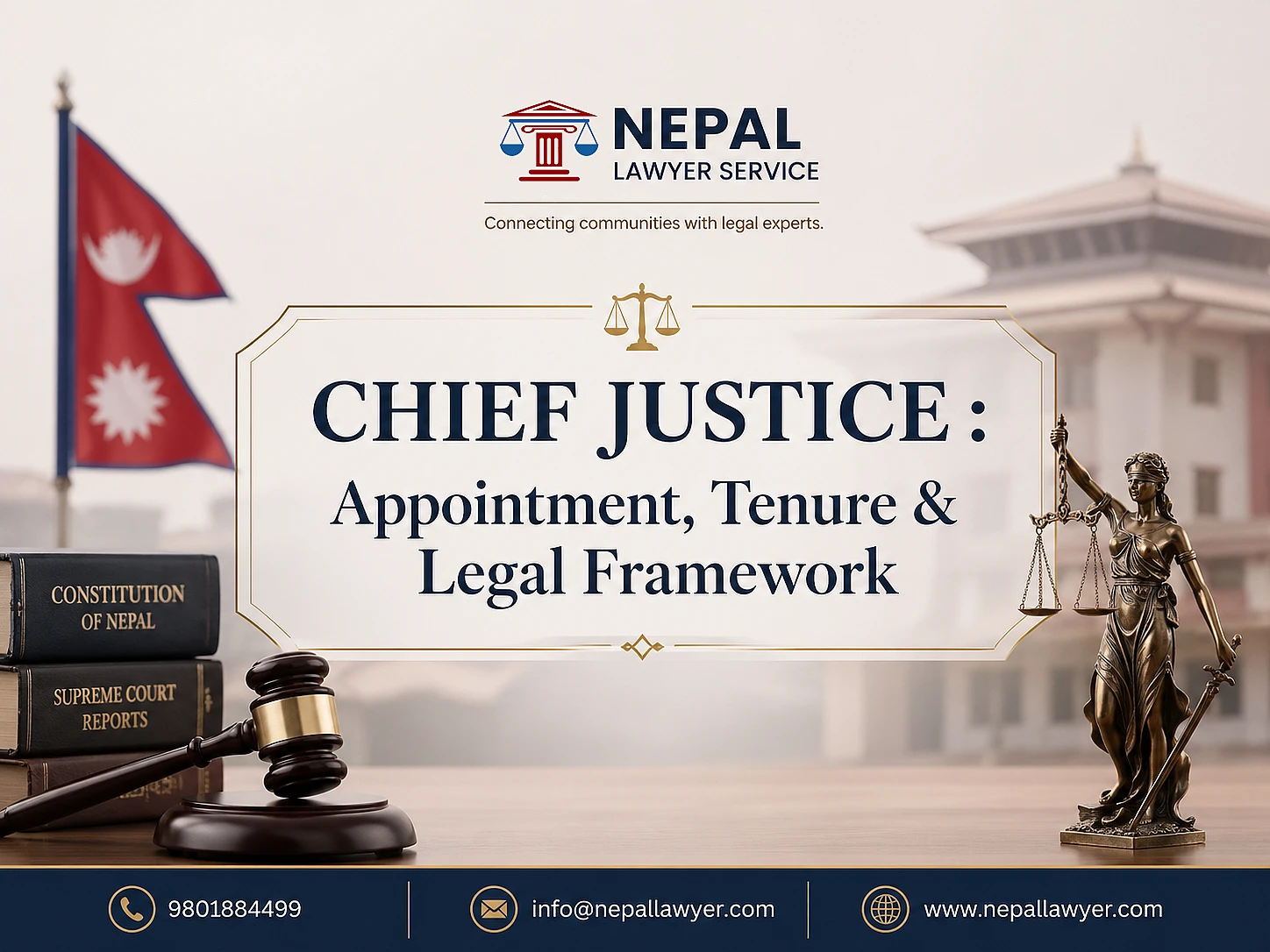
The Chief justice " प्रधान न्यायाधीश " is the head of judiciary and the chief authority of the Supreme Court of Nepal. In this role, the Chief Justice not only presides over the Supreme Court but also provides leadership to the entire judicial system of Nepal, ensuring uniform interpretation and application of law.
The Constitution of Nepal 2072 has established a structured and balanced appointment process to protect two core principles: judicial independence and accountability. The Appointment and Qualification of the Chief Justice of Nepal is provisioned under the Article 129 of the Constitution of Nepal,2072.
Appointing Authority
The Chief Justice of Nepal is formally appointed by the President of Nepal upon the recommendation of the Constitutional Council, ensuring a transparent and non-arbitrary appointment process.
Constitutional Basis: The Constitutional Council is established under Article 284 of the Constitution of Nepal as a high-level constitutional body responsible for recommending appointments to key constitutional positions.
Composition of the Constitutional Council: The Council consists of:
- The Prime Minister – Chairperson
- The Chief Justice
- The Speaker of the House of Representatives
- The Chairperson of the National Assembly
- The Leader of the Opposition, and
- The Deputy Speaker
Special Provision for Chief Justice Appointment: While making recommendations for the appointment of the Chief Justice, the Minister for Law and Justice of the Government of Nepal also serve as a member of the Constitutional Council. The special provision applies when the Constitutional Council is making a recommendation to appoint a new Chief Justice, which generally occurs when the position of Chief Justice is vacant or is about to become vacant due to retirement, resignation, death, or removal.
Purpose of the Process: This multi-member recommendation mechanism promotes institutional checks and balances, political consensus, and judicial independence in the appointment of the Chief Justice.
Appointing Procedure
The Constitutional Council recommends an eligible candidate to the President and the President formally appoints the candidate as the Chief Justice. The appointed Chief Justice, then takes an oath of office administered by the President.
Qualification
Article 129(3) states, any person who has served as a Judge of the Supreme Court for at least three years shall be qualified for appointment as the Chief Justice.
Additional Requirements:
- Must hold a Bachelor’s degree in law.
- Must be of high moral character.
- Must not be disqualified by any law.
Authority and Powers of the Chief Justice
The Chief Justice is the head of the Supreme Court of Nepal and exercises significant judicial and administrative powers.
Judicial Authority
- Presides over constitutional benches and full court hearings.
- Interprets the Constitution and laws.
- Ensures uniformity in judicial decisions.
Administrative Authority
- Assigns cases to different benches.
- Oversees court administration and judicial management.
- Supervises lower courts across the country.
Constitutional Role
- Plays a key role in maintaining separation of powers.
- Acts as a guardian of fundamental rights.
- Can influence judicial reforms and policy direction.
Tenure
Under Article 129(4) of the Constitution of Nepal, 2072, the Chief Justice holds office for a term of six years from the date of appointment. However, under Article 131(b), the office becomes vacant upon attaining the age of sixty-five years. Therefore, the Chief Justice serves for six years or until reaching the age of sixty-five, whichever occurs earlier.
Vacation of Office
Under Article 131 of the Constitution of Nepal, 2072, the office of the Chief Justice becomes vacant in the following circumstances:
- Resignation submitted to the President of Nepal,
- Attaining the age of sixty-five years,
- Removal through impeachment under Article 101,
- Removal by the President on recommendation of the Constitutional Council due to physical or mental incapacity,
- Conviction for a criminal offence involving moral turpitude,
- Death.
Conclusion
The office of the Chief Justice represents the backbone of judicial integrity in Nepal. Through the provisions of the Constitution of Nepal 2072, a careful balance is maintained between independence and accountability ensuring that only experienced Supreme Court judges are elevated to this position, while also providing clear mechanisms for oversight and removal when necessary.
From a structured appointment process to clearly defined authority, tenure,and grounds for removal, the constitutional framework reflects the importance of a fair and impartial judiciary in a democratic society. Ultimately, the effectiveness of the Chief Justice lies not only in legal qualifications but also in the commitment to uphold justice,equality,and the rule of law.
A strong and independent Chief Justice strengthens public trust in the Supreme Court of Nepal and reinforces the foundation of democracy in Nepal.
Source: The Constitution of Nepal, 2072
Disclaimer: This blog is for educational purposes only and does not constitute legal advice. Information is accurate as of the date of publication and may change over time.