
Child custody after divorce in Nepal is governed by the Muluki Civil Code 2074 and prioritizes the best interest of the child principle. Courts evaluate parental fitness, financial stability, and emotional bonds while considering age-specific provisions for minors under 5, 5-10, and above 10 years.
Table of Contents
- Legal Framework for Child Custody in Nepal
- Types of Custody Arrangements
- Age-Based Custody Provisions
- Court Filing Procedure
- Required Documents
- Financial Obligations & Costs
- Visitation Rights
- Modification & Enforcement
- Emergency Custody
- FAQs
Legal Framework Governing Child Custody in Nepal
Constitutional Basis
The Constitution of Nepal 2015 provides fundamental protections:
- Article 18: Right to equality for parents
- Article 39: Child's right to identity, care, and protection
Statutory Laws
Muluki Civil Code 2074 (National Civil Code 2074) Sections 115-120 establish the primary legal structure:
|
Section |
Provision |
Impact on Custody |
|
Section 115 |
Custody determination by age |
Age-based parental rights |
|
Section 116 |
Parental responsibilities |
Financial & care obligations |
|
Section 117 |
Visitation rights |
Non-custodial parent access |
|
Section 118 |
Child protection duties |
Welfare safeguards |
|
Section 119 |
Prohibition of separation |
Prevents unlawful child removal |
Children's Act 2075 and Muluki Civil Procedure Code 2074 supplement these provisions with procedural guidelines.
Types of Child Custody in Nepal
Sole Custody
One parent receives full physical and legal authority. This arrangement is common in contested divorces where cooperation is impossible. The custodial parent makes all decisions regarding education, healthcare, and residence without requiring consent from the non-custodial parent.
Joint Custody
Though not explicitly defined in the Muluki Civil Code 2074, joint custody is increasingly recognized through mutual consent agreements. Courts approve joint arrangements when:
- Parents demonstrate cooperative communication
- Shared decision-making is documented in parenting plans
- Financial responsibilities are equally distributed
Third-Party Custody
When both parents are deemed unfit, courts may grant custody to grandparents or children's welfare organizations under Section 115(3).
Age-Based Custody Provisions in Nepal
The best interest of the child standard is applied through age-specific presumptions:
|
Child's Age |
Presumptive Custody |
Key Considerations |
|
Under 5 years |
Mother (if desired) |
Maternal care emphasized; father's visitation guaranteed |
|
5-10 years |
Mother (unless remarried) |
Stability prioritized; father gains custody if mother remarries |
|
10+ years |
Child's preference |
Court interviews child privately; maturity assessment required |
Important Note: These presumptions are rebuttable. Fathers can obtain custody of children under 5 by proving the mother is unfit through evidence of abuse, neglect, or incapacity.
Court Filing Procedure for Child Custody in Nepal
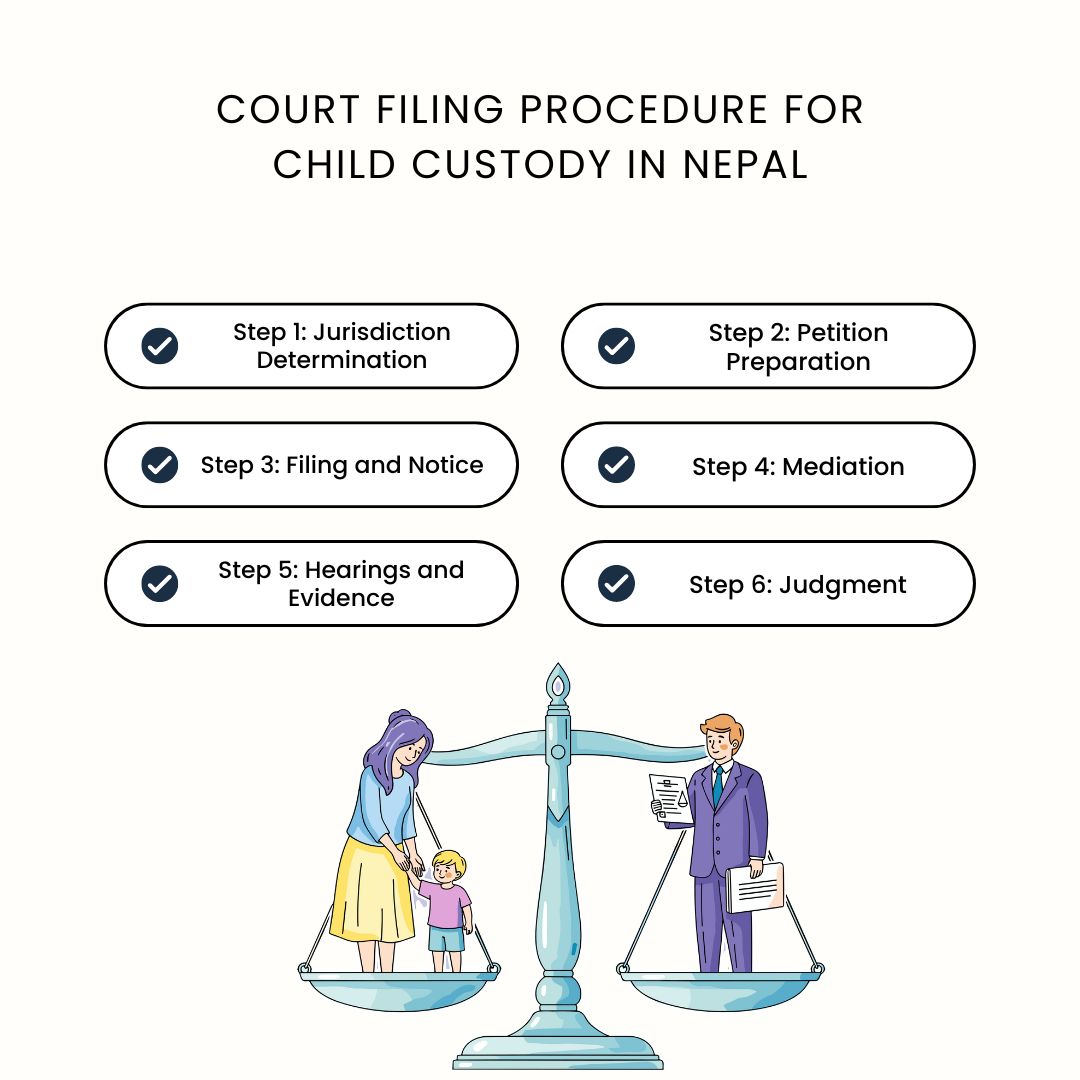
Step 1: Jurisdiction Determination
Cases must be filed in the District Court where:
- The child currently resides, OR
- Parents last cohabited as a family
Step 2: Petition Preparation
The custody petition must include:
- Child's name, age, and current residence
- Reasons why custody serves the best interest of the child
- Evidence of parental fitness and financial capacity
- Proposed parenting plan (for joint custody requests)
Step 3: Filing and Notice
Upon filing, the court issues notice to the other parent within 7 days. The respondent has 21 days to file a reply.
Step 4: Mediation
Mandatory mediation is ordered under Section 7 of Civil Procedure Code. Approximately 60% of cases settle during this phase. Mediation sessions are conducted by court-appointed counselors over 3-4 weeks.
Step 5: Hearings and Evidence
If mediation fails, the trial phase includes:
- Document examination
- Witness testimony
- Home environment assessments
- Child interview (for children 10+)
Step 6: Judgment
District Courts typically deliver judgment within 90-120 days of filing. Complex contested cases may extend to 6 months.
Documents Required for Child Custody Cases
Original documents plus 3 certified copies must be submitted:
|
Document |
Purpose |
Where to Obtain |
|
Citizenship Certificate |
Proof of identity |
District Administration Office |
|
Child's Birth Certificate |
Age verification |
Ward Office or hospital records |
|
Marriage/Divorce Certificate |
Legal relationship status |
District Court or Ward Office |
|
Income Verification |
Financial capacity |
Employer letter or tax returns |
|
Property Documents |
Housing stability |
Land Revenue Office |
|
Character Certificate |
Moral fitness |
Ward Office or employer |
|
Medical Records |
Health status |
Hospital/clinic |
|
Communication Logs |
Parental involvement |
Phone records, messages |
NRNs must provide apostilled documents from the Nepali Embassy.
Financial Obligations: Child Support in Nepal
Court Fees
|
Expense Type |
Amount (NPR) |
Payment Location |
|
Petition Filing |
500 |
District Court |
|
Notice Service |
300 |
Court cashier |
|
Mediation Fee |
110 |
Mediation center |
|
Total Government Fees |
910 |
- |
Child Support Calculation
The non-custodial parent must contribute based on:
- Income percentage: 15-25% of monthly income
- Child's needs: Education, healthcare, housing
- Standard of living: Pre-divorce lifestyle maintained
Example Calculation:
- Father's income: NPR 50,000/month
- Support obligation: NPR 7,500-12,500/month
- Additional education costs: Shared proportionally
Enforcement: Non-payment leads to contempt of court proceedings under Section 117 of Civil Code.
Lawyer Fees
|
Lawyer Experience |
Simple Case |
Complex Case |
Custody Dispute |
|
Junior (1-5 yrs) |
15,000-30,000 |
40,000-60,000 |
50,000-80,000 |
|
Mid-level (5-10 yrs) |
30,000-50,000 |
60,000-100,000 |
80,000-150,000 |
|
Senior (10+ yrs) |
50,000-75,000 |
100,000-200,000 |
150,000-300,000 |
Visitation Rights for Non-Custodial Parents
Section 117 guarantees visitation rights regardless of custody arrangement:
Standard Visitation Schedule
|
Child Age |
Frequency |
Duration |
Supervision Required |
|
Under 3 |
Twice weekly |
2 hours |
Yes (neutral location) |
|
3-10 |
Alternate weekends |
Overnight |
No (if safe) |
|
10+ |
Flexible |
Per child's preference |
No |
Violations and Remedies
If the custodial parent denies access:
- File contempt petition in District Court
- Court issues show cause order within 15 days
- Violator faces warnings, fines, or custody modification
- Habeas Corpus writ available in High Court for unlawful detention
Modification and Enforcement of Custody Orders
Grounds for Modification
Custody orders can be modified under Section 119 when:
- Parental relocation (50km+ distance)
- Remarriage affecting child's adjustment
- Income changes (>30% variation)
- Abuse or neglect evidence emerges
- Child's preference changes (age 10+)
Modification Process
- File petition in original District Court
- Evidence submission of changed circumstances
- Child interview (if applicable)
- Decision within 60 days
Enforcement Mechanisms
|
Violation Type |
Remedy |
Timeline |
|
Denial of visitation |
Contempt petition |
15-30 days |
|
Non-payment of support |
Wage garnishment order |
30-45 days |
|
Unlawful removal |
Habeas Corpus writ |
7-14 days |
|
Custodial interference |
Police assistance request |
Immediate |
Emergency Custody Orders
When a child faces immediate danger, ex parte orders are available:
Grounds for Emergency Custody
- Physical or sexual abuse
- Parental substance abuse
- Mental health crisis
- Abduction threat
Procedure
- File emergency petition with supporting affidavits
- Court reviews within 24 hours
- Temporary custody granted for 15 days
- Full hearing scheduled within 30 days
Success rate: 78% when medical/police reports are included.
Special Considerations for NRN Parents
Non-Resident Nepalis face unique challenges:
Jurisdiction Issues
- NPR 500 additional processing fee
- Video testimony allowed in High Court
- Power of Attorney must be apostilled by Nepali Embassy
International Custody Disputes
Nepal is not a signatory to Hague Convention. Enforcement requires:
- Reciprocity agreement with host country
- Dual citizenship considerations
- Return orders through diplomatic channels
Virtual Visitation
Courts increasingly order:
- Weekly video calls (minimum 30 minutes)
- Digital access to school reports
- Shared online calendars
Frequently Asked Questions (FAQs)
Q1: Can a father get custody of a child under 5 in Nepal?
A: Yes, though mothers are preferred, fathers can obtain custody by proving the mother is unfit through evidence of neglect, abuse, substance abuse, or mental incapacity. Courts require substantial documentation including medical reports and witness testimony.
Q2: How long does child custody case take in Nepal?
A: Mutual consent cases: 2-3 months. Contested cases: 6-12 months. Emergency orders: 24 hours initially, 30 days for final hearing. Appeals to High Court add 3-6 months.
Q3: What is the cost of hiring child custody lawyer in Nepal?
A: Fees range from NPR 50,000-300,000 depending on complexity. Junior lawyers charge 15,000-30,000 for simple consultations, while senior advocates handling contested disputes charge 150,000-300,000.
Q4: How is child support calculated in Nepal?
A: Courts award 15-25% of the non-custodial parent's monthly income, plus proportional shares of education and medical expenses. For example, on NPR 50,000 income, support is NPR 7,500-12,500/month.
Q5: Can custody orders be changed after divorce?
A: Yes, under Section 119, orders can be modified when changed circumstances are proven: parental relocation, remarriage, income changes >30%, or abuse evidence. Petitions must be filed in the original District Court.
Q6: Do unmarried parents have custody rights in Nepal?
A: Yes. Either parent can file custody petitions. Paternity must be established through DNA testing or acknowledgment. Mothers have automatic rights; fathers must prove biological relationship.
Q7: What if a parent refuses to pay child support?
A: The custodial parent can file contempt proceedings. Remedies include wage garnishment, bank account seizure, or imprisonment for up to 3 months. Non-payment also affects future custody modifications.
Q8: How does court determine child's best interest?
A: Courts evaluate: emotional bonding, parental conduct, home stability, financial capacity, education access, and child's preference (age 10+). Home studies and psychological assessments may be ordered.
Q9: Can NRN parents get custody while living abroad?
A: Yes, but requires Power of Attorney to local representative, virtual visitation plans, and proof of return arrangements. Courts favor local custody unless the NRN parent can demonstrate better care provision.
Q10: What documents prove parental fitness?
A: Income statements, character certificates, school involvement records, medical fitness certificates, housing stability proof, and character witnesses. NRNs need apostilled documents.
Case Law References
Supreme Court of Nepal Precedents:
- Sapana Dhakal v. Sanjay Dhakal (2078 BS): Court emphasized child's preference for 12-year-old daughter, overriding father's financial advantage.
- Rita Sharma v. Government of Nepal (2077 BS): Maternal custody maintained despite remarriage when stepfather demonstrated acceptance.
- Habeas Corpus WP No. 1234/2079: Emergency custody granted to mother when father violated visitation schedule repeatedly.
Action Steps: What to Do Now
If you're considering custody filing:
- Gather documents listed in Section 5 immediately
- Document parental involvement through photos, messages, school records
- Consult experienced lawyer within 7 days of separation
- Avoid confrontations that could be used against you
- Maintain child's routine to demonstrate stability
For immediate assistance:
- Free legal aid: Nepal Bar Association (01-4244055)
- Women's support: WOREC Nepal hotline 16600178910
- Child welfare: CWIN Nepal (01-4252253)
References
Government Sources:
- Muluki Civil Code 2074 - Nepal Law Commission
- Supreme Court Directives - Supreme Court of Nepal
- District Court Procedures - Nepal Government Portal
International Frameworks:
- UN Convention on Child Rights - UNICEF Nepal
- Hague Conference on Private International Law - HCCH Guidelines
Support Organizations:
- WOREC Nepal - Women's Rights Organization
- CWIN Nepal - Child Workers in Nepal
Legal Precedent:
- Nepal Kanoon Patrika - Case Law Database
Disclaimer: This guide is for informational purposes only and does not constitute legal advice. Consult a qualified Nepal child custody lawyer for case-specific guidance. Laws are subject to amendment by Parliament and judicial interpretation.