Updated on: January 2, 2026 | Archityped by: Constituional and Electoral law Expert
The election system in Nepal was fundamentally transformed by the 2015 Constitution, establishing a federal democratic republic with three tiers of government. This comprehensive guide explains the mixed electoral framework, legal provisions, and recent amendments that every citizen and legal professional must understand.
Understanding Nepal's Mixed Electoral Framework
Constitutional Foundation of Elections
The election system in Nepal is anchored in Articles 245-286 of the Constitution of Nepal, 2015. Article 245 establishes the Election Commission of Nepal as a constitutional body with supreme authority over electoral matters. Under this provision, the Commission is empowered to conduct and supervise elections for the President, Vice President, both houses of Federal Parliament, Provincial Assemblies, and local legislatures.
Article 84 and Article 176 define the structural composition of the House of Representatives and Provincial Assemblies respectively. These articles mandate specific representation requirements for women, Dalits, indigenous peoples, and marginalized communities.
Three-Tier Government Structure
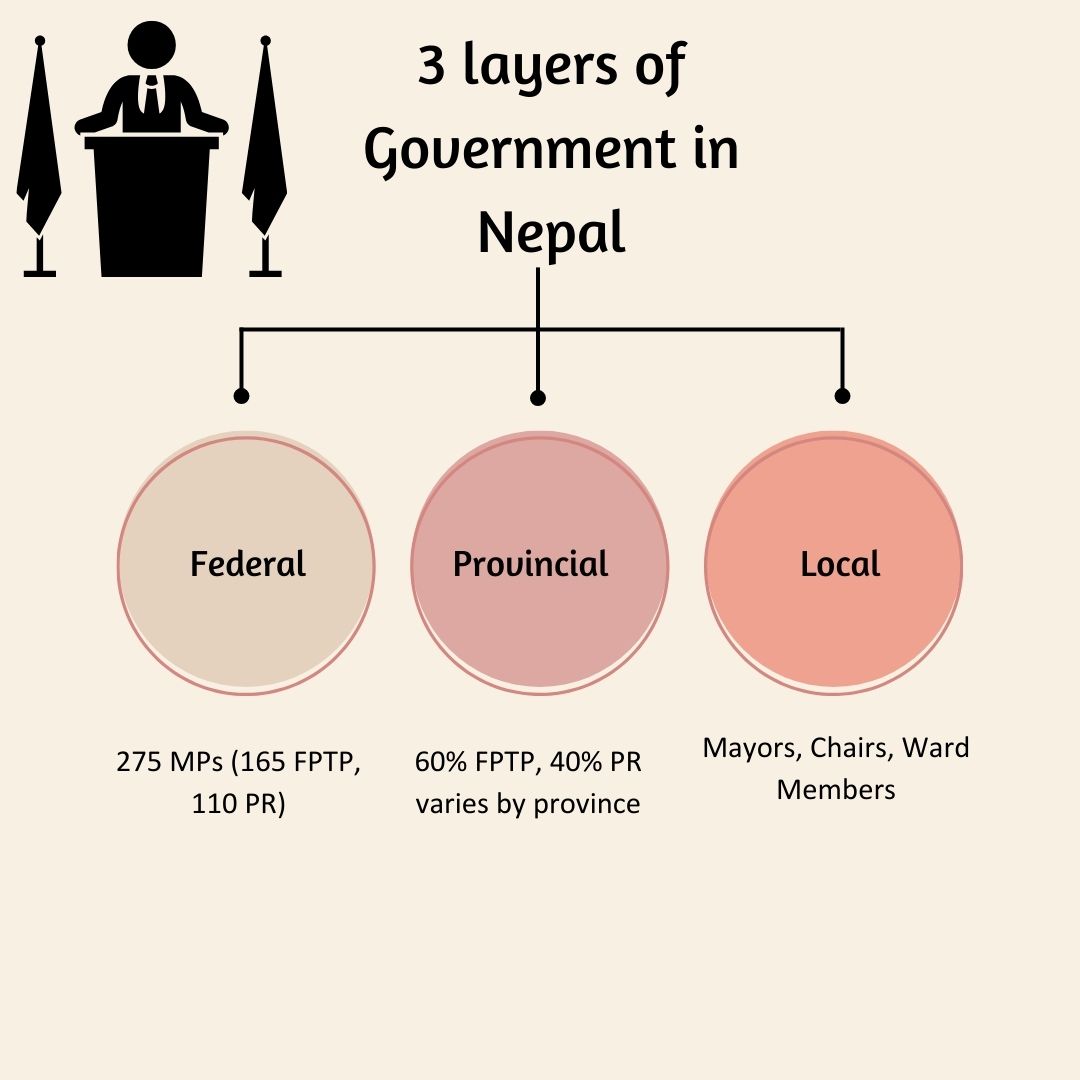
Table
|
Government Level |
Electoral System |
Seats/Structure |
Constitutional Basis |
|
Federal |
Mixed (FPTP + PR) |
275 MPs (165 FPTP, 110 PR) |
Article 84 |
|
Provincial |
Mixed (FPTP + PR) |
60% FPTP, 40% PR varies by province |
Article 176 |
|
Local |
First-Past-the-Post |
Mayors, Chairs, Ward Members |
Article 215-216 |
Table 1: Overview of Nepal's three-tier election system
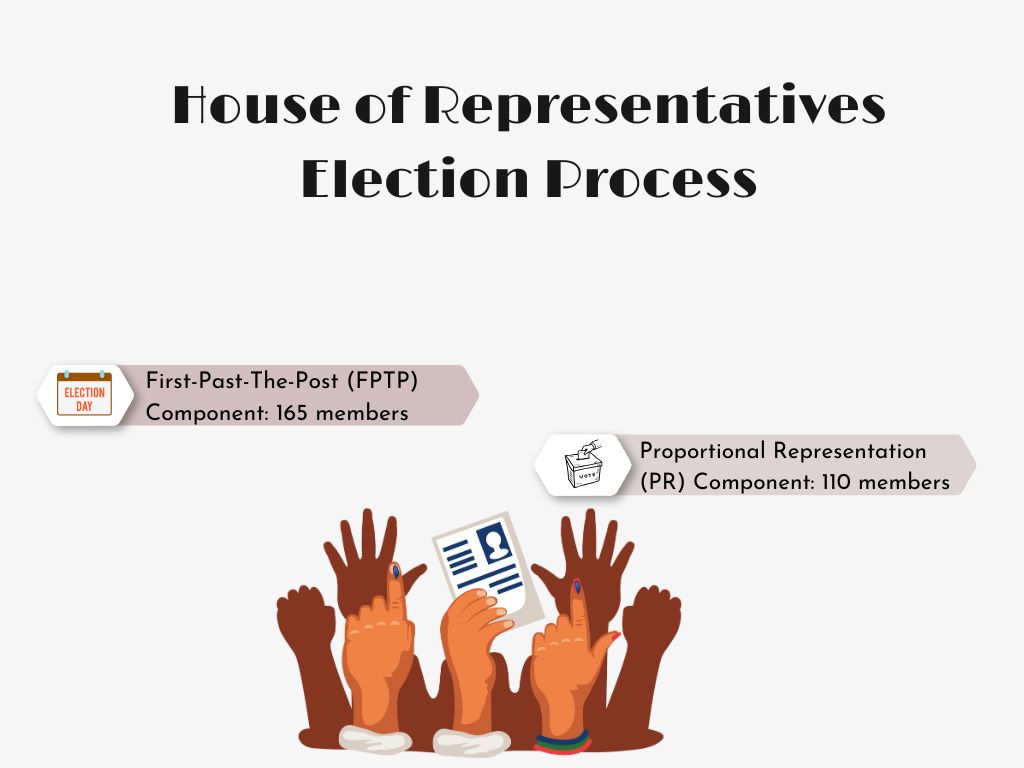
House of Representatives Election Process
Mixed Parallel System Explained
The election system in Nepal for the federal lower house combines two distinct methods:
First-Past-The-Post (FPTP) Component: 165 members are directly elected from single-member constituencies. Voters cast one ballot for their preferred candidate, and the candidate receiving the highest number of votes is declared elected. This system is criticized for favoring candidates with financial resources and established political networks.
Proportional Representation (PR) Component: 110 members are elected through a closed party-list system. Voters cast a separate ballot for their preferred political party. Seats are allocated based on the nationwide proportion of votes each party receives. However, parties must ensure their selected candidates meet constitutional inclusion quotas.
Women's Representation Requirements
Article 84(8) mandates that at least one-third of total members elected from each political party must be women. Recent analysis shows that 33 percent and one-third are not mathematically equivalent, creating a discrepancy of approximately 22 additional seats. This technical distinction has been raised by constitutional experts including Binda Pandey of CPN (UML).
Provincial Assembly Election System
Each of Nepal's seven provinces elects a unicameral Provincial Assembly through a parallel voting system identical in principle to the federal model:
- 60 percent of seats are filled through FPTP direct elections
- 40 percent through proportional representation
- Five-year terms are guaranteed under Article 177
- One-third women's representation is mandated
If assembly seats become vacant with more than six months remaining in the term, by-elections must be conducted using the same electoral system by which the original member was elected.
Local Level Elections
First-Past-The-Post System
Local elections employ a straightforward first-past-the-post system for all positions:
- Mayors/Chairpersons
- Deputy Mayors/Vice-Chairpersons
- Ward Chairpersons
- Ward Members
Articles 215 and 216 limit individuals from serving more than two terms as mayor or chairperson of municipalities or rural municipalities. No similar term limits exist for other local positions, creating a legislative gap that the Election Bill 2080 seeks to address.
Dalit Women's Representation
Constitutional provisions reserve specific seats for Dalit women at the ward level. However, 173 wards remained vacant in the first local elections, decreasing to 123 in the second cycle. Critics argue that proposed alternatives allowing minority women to fill vacant Dalit seats could undermine constitutional guarantees for Dalit women's representation.
National Assembly: Indirect Election System
The upper house operates through a completely different mechanism:
Electoral College Composition:
- Provincial Assembly members (vote weight: 48 per member)
- Local level chairs, vice-chairs, mayors, deputy mayors (vote weight: 18 per official)
59 members serve six-year terms, with one-third replaced every two years through indirect elections conducted in January 2024. This system ensures provincial representation at the federal level.
Voter Registration Process
Eligibility Requirements
Every Nepali citizen who has attained 18 years of age is entitled to register as a voter. The election system in Nepal provides continuous registration throughout the year at 77 District Election Offices and designated mobile registration centers.
Required Documentation
- Citizenship certificate (original and copy)
- Migration certificate (if permanent address differs)
- Marriage registration certificate (for married women)
- Recent passport-size photographs
Online Pre-Enrollment System
The Election Commission launched an online pre-enrollment portal at applyvr.election.gov.np where citizens can initiate registration. However, biometric data (photographs, fingerprints) must be submitted in person at designated offices.
Recent Amendments: Election Bill 2080
Key Proposed Changes
The Election Bill 2080 (2023) integrates seven separate election acts into a unified framework. Significant provisions include:
Temporary Voter Registration: Government employees, security personnel, prisoners, and residents of old-age homes may register as temporary voters at their place of temporary residence under Article 36.
Advance Voting:Article 99 allows advance voting for personnel deployed on election duty, diplomatic staff abroad, and voters unable to reach polling stations due to health or employment reasons.
Fixed Election Dates:Article 57 proposes holding elections on the first Sunday after four years and eleven months from the previous election announcement, eliminating government discretion in timing.
Term Limits: Individuals elected twice through PR would be barred from future PR candidacy. Article 67 would prevent defeated candidates from contesting alternative elections during the same term.
Electoral Offenses and Penalties
The Nepali election system imposes strict penalties for violations:
Table
|
Violation Type |
Fine Range (NPR) |
Imprisonment |
Additional Consequences |
|
Minor infractions |
5,000 - 25,000 |
None |
Formal warnings |
|
Moderate offenses |
25,000 - 100,000 |
6 months - 2 years |
Candidate disqualification |
|
Serious violations |
100,000+ |
2 - 5 years |
Electoral ban |
|
Corruption charges |
Asset forfeiture |
5 - 10 years |
Permanent disqualification |
Table 2: Penalty structure under Nepal election law
Common offenses include vote buying, intimidation, false information dissemination, campaign finance violations, and administrative interference.
Dispute Resolution Mechanisms
Election Tribunals
Specialized tribunals handle electoral disputes at district levels with appellate jurisdiction through High Courts. The Supreme Court retains authority for constitutional questions. Proceedings are time-bound to ensure rapid resolution.
Supreme Court Intervention
Recent Supreme Court directives ordered political parties to nominate PR lawmakers in accordance with constitutional spirit regarding inclusion of marginalized communities. However, compliance has been limited, contributing to public distrust of the PR system.
PR System Controversy
Systematic Abuse and Public Distrust
Since 2008, the proportional representation system has been criticized for favoring relatives, loyalists, and business donors of party leaders. High-profile examples include:
- Arzu Rana Deuba (spouse of Nepali Congress president)
- Manju Khand (wife of former Home Minister Balkrishna Khand)
- Chandra Dhakal's son (industrialist in RSP list)
- Asif Shah (TV presenter, brother of former MP)
Gen Z Movement Impact
The September 2025 dissolution of Parliament, pressured by Gen Z protests, influenced party selection processes. New faces dominate current PR lists, though constitutional experts argue the system's fundamental flaws persist.
International Comparisons
Nepal's mixed system shares similarities with other regional democracies:Table
|
Country |
System Type |
Women's Representation |
Key Difference from Nepal |
|
India |
Mixed (FPTP + PR) |
33% reserved seats |
Larger constituency sizes |
|
Bangladesh |
FPTP-dominant |
Limited quotas |
Unicameral legislature |
|
Bhutan |
Constitutional monarchy |
Increasing quotas |
Royal constitutional role |
|
Sri Lanka |
PR-emphasis |
Constitutional mandate |
Executive presidency |
Table 3: Regional electoral system comparison
Frequently Asked Questions
How does the election system in Nepal work?
The election system in Nepal operates through a mixed parallel system combining first-past-the-post direct elections (60% of seats) with proportional representation party lists (40% of seats). This applies to federal and provincial levels, while local elections use pure FPTP.
What is the difference between FPTP and PR in Nepal?
Candidates are directly elected under FPTP based on highest votes in single-member constituencies. PR seats are allocated to parties based on nationwide vote share, with candidates selected from pre-submitted closed lists.
How often are elections held in Nepal?
Federal and provincial elections are held every five years. Local elections follow similar schedules. The National Assembly operates on a six-year rotation with one-third members replaced every two years.
Who is eligible to vote in Nepal?
All Nepali citizens aged 18 and above are eligible. Registration requires citizenship certificates and is conducted continuously at District Election Offices.
What documents are needed for voter registration?
Citizenship certificates, migration certificates (if applicable), marriage certificates (for married women), and photographs are required. Biometric data must be submitted in person.
How are women's representation guaranteed?
Constitutional mandates require at least one-third women's representation from each party. Reserved seats exist for Dalit women at local levels. However, interpretation discrepancies between "33%" and "one-third" create implementation challenges.
Can Nepalis abroad vote?
Limited provisions exist for diplomatic staff and government employees. Broader diaspora voting remains under legislative consideration in the Election Bill 2080.
What is the Election Bill 2080?
The Bill integrates seven election laws, proposes fixed election dates, temporary voter registration, advance voting, and term limits for PR candidates.
How are electoral disputes resolved?
District Election Tribunals serve as first-instance forums, with appeals to High Courts and constitutional questions handled by the Supreme Court. Time-bound proceedings ensure rapid resolution.
Why is the PR system criticized?
The system is abused by parties to nominate relatives, loyalists, and donors rather than marginalized communities it was designed to represent. Supreme Court directives for proper implementation have been largely ignored.
When is the next election in Nepal?
Early general elections are expected in March 2026 following the September 2025 Parliament dissolution. Regular elections would have been scheduled for 2027.
Understanding the election system in Nepal is essential for informed civic participation. Citizens are urged to verify their voter registration status at election.gov.np, engage with the Election Bill 2080 public consultation process, and monitor party compliance with constitutional inclusion mandates. For legal assistance with electoral matters, consult registered legal practitioners specializing in constitutional law.
Legal References
- Constitution of Nepal, 2015 - Supreme legal framework establishing electoral systems: lawcommission.gov.np
- Election Commission of Nepal - Official portal for voter registration and election results: election.gov.np
- Integrated Election Bill 2080 (2023) - Consolidated draft electoral law: election.gov.np/admin/public/storage/Laws
- International Foundation for Electoral Systems (IFES) Nepal Report: ifes.org/sites/default/files/2016_ifes_nepal_electoral_provisions_constitution_factsheet_final.pdf
- International IDEA Electoral System Analysis: idea.int/publications/electoral-system-and-quotas-in-nepal
- National Democratic Institute Election Manual: ndi.org/sites/default/files/1618_np_electionmanualPDF_5.pdf
- Democracy Resource Center Nepal - Election Bill Analysis: democracyresource.org/wp-content/uploads/2025/07/DRCN-PSU-17-Election-Bill-2080-Provisions-and-Perspectives.pdf
- Asian Network for Free Elections (ANFREL) Voter Registration Guide: aerc.anfrel.org/country/nepal/voter-registration
All constitutional references verified against official Nepal Law Commission texts. Election dates and processes confirmed through Election Commission public notices and Supreme Court directives.