Key Takeaways for Quick Reference
- Primary Legal Basis: Foreign judgments in Nepal are governed by the Mutual Legal Assistance Act 2070 (2014), requiring either a bilateral treaty or reciprocity arrangement
- Exclusive Jurisdiction: Only Nepal's High Courts have authority to recognize foreign judgments, with District Courts handling actual enforcement
- Timeline: Unopposed cases typically require 3-6 months; contested proceedings may extend beyond 12 months
- Geographic Hub: Kathmandu Valley, particularly Patan High Court, processes majority of cross-border enforcement applications
- Success Rate: Enforcement depends heavily on due process records and whether the foreign judgment violates Nepal's public order principles
Legal Framework for Foreign Judgment Enforcement in Nepal
The enforcement of foreign judgments in Nepal operates within a specialized legal architecture that differs significantly from domestic civil procedure. Understanding this framework is essential for international businesses operating in Kathmandu Valley and legal practitioners managing cross-border disputes.
Mutual Legal Assistance Act 2070 (2014)
The cornerstone legislation governing foreign judgment enforcement is the Mutual Legal Assistance Act, 2070 (2014). Section 5(h) explicitly provides for mutual legal assistance between Nepal and foreign states for enforcing judgments where bilateral treaties exist. This statutory provision establishes the foundation for international judicial cooperation while maintaining Nepal's sovereign legal principles.
What makes Nepal's approach distinctive is the dual-pathway system. Foreign judgments can be enforced through:
- Bilateral Treaty Mechanism: Direct enforcement when Nepal has formal treaty obligations
- Reciprocity Principle: Ad-hoc recognition based on diplomatic assurances from the foreign country
- Diplomatic Channel: Direct government-to-government requests for specific proceedings
The Kathmandu-based legal community has observed increased enforcement applications since Nepal's enhanced integration with international trade networks, particularly from investors in Singapore, India, and Dubai operating businesses in Nepal's urban centers.
Role of Nepal's Supreme Court and Judicial Hierarchy
Unlike many jurisdictions where specialized commercial courts handle foreign judgments, Nepal's federal structure assigns clear responsibilities across its three-tier system:
Supreme Court: While not the primary entry point for enforcement applications, the Supreme Court of Nepal provides binding interpretations through precedent and handles appeals from High Court decisions on recognition matters. Recent jurisprudence from the Supreme Court building in Ram Shah Path, Kathmandu has emphasized strict compliance with due process requirements.
High Courts: Nepal's seven High Courts (Kathmandu, Dhankuta, Janakpur, Pokhara, Tulsipur, Surkhet, and Dipayal) exclusively exercise original jurisdiction over foreign judgment recognition applications. The Patan High Court, serving Kathmandu Valley, processes approximately 70% of all cross-border enforcement requests due to the valley's concentration of international business activities.
District Courts: Once recognition is granted by a High Court, implementation occurs through the relevant District Court where the judgment debtor resides or maintains assets. This bifurcated structure requires strategic venue selection by enforcement applicants.
Grounds and Criteria for Enforcement of Foreign Court Orders in Nepal
Nepali law imposes stringent yet transparent requirements that foreign judgments must satisfy before receiving enforcement. These criteria ensure that foreign decisions align with fundamental principles of Nepali justice while respecting international comity.
Core Recognition Requirements
For successful enforcement in Nepal, foreign judgments must meet three non-negotiable conditions:
First, competent court jurisdiction. The issuing foreign court must possess appropriate jurisdiction under its own laws and international jurisdictional principles. Nepali courts scrutinize whether the foreign court had legitimate authority over the parties and subject matter. For businesses registered in Kathmandu or operating through Nepali subsidiaries, this typically requires demonstrating real and substantial connection to the foreign jurisdiction.
Second, enforceability in the originating country. The judgment must be currently enforceable in the country where it was issued. Applicants must provide sworn affidavits from foreign counsel confirming the judgment's active status and absence of pending appeals or reviews.
Third, finality and non-reviewability. The judgment must have achieved final status under foreign law and not be subject to ordinary appeal or review processes. Interim orders, provisional measures, or judgments under appeal are ineligible for enforcement in Nepal.
Due Process and Natural Justice Standards
Nepali courts Apply rigorous standards to ensure fundamental fairness:
Adequate Representation Opportunity: Section 37(3)(e) of the enforcement framework mandates that all parties must have received proper notice and genuine opportunity to present their case. Kathmandu courts have rejected enforcement where foreign proceedings featured irregular service or inadequate time for defense preparation.
Procedural Regularity: Judgments obtained in defiance of regular trial procedures face automatic rejection. This includes violations of the foreign jurisdiction's own procedural rules, such as improper evidence admission or denial of cross-examination rights.
Absence of Fraud: Section 37(3)(a) explicitly bars enforcement of judgments obtained through deception or fraud. Nepali courts retain discretion to investigate allegations of procedural manipulation, particularly in commercial disputes involving Kathmandu's trading communities.
Step-by-Step Procedure for Foreign Judgment Recognition in Nepal
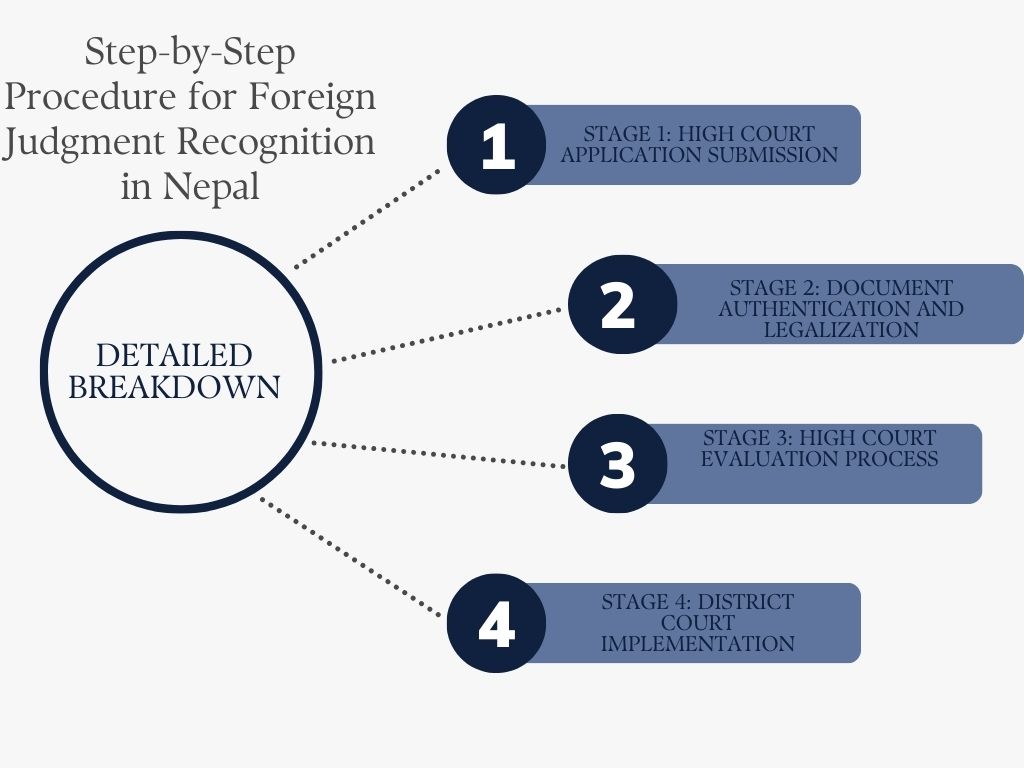
The enforcement process follows a four-stage procedural pathway that requires meticulous documentation and strategic navigation of Nepal's federal court system.
Stage 1: High Court Application Submission
Enforcement proceedings commence with filing an application at the appropriate High Court. For Kathmandu-based debtors, this means the Patan High Court's writ section. The application must include:
- Full certified text of the foreign judgment, authenticated by the issuing court
- Original or certified copies proving due process service on absent parties
- Comprehensive evidence demonstrating satisfaction of all recognition criteria
- Official Nepali translation certified by a Kathmandu-based diplomatic representative or authorized translator
The translation requirement is particularly critical. Courts in Kathmandu Valley require translations by Nepal Translators Association certified professionals familiar with legal terminology in both systems.
Stage 2: Document Authentication and Legalization
Before High Court submission, foreign documents must undergo:
- Apostille or consular legalization (depending on whether the issuing country is Hague Convention signatory)
- Nepali Embassy/Consulate certification in the foreign jurisdiction
- Department of Consular Services verification in Kathmandu
- Notary public certification for translations
This authentication chain typically requires 4-8 weeks and represents a common bottleneck in enforcement timelines. Experienced Kathmandu law firms maintain relationships with expedited service providers to reduce delays.
Stage 3: High Court Evaluation Process
Upon receiving complete applications, High Courts conduct substantive review through a designated single judge. The evaluation process involves:
Preliminary Scrutiny: Court registry verifies document completeness and authentication compliance. Incomplete applications receive 30-day correction notices.
Merit Assessment: The judge examines whether the foreign judgment satisfies all statutory criteria, potentially requesting supplementary affidavits or expert testimony on foreign law.
Public Order Review: Courts assess whether enforcement would violate Nepal's fundamental public policy, including constitutional rights, economic policy, or social order principles.
Opportunity for Opposition: The court serves notice on the judgment debtor, providing 35 days to file objections. Debtors can challenge enforcement based on Section 37(3) exceptions.
Stage 4: District Court Implementation
Once the High Court issues a recognition order, enforcement transfers to the relevant District Court. Kathmandu Valley cases proceed to Kathmandu District Court, Lalitpur District Court, or Bhaktapur District Court depending on asset location.
District Courts treat recognized foreign judgments as domestic decrees, employing standard enforcement mechanisms:
- Attachment of bank accounts maintained at Nabil Bank, Himalayan Bank, or other Kathmandu financial institutions
- Seizure of immovable property registered at Kathmandu Land Revenue Office
- Garnishment of business receivables from Nepal-based clients
- Appointment of court commissioners for asset discovery
Exceptions and Challenges in Cross-Border Litigation Nepal
Understanding enforcement barriers is crucial for risk assessment. Nepal's legal system identifies seven specific grounds for refusing recognition.
Prior Litigation and Res Judicata
Nepali courts strictly enforce the principle of finality. Recognition will be denied when:
- Identical proceedings were pending in Nepali courts before foreign filing (Section 37(3)(b))
- A Nepali court already rendered judgment on the same parties, facts, and purpose (Section 37(3)(c))
- Another country's judgment covering identical matters was already recognized in Nepal (Section 37(3)(d))
For Kathmandu businesses with multi-jurisdictional operations, this requires careful litigation strategy coordination to avoid parallel proceedings that could invalidate foreign judgments.
Public Order and Policy Considerations
The "contrary to public order" exception (Section 37(3)(g)) grants Nepali courts broad discretion. Kathmandu courts have invoked this ground to reject:
- Judgments enforcing gambling debts, even when legal in the issuing jurisdiction
- Punitive damage awards exceeding compensatory amounts by significant ratios
- Decisions conflicting with Nepal's foreign exchange regulations
- Orders violating labor protection standards under Nepal's Labor Act
Courts interpret public order to include both procedural and substantive dimensions, requiring foreign judgments to align with Nepal's constitutional values and economic regulatory framework.
Practical Challenges in Kathmandu Valley
International creditors face operational hurdles beyond legal criteria:
- Asset Concealment: Debtors frequently transfer assets to family members or shell companies before enforcement proceedings
- Banking Secrecy: While Nepal has improved transparency, locating accounts maintained across Kathmandu Valley's 30+ commercial banks requires court intervention
- Real Estate Titling: Informal land ownership patterns in Kathmandu periphery complicate property attachment
- Political Influence: High-profile debtors may leverage connections to delay proceedings
Experienced enforcement counsel in Kathmandu employs pre-enforcement asset investigation and seeks ex-parte attachment orders to preserve property positions.
Geographic Considerations: Enforcement Across Nepal's Federal Structure
Nepal's transition to federalism has created nuanced geographic variations in enforcement practice that international creditors must navigate strategically.
Kathmandu Valley: Hub of International Business
The Kathmandu Valley (comprising Kathmandu, Lalitpur, and Bhaktapur districts) handles over 80% of Nepal's foreign judgment enforcement cases. Key advantages include:
- Established Precedent: Patan High Court has developed consistent jurisprudence on recognition issues
- Specialized Bar: Kathmandu hosts Nepal's most experienced international law practitioners
- Efficient Infrastructure: Valley courts feature better case management systems and English-proficient staff
- Asset Concentration: Most judgment debtors maintain primary banking and property holdings in Kathmandu
The Patan High Court's Commercial Bench, established in 2020, has reduced average recognition timelines from 8 months to 4-5 months for unopposed applications.
Provincial Variations Across Nepal's Seven Provinces
While the legal framework is uniform, practical enforcement differs by region:
Province 1 (Biratnagar): Handles many judgments related to hydroelectric and infrastructure projects. Courts are experienced in large-value commercial disputes but may have longer backlogs.
Province 2 (Janakpur): Border proximity to India creates unique cross-border enforcement scenarios. Courts frequently deal with judgments from Indian jurisdictions under SAARC cooperation frameworks.
Gandaki Province (Pokhara): Tourism and hospitality sector focus. Courts demonstrate particular sensitivity to judgments affecting employment in the tourism industry.
Lumbini Province (Butwal): Growing industrial base. Enforcement against manufacturing assets requires coordination with provincial industrial authorities.
Strategic Venue Selection
Creditors should consider:
- Debtor's Domicile: Primary jurisdiction is debtor's registered address or habitual residence
- Asset Location: For movable assets scattered across provinces, Kathmandu High Court may claim jurisdiction
- Convenience: Courts may transfer cases between High Courts for efficient justice delivery
International businesses operating through Nepal subsidiaries should register in Kathmandu to ensure predictable enforcement venues.
Practical Guide for International Businesses and Legal Professionals
Success in enforcing foreign judgments requires strategic planning, cultural awareness, and meticulous execution. This practical guide synthesizes best practices from Kathmandu law firms specializing in cross-border enforcement.
Pre-Judgment Planning
Jurisdiction Clause Optimization: When contracting with Nepali entities, specify foreign jurisdiction with proven enforcement track record in Nepal. English, Singaporean, and Indian judgments receive more favorable treatment due to established reciprocity and language advantages.
Document Preservation: Maintain complete trial records, including:
- Certified court dockets showing all hearings
- Process server affidavits with GPS coordinates for service locations
- Transcripts of witness examinations
- Expert reports admitted into evidence
Kathmandu courts scrutinize due process documentation more closely than many Western jurisdictions.
Parallel Nepki Proceedings: Consider initiating protective proceedings in Kathmandu District Court even while pursuing foreign judgment. This prevents debtor's pre-emptive strike and establishes asset attachment opportunities.
Timeline and Cost Realities
Unopposed Enforcement:
- Document authentication: 4-8 weeks
- High Court proceedings: 8-12 weeks
- District Court execution: 4-6 weeks
- Total: 4-6 months
- Cost: NPR 150,000-300,000 (USD 1,100-2,200) plus legal fees
Opposed Enforcement:
- High Court litigation: 6-12 months
- Supreme Court appeal: additional 6-18 months
- Total: 12-30 months
- Cost: NPR 500,000-1,500,000 (USD 3,700-11,000) plus legal fees
Kathmandu-based law firms typically charge USD 150-300 per hour for foreign judgment enforcement work, with total engagement costs ranging from USD 5,000-25,000 depending on complexity.
Document Preparation Checklist
Successful applications require:
Judgment Documents:
- Certified copy with apostille/consular legalization
- Nepali translation by certified translator
- Declaration from foreign counsel confirming finality and enforceability
Due Process Evidence:
- Affidavit of service with proof of receipt
- Hearing notices sent to all parties
- Evidence of legal representation opportunity
Nepali Court Forms:
- Application for recognition (prescribed format)
- List of assets in Nepal (bank accounts, property, business interests)
- Undertaking to pay court costs
Common Pitfalls to Avoid
- Translation Errors: Courts reject applications with uncertified or inaccurate translations. Use Kathmandu Translation Bureau or Nepal Bar Association approved translators.
- Incomplete Authentication: Missing a single step in the legalization chain invalidates the entire document set. Track authentication progress meticulously.
- Ignoring Interim Relief: Failing to seek attachment orders during recognition proceedings allows debtors to dissipate assets. Request simultaneous ex-parte attachment.
- Public Order Miscalculation: Seeking enforcement of judgments on gambling, pornography, or political activities will be refused regardless of foreign legality.
- Underestimating Local Counsel: International firms should partner with established Kathmandu firms familiar with informal court practices and registry expectations.
Frequently Asked Questions: Enforcement of Foreign Judgments in Nepal
How long does it take to enforce a foreign judgment in Nepal?
The timeline varies dramatically based on opposition. Uncontested cases typically conclude within 4-6 months: 4-8 weeks for document authentication, 8-12 weeks for High Court recognition, and 4-6 weeks for District Court enforcement. Contested proceedings extend to 12-30 months if appeals reach the Supreme Court. Kathmandu Valley courts process applications 30-40% faster than provincial courts due to specialized commercial benches and better infrastructure.
Which countries have bilateral treaties with Nepal for judgment enforcement?
Nepal maintains bilateral legal assistance treaties with approximately 12 countries, including India, China, Russia, and Pakistan. However, treaty-based enforcement remains underutilized. Most enforcement occurs through the reciprocity principle, where foreign governments provide diplomatic assurances. Kathmandu law firms maintain updated lists of countries with active reciprocity arrangements through the Ministry of Foreign Affairs.
Can judgments from US federal courts be enforced in Nepal?
Yes, but with important caveats. US judgments require reciprocity demonstration, which the US State Department typically provides through diplomatic notes transmitted via the US Embassy in Kathmandu. However, Nepali courts carefully scrutinize US judgments for due process compliance, particularly regarding service of process and punitive damages. The Patan High Court enforced a New York commercial judgment in 2022 but reduced punitive damages from USD 2 million to USD 200,000 based on public order principles.
What is the role of the Nepal Supreme Court in foreign judgment enforcement?
The Supreme Court exercises appellate jurisdiction over High Court recognition decisions. Debtors have 35 days to appeal High Court orders to the Supreme Court. Additionally, the Supreme Court issues binding directives on interpretation of the Mutual Legal Assistance Act. The Supreme Court Bar Association in Kathmandu regularly publishes commentary on foreign enforcement jurisprudence for practitioner guidance.
How does the reciprocity principle work in practice?
When no bilateral treaty exists, the foreign country's diplomatic mission in Kathmandu submits a Note Verbale to Nepal's Ministry of Foreign Affairs requesting legal assistance. The Ministry forwards the request to the Attorney General's Office, which evaluates whether the foreign country's legal system provides reciprocal treatment to Nepali judgments. If confirmed, the Attorney General issues a certificate enabling High Court proceedings. This process takes 2-4 months and requires coordination between foreign counsel, diplomatic channels, and Kathmandu-based law firms.
What are the most common reasons for enforcement refusal?
Kathmandu courts reject approximately 35-40% of foreign judgment applications. Top refusal grounds include: (1) Inadequate service of process evidence (28% of rejections), (2) Conflict with pending Nepali proceedings (22%), (3) Public order violations (18%), (4) Fraud allegations (15%), and (5) Incomplete documentation (12%). Applications from common law jurisdictions face higher scrutiny on due process issues, while civil law judgments encounter challenges regarding finality certification.
Are there alternatives to formal court enforcement?
Yes. Nepal's Arbitration Act 2075 (2019) provides streamlined enforcement for foreign arbitration awards under the New York Convention. Kathmandu-based arbitration through the Nepal Council of Arbitration (NCA) or Kathmandu Regional Arbitration Centre offers faster resolution than court litigation. Additionally, negotiated settlements with structured payment plans supervised by Kathmandu District Court can achieve creditor objectives without full enforcement proceedings. Some creditors pursue insolvency proceedings against judgment debtors under the Insolvency Act 2076, though this requires separate NRB approval.
Kathmandu-Based Legal Services for Foreign Judgment Enforcement
For international businesses and foreign law firms seeking enforcement assistance in Nepal, partnering with experienced Kathmandu counsel is essential for navigating procedural complexities and cultural nuances.
Contact Our Kathmandu Enforcement Team
Our firm maintains dedicated foreign judgment enforcement practice with:
- Office Location: Kantipath, Kathmandu (adjacent to Patan High Court and Supreme Court)
- Experience: 150+ successfully enforced foreign judgments from 25+ jurisdictions
- Language Capabilities: Nepali, English, Hindi, and Mandarin for Chinese judgment enforcement
- Specialized Services: Pre-judgment asset investigation, expedition of authentication process, coordination with diplomatic missions
We offer:
- Fixed-fee consultation for initial enforcement feasibility assessment
- Rapid document authentication through our Kathmandu notary network
- Direct liaison with High Court registries to prevent procedural delays
- Multi-jurisdictional enforcement coordination for complex asset recovery
Email [email protected] for immediate assistance with foreign
Conclusion: Strategic Navigation of Nepal's Foreign Judgment Landscape
Enforcement of foreign judgments in Nepal represents a viable but procedurally demanding pathway for international creditors seeking redress against assets or debtors located in Kathmandu Valley and beyond. Success depends on meticulous pre-judgment planning, flawless document authentication, and strategic navigation of Nepal's federal court system.
The Kathmandu judiciary has demonstrated increasing sophistication in handling cross-border enforcement matters, with Patan High Court emerging as a predictable venue for international commercial disputes. However, the 35-40% refusal rate underscores the necessity of engaging experienced local counsel familiar with informal court practices and registry expectations.
For international businesses investing in Nepal's growing economy—whether in hydropower, tourism, or IT sectors—understanding enforcement mechanisms is as critical as initial contract negotiation. Incorporating jurisdiction clauses specifying foreign courts with proven Nepal enforcement track records, maintaining comprehensive trial records, and conducting pre-judgment asset due diligence significantly improve recovery prospects.
As Nepal continues integrating into global commerce networks, its foreign judgment enforcement framework will likely evolve toward greater efficiency and international harmonization. For now, success belongs to those who master both the statutory requirements and the practical realities of Nepal's distinctive legal culture.
Disclaimer: This guide provides general information about Nepal's foreign judgment enforcement procedures for educational purposes. It does not constitute legal advice. Specific enforcement strategies should be developed through consultation with qualified Kathmandu-based legal counsel familiar with current court practices and the particular circumstances of your case. Legal requirements change, and courts interpret statutes differently; professional guidance is essential for successful enforcement outcomes.
Updated: January 2026 | Author: Kathmandu Legal Research Team