
What is the process of filing cases in Nepal?
The legal framework of Nepal is governed by the Constitution, the Civil Procedure Code 2074, and the Criminal Procedure Code 2074. When a dispute arises, the solution is sought through the courts. However, the process is often viewed as complex by the general public.
In this comprehensive guide, the entire process of how to file a case in Nepal is dissected. Whether a civil case procedure in Nepal is being followed or a criminal case procedure in Nepal is initiated, the steps must be understood clearly.
Difference Between Filing a Case and Filing a Complaint in Nepal
Before a petition is drafted, the distinction between a case and a complaint must be understood. Often, these terms are used interchangeably, but legally, significant differences are noted.
- Filing a Complaint: Generally, a complaint is lodged at a police station for criminal matters. An FIR (First Information Report) is registered. This is the starting point of a criminal case procedure in Nepal.
- Filing a Case: This refers to the formal submission of a plaint or petition to a court of law. It applies to both civil suits and criminal trials where the court's jurisdiction is directly invoked.
Why This Distinction Matters for Court Case Filing in Nepal
If a wrong forum is chosen, the application is dismissed. For instance, a property dispute is not settled by a police complaint; it is settled by court case filing in Nepal. Conversely, theft requires a police complaint before a trial can proceed in court.
Understanding Legal Procedure in Nepal: Civil vs. Criminal
The judicial system is primarily divided into three tiers: District Courts, High Courts, and the Supreme Court. For most individuals, the District court procedure Nepal is the first point of contact.
To initiate legal action, the nature of the dispute must be identified.
1. Civil Case Procedure in Nepal
Civil matters include property disputes, contract breaches, family law (divorce), and rent issues. The Civil Procedure Code 2074 is followed.
Key Steps in Civil Case Filing:
- Plaint Drafting: A legal document called a "Plaint" is prepared. It contains the facts of the dispute and the relief sought.
- Jurisdiction: It is determined which court has the authority to hear the case. This is usually the court where the defendant resides or where the cause of action arose.
- Filing: The Plaint is submitted to the District Court.
- Court Fees: Government revenue is paid based on the value of the property or claim.
2. Criminal Case Procedure in Nepal
Criminal matters include theft, assault, fraud, and offenses against the state. The Criminal Procedure Code 2074 is followed.

Key Steps in Criminal Case Filing:
- FIR Registration: An FIR is lodged at the nearest police station.
- Investigation: Evidence is collected by the police.
- Charge Sheet: If evidence is found, a charge sheet is filed by the prosecution in the court.
- Trial: The accused is tried, and witnesses are examined.
How to File an FIR in Nepal (Criminal Case Filing Process)
When a cognizable offense is committed, an FIR filing process in Nepal is initiated. This is a written document prepared by the police.
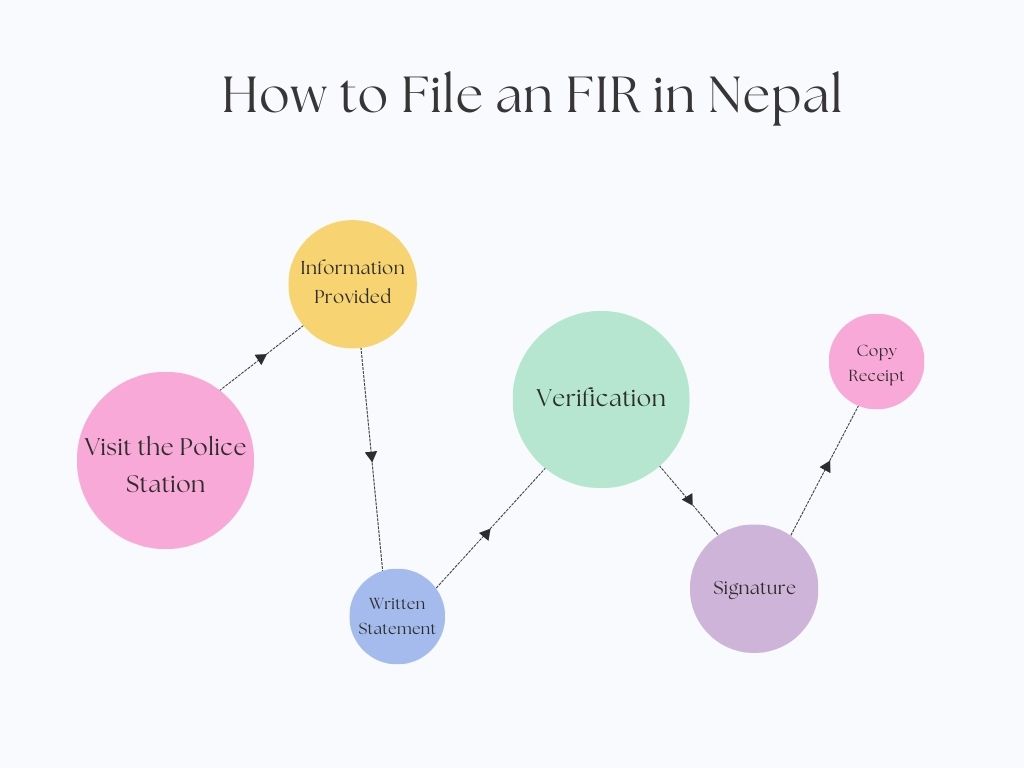
Step-by-Step Guide to FIR Filing
- Visit the Police Station: The nearest police station to the crime scene is approached.
- Information Provided: Details of the event, time, date, and perpetrators are provided.
- Written Statement: The statement is written down by the officer.
- Verification: The information is read back to the informant.
- Signature: The document is signed by the informant and the officer.
- Copy Receipt: A copy of the FIR is mandatorily provided to the informant free of cost.
Note: If an FIR is refused by the police, a complaint can be sent directly to the District Court or the Chief District Officer (CDO).
How to File a Civil Case in Nepal: District Court Procedure Nepal
For civil disputes, the District court procedure Nepal is strictly adhered to. The process is technical and requires precision.
|
Requirement |
Description |
|
Plaint (Mudda) |
The main document containing facts and grounds for the lawsuit. |
|
Written Statement (Jawab) |
The reply submitted by the defendant within 15 days of notice. |
|
Jurisdiction |
The case must be filed where the defendant lives or where the incident occurred. |
|
Court Fee Ticket |
Revenue stamps purchased based on the claim amount. |
|
Verification |
An oath is taken by the plaintiff stating the facts are true. |
Table: Civil Case Filing Requirements
Detailed Process of Court Case Filing in Nepal (Civil)
- Consultation: Although a lawyer is not mandatory for small claims, legal counsel is highly recommended. The plaint is drafted by an advocate.
- Document Preparation: All evidence, contracts, and ID documents are collected.
- Submission: The file is submitted to the "Bhishi Heralne" (Filing Section) of the District Court.
- Diary Number: A diary number is issued by the court administration.
- Registration: If the documents are in order, a case number is assigned.
- Summons: Notice is sent to the defendant by the court.
Which Court Has Jurisdiction in Nepal?
Jurisdiction is the authority of a court to hear a case. In court case filing Nepal, jurisdiction is a critical concept.
Types of Jurisdiction
- Pecuniary Jurisdiction: Based on the monetary value of the dispute. District courts handle higher sums, while local bodies (Judicial Committees) handle smaller amounts (e.g., under 10 Lakhs NPR in some cases).
- Territorial Jurisdiction: The case must be filed in the geographic area where the cause of action arose.
- Subject Matter Jurisdiction: Specific courts handle specific topics (e.g., Family courts for divorce, Labor courts for employment issues).
Failure to file in the correct jurisdiction results in the rejection of the plaint.
Cost of Filing a Case in Nepal: Government Fees
The cost is not fixed; it is determined by the Court Fee Act.
Table: Estimated Court Fees for Filing a Case in Nepal
|
Type of Case |
Estimated Court Fee (Approx.) |
|
Divorce Case |
NPR 2,000 - NPR 5,000 |
|
Property Dispute |
1% to 2% of the property value |
|
Partition Case |
NPR 5,000 - NPR 25,000 |
|
Rent Dispute |
NPR 1,000 - NPR 3,000 |
|
Criminal Complaint |
Nominal (often free for FIR) |
Note: Lawyer fees are separate and vary based on the seniority and experience of the advocate.
How to Draft a Plaint in Nepal (Civil Case)
The Plaint is the backbone of the civil case procedure in Nepal. It must be concise and factual.
Essential Elements of a Plaint
- Name of the Court: The specific District Court is mentioned.
- Parties: Details of the Plaintiff (Petitioner) and Defendant (Respondent) are provided.
- Cause of Action: The reason why the suit is filed is explained.
- Facts: A chronological account of events is presented.
- Relief Sought: The specific remedy requested (e.g., "Divorce be granted" or "Payment of 10 Lakhs be ordered") is stated.
- Signature: The plaint must be signed by the plaintiff or the advocate.
What Documents Are Required for Filing a Case?
Proper documentation is required for successful legal procedure in Nepal.
Checklist: Documents Required
- Citizenship Certificate (Copy of Plaintiff and Defendant).
- Recent Passport-sized photos.
- Evidence (Contracts, Land Ownership Certificates, Receipts).
- Power of Attorney (if represented by a lawyer).
- Marriage Registration Certificate (for family cases).
- Tax Clearance Certificate (for business cases).
Where Can You File a Case in Nepal?
For those residing in the Kathmandu Valley, specific locations are noted. This information is crucial for court case filing Nepal.
- Kathmandu District Court: Located in Babarmahal, Kathmandu. Handles cases within Kathmandu district.
- Lalitpur District Court: Located in Lagankhel, Lalitpur.
- Bhaktapur District Court: Located in Suryabinayak, Bhaktapur.
For criminal cases, the nearest police circle or ward office is the first point of contact for an FIR filing process in Nepal.
Limitation Period for Filing a Case in Nepal
A case cannot be filed after a certain time period has passed. This is known as the Limitation Period.
- Civil Suits: Usually 3 years from the date the right to sue accrues (e.g., 3 years from the date of default on a loan).
- Criminal Complaints: Varies by offense. For serious crimes like murder, there is no limitation period. For minor offenses, it may be 3 months to 1 year.
- Appeals: Usually 35 days for District Court decisions, 45 days for High Court decisions.
If the deadline is missed, the case is dismissed as "time-barred."
What Happens After Judgment? (Appeal Process in Nepal)
Even after a judgment is passed, the legal process may continue. The losing party has the right to appeal.
- District Court to High Court: An appeal is filed against the District Court's verdict.
- High Court to Supreme Court: A writ petition or appeal is filed against the High Court's decision.
The Supreme Court is the court of record and the final interpreter of the law.
What People Ask
To ensure this guide ranks on Google and answers user queries effectively, common questions regarding how to file a case in Nepal are addressed below.
1. Can a case be filed without a lawyer in Nepal?
Yes, a case can be filed without a lawyer. However, legal procedure is complex, and a mistake in the plaint can lead to dismissal. It is advised that an advocate be hired for court case filing Nepal.
2. How long does it take to get a case hearing date?
Usually, the first hearing date is scheduled within 15 to 35 days from the date of registration. However, this varies by the workload of the specific court.
3. What is the difference between a Writ Petition and a Regular Case?
A Writ Petition is filed under Article 133 of the Constitution for fundamental rights violations. A regular case follows the Civil or Criminal Procedure Code. Writs are usually filed at the High Court or Supreme Court.
4. Is online complaint filing available in Nepal?
The government is introducing digital systems, but physical presence is still largely required for evidence submission and hearings in District Courts. Some police departments allow online reporting of minor crimes, but the FIR filing process in Nepal is primarily offline.
5. How much does a lawyer charge in Nepal?
Fees depend on the complexity of the case. Retainers can range from NPR 15,000 to NPR 100,000 or more for senior advocates.
6. What happens if the defendant does not appear in court?
If the defendant does not appear after repeated summons, the court can issue an arrest warrant or conduct the trial ex-parte (in the absence of the defendant).
Conclusion: Your Next Steps
The legal procedure in Nepal is systematic but requires patience and precision. Whether you are engaging in civil case procedure in Nepal or navigating the criminal case procedure in Nepal, preparation is key.
Documents must be gathered, the correct jurisdiction identified, and fees paid.
Call for Action:
If you are unsure about the process or if your legal rights have been violated, do not delay. Contact a qualified legal expert today to ensure your case is filed correctly. Delay can result in the case becoming time-barred. Professional guidance is recommended for all court case filing Nepal matters.
Government sites
For further reading and verification of laws, the following authoritative government and legal resources are referenced.
- Supreme Court of Nepal - The official website for case laws and judgments.
- Nepal Law Commission - Access to the Civil Code and Criminal Code of Nepal.
- Office of the Attorney General Nepal - Government legal opinions and notices.
- District Court Kathmandu - Procedures and notices for Kathmandu district.
- Ministry of Home Affairs Nepal - Information regarding police procedures and security.
- Parliament of Nepal - Official legislative documents and bills.