Key Legislation Governing Fraud in Nepal
Fraud cases in Nepal are governed by multiple legal frameworks. The National Penal Code, 2074 (Muluki Ain) Section 279 addresses general fraud, while specialized laws cover banking and electronic fraud. Victims often feel overwhelmed by the legal process. Therefore, clear guidance is provided below.
Legal Framework for Fraud Cases in Nepal
Fraud is criminalized under several statutes. Understanding these laws is essential before filing any complaint.
Table 1: Fraud Laws and Applicability
|
Legal Act |
Section |
Fraud Type |
Punishment |
|
Muluki Criminal Code 2074 |
279 |
General fraud |
Up to 3 years imprisonment + NPR 30,000 fine |
|
Banking Offence Act 2064 |
4-9 |
Banking fraud |
1-5 years imprisonment + fine (varies by offense) |
|
Electronic Transactions Act 2063 |
44-47 |
Cyber/e-fraud |
Up to 5 years imprisonment + NPR 200,000 fine |
|
Consumer Protection Act 2075 |
50-55 |
Consumer fraud |
Compensation order + up to NPR 50,000 fine |
Note: These provisions are applied based on the nature of the fraudulent activity. Multiple charges can be filed simultaneously if the fraud involves different domains.
Types of Fraud Recognized Under Nepali Law
Different categories of fraud are recognized. Each type follows a slightly different procedural path.
- Property Fraud: False representation in land transactions, fake ownership documents
- Financial Fraud: Banking offenses, loan fraud, unauthorized withdrawals
- Commercial Fraud: Forged contracts, fake business agreements
- Cyber Fraud: Online scams, phishing, identity theft
- Consumer Fraud: Defective products, misleading advertisements
- Insurance Fraud: False claims, manipulated documents
Where to File Fraud Complaint in Nepal
Multiple authorities accept fraud complaints. Selection depends on fraud type and jurisdiction.
Primary Filing Locations for Fraud Cases
Table 2: Complaint Jurisdiction Guide
|
Authority |
Fraud Type Handled |
Location |
Contact |
|
Local Police Station |
General fraud, property fraud |
Nearest station |
100 emergency |
|
Cyber Crime Bureau |
Online fraud, e-fraud |
Bhotahity, Kathmandu |
01-5970021 |
|
Banking Fraud Unit (NRB) |
Banking offenses |
Nepal Rastra Bank, Kathmandu |
01-4411522 |
|
District Court |
Direct complaint (limited cases) |
District headquarters |
Varies by district |
|
CIB Nepal Police |
High-value financial fraud |
Kathmandu |
01-4411520 |
Important: For most fraud cases, the nearest police station is the starting point. Cases are transferred to specialized units after initial registration.
Step-by-Step Process: How to File Fraud Case in Nepal
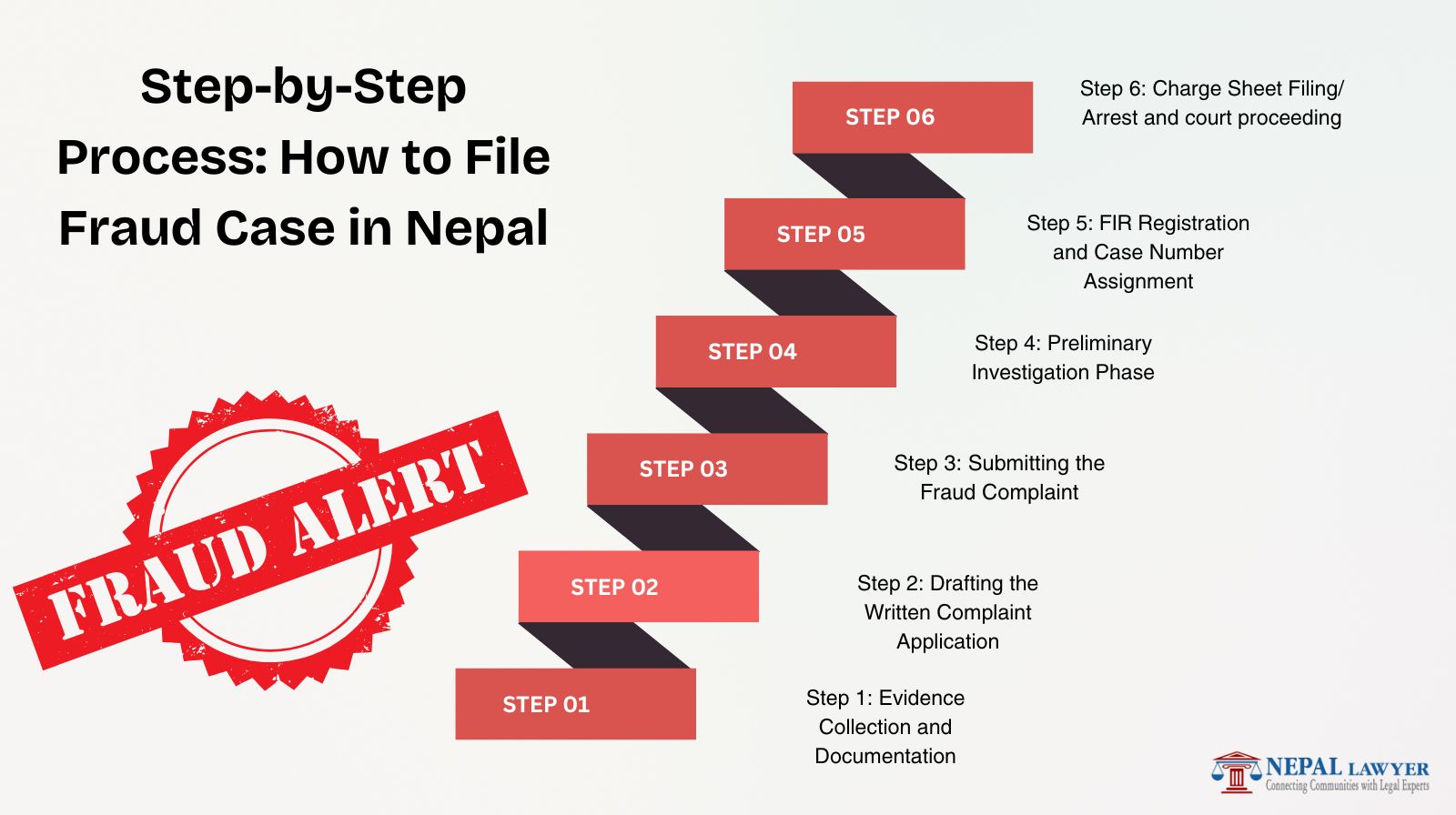
Step 1: Evidence Collection and Documentation
Before approaching authorities, comprehensive evidence must be compiled. Documentary evidence forms the foundation of fraud prosecution.
Required Evidence Checklist:
- Original transaction documents
- Communication records (SMS, email, chat screenshots with timestamps)
- Bank statements and payment receipts
- Witness statements (if available)
- Audio/video recordings (legally obtained)
- Property ownership papers (for property fraud)
- Contract agreements and invoices
- Complainant's citizenship certificate
Digital Evidence Requirements:
Screenshots without metadata are often rejected. Therefore, original devices should be preserved. Email headers must be visible. Call logs should show phone numbers and timestamps.
Step 2: Drafting the Written Complaint Application
A formal written complaint must be prepared. The application should be written in Nepali or English.
Table 3: Complaint Application Components
|
Section |
Required Information |
Details |
|
Complainant Details |
Full name, citizenship number, address, contact |
Must match official ID |
|
Incident Description |
Date, time, location, sequence of events |
Chronological order preferred |
|
Fraud Type |
Specific legal sections violated |
Refer to Table 1 |
|
Accused Information |
Name, address, contact (if known) |
"Unknown" is acceptable |
|
Financial Loss |
Exact amount defrauded |
Attach proof |
|
Evidence List |
Inventory of attached documents |
Number each item |
|
Relief Sought |
Investigation, arrest, recovery |
Be specific |
Sample Structure:
- Introduction (who you are)
- Background (relationship with accused, if any)
- Incident details (what happened, when, how)
- Discovery of fraud (when you realized)
- Evidence summary (what proof you have)
- Request for action (what you want police to do)
Step 3: Submitting the Fraud Complaint
Two primary submission methods are available. Both are equally valid.
Method A: Police Station Submission
- Visit nearest police station during working hours (10 AM - 5 PM)
- Request complaint registration form (FIR form)
- Submit hand-written complaint with all evidence
- Obtain acknowledgment receipt with reference number
- Note investigating officer's name and contact
Method B: Cyber Bureau Online Submission (for cyber fraud)
- Visit www.cyberbureau.gov.np
- Click "File a Complaint" section
- Fill digital form with incident details
- Upload scanned documents (PDF format, max 10MB)
- Submit and save acknowledgment number
- Expect contact within 3-5 working days
Step 4: Preliminary Investigation Phase
Police conduct initial verification within 7-15 days. This includes:
- Authenticity check of submitted documents
- Preliminary suspect identification
- Bank record verification (for financial fraud)
- Property record check (for property fraud)
- Complainant statement recording (official statement)
Critical Note: Approximately 40% of fraud complaints are rejected at this stage due to insufficient evidence. Therefore, forensic preservation of original documents is essential.
Step 5: FIR Registration and Case Number Assignment
Upon finding prima facie evidence, police register the First Information Report (FIR) under relevant sections. The FIR number serves as official case identification.
Table 4: Common FIR Sections for Fraud Cases
|
Fraud Type |
Primary Section |
Secondary Section |
Case Category |
|
General fraud |
Muluki Criminal Code 279 |
- |
Public offense |
|
Bank fraud |
Banking Offence Act 4 |
Muluki Criminal Code 279 |
Financial crime |
|
Cyber fraud |
Electronic Transactions Act 44 |
Muluki Criminal Code 279 |
Cybercrime |
|
Property fraud |
Muluki Criminal Code 279 |
Land Act sections |
Property crime |
Step 6: Detailed Investigation Process
After FIR registration, investigation is conducted by specialized units.
Investigation Timeline:
- Day 1-7: Suspect identification and location tracing
- Day 8-30: Evidence collection, bank record seizure, witness statements
- Day 31-60: Expert opinion (document authenticity, handwriting expert)
- Day 61-90: Final investigation report preparation
Investigation Powers:
Police can:
- Issue summons for accused appearance
- Request bank transaction details (suspicious transaction reports)
- Seize property and documents (with court warrant)
- Arrest suspects (with court warrant)
- Request mutual legal assistance (for cross-border fraud)
Step 7: Charge Sheet Filing
Upon investigation completion, the case is forwarded to the District Government Attorney. The attorney reviews evidence and files a charge sheet in court within 15-30 days.
Charge Sheet Contents:
- Case summary
- Accused details
- Legal sections applied
- Witness list
- Evidence inventory
- Investigation findings
Step 8: Court Trial Process
After charge sheet filing, court proceedings begin.
Table 5: Court Procedure Timeline
|
Stage |
Duration |
Activity |
|
Initial hearing |
Day 1-7 |
Charge reading, bail application |
|
Evidence presentation |
Day 8-45 |
Prosecution evidence submission |
|
Defense evidence |
Day 46-75 |
Accused evidence submission |
|
Final arguments |
Day 76-90 |
Both sides arguments |
|
Judgment |
Day 91-120 |
Verdict and sentencing |
Note: Complex fraud cases may take 9-18 months for final judgment.
Required Documents for Fraud Complaint in Nepal
Comprehensive documentation is mandatory. Missing documents cause delays or rejection.
Table 6: Complete Document Checklist
|
Document |
Purpose |
Source |
Mandatory |
|
Citizenship certificate |
Identity verification |
Ward office |
Yes |
|
Passport (foreigners) |
ID for non-Nepali |
Immigration |
Yes (for foreigners) |
|
Complaint application |
Formal request |
Self-prepared |
Yes |
|
Original contracts/agreements |
Proof of transaction |
Parties involved |
Yes (if applicable) |
|
Bank statements |
Financial proof |
Bank |
Yes (for financial fraud) |
|
Property ownership papers |
Ownership evidence |
Land revenue office |
Yes (for property fraud) |
|
Communication records |
Intent/discovery proof |
Phone/email |
Highly recommended |
|
Witness statements |
Supporting evidence |
Witnesses |
Recommended |
|
Medical reports (if applicable) |
Damage proof |
Hospital |
For fraud causing injury |
|
Power of attorney (if represented) |
Legal representation |
Court/notary |
If using lawyer |
Important: All documents must be self-attested. Photocopies should be clear and legible. Originals must be available for verification.
Timeline for Fraud Case Resolution in Nepal
Understanding realistic timelines helps manage expectations. Fraud cases take considerable time due to investigation complexity.
Table 7: Typical Case Duration
|
Case Complexity |
Investigation |
Trial |
Total Duration |
|
Simple fraud (clear evidence) |
30-45 days |
3-6 months |
4-8 months |
|
Moderate fraud (some investigation needed) |
60-90 days |
6-12 months |
8-15 months |
|
Complex fraud (multiple suspects, jurisdictions) |
90-180 days |
12-24 months |
15-30 months |
|
Banking/corporate fraud (high-value) |
180-365 days |
18-36 months |
2-4 years |
Factors Affecting Timeline:
- Evidence quality and availability
- Suspect cooperation
- Witness availability
- Court backlog
- Need for expert opinions
- International cooperation requirements
Fraud Case Investigation Process: Detailed Breakdown
Phase 1: Initial Verification (Days 1-15)
During this phase, basic facts are verified. Police check:
- Complainant credential authenticity
- Document genuineness (preliminary check)
- Whether an offense is made out
- Jurisdiction determination
Phase 2: Evidence Collection (Days 16-45)
Intensive evidence gathering occurs:
- Bank record requisition (Suspicious Transaction Reports from Financial Intelligence Unit)
- Digital device analysis (if cyber fraud)
- Property record verification (if property fraud)
- Witness examination
- Expert consultation (handwriting, document authenticity)
Phase 3: Suspect Handling (Days 46-75)
- Summons issuance for accused appearance
- Interrogation at police station
- Arrest (if warrant obtained from court)
- Remand request for extended custody
- Statement recording
Phase 4: Report Preparation (Days 76-90)
- Investigation report drafting
- Evidence compilation
- Charge sheet preparation
- Forwarding to District Attorney
Rights of Complainants in Fraud Cases
Legal rights are protected under the Criminal Procedure Code, 2074.
Table 8: Complainant Rights
|
Right |
Description |
How to Exercise |
|
Right to information |
Status updates every 15 days |
Request in writing |
|
Right to protection |
Protection from accused intimidation |
Request police protection |
|
Right to legal representation |
Hire lawyer anytime |
Through Nepal Bar Association |
|
Right to compensation |
Restoration of losses |
File separate civil claim |
|
Right to appeal |
Challenge police inaction |
File petition in District Court |
|
Right to evidence submission |
Provide additional proof |
Submit to investigating officer |
Victim Protection: In high-value fraud cases, witness protection may be provided. Requests should be made to the Superintendent of Police.
Costs and Fees for Filing Fraud Case in Nepal
Fraud case filing has minimal government fees. However, associated costs exist.
Table 9: Cost Breakdown
|
Item |
Amount (NPR) |
Paid To |
|
Police complaint registration |
Free |
Nepal Police |
|
Court registration fee |
500-2,000 |
District Court |
|
Document attestation |
50-200 per document |
Notary/Ward office |
|
Lawyer fees (if hired) |
15,000-100,000+ |
Law firm/lawyer |
|
Expert opinion (if needed) |
5,000-25,000 |
Government lab/private expert |
|
Property valuation (if applicable) |
2,000-10,000 |
Land revenue office |
Note: Government fees are nominal. Primary costs are legal representation and expert opinions.
Fraud Case Punishment and Penalties in Nepal
Punishment depends on fraud type, amount, and severity. Sentencing guidelines are prescribed by respective laws.
Table 10: Punishment Framework
|
Fraud Category |
Imprisonment |
Fine |
Additional Penalties |
|
General fraud (Section 279) |
Up to 3 years |
Up to NPR 30,000 |
Property return to victim |
|
Bank fraud (Banking Offence Act) |
1-5 years |
NPR 50,000-500,000 |
License cancellation (for institutions) |
|
Cyber fraud (ETA 2063) |
Up to 5 years |
Up to NPR 200,000 |
Ban from electronic transactions |
|
Document fraud (Section 276) |
5-10 years |
NPR 50,000-100,000 |
Additional fine equal to gain |
|
Consumer fraud (CPA 2075) |
Up to 1 year |
Up to NPR 50,000 |
Compensation order |
Aggravating Factors:
- Fraud amount exceeding NPR 1 million
- Multiple victims
- Abuse of position/trust
- Cross-border elements
- Organized crime involvement
Mitigating Factors:
- First offense
- Voluntary restitution
- Guilty plea
- Cooperation with investigation
Appeal Process for Fraud Cases in Nepal
Both parties have appeal rights. The process is governed by the Criminal Procedure Code, 2074.
First Appeal: High Court (Patan High Court)
Timeline: Within 35 days of District Court judgment
Grounds:
- Legal interpretation error
- Procedural irregularity affecting outcome
- Insufficient evidence consideration
- Excessive punishment
Process:
- Appeal petition filing through prison authority (if convicted) or directly
- Case record transmission from District Court
- Hearing notice to opposite party
- Arguments presentation
- Judgment within 6-12 months
Second Appeal: Supreme Court
Timeline: Within 30 days of High Court judgment (only on constitutional/legal questions)
Grounds:
- Fundamental rights violation
- Substantial question of law
- Precedent-setting issues
Note: Supreme Court appeal is not automatic. Leave must be granted.
Revision Petition
Within 90 days of judgment, revision can be filed in the same court for:
- Clerical errors
- Mistakes apparent on record
- Newly discovered evidence
Special Considerations for Different Fraud Types
Banking Fraud Cases
Unique Requirements:
- Bank's internal investigation report must be obtained
- Nepal Rastra Bank notification is mandatory
- Financial Intelligence Unit (FIU) report is often required
- Professional audit may be needed for complex cases
Reporting Authority: Banking Offence Unit, Nepal Rastra Bank (in addition to police)
Property Fraud Cases
Unique Requirements:
- Land ownership verification from Land Revenue Office
- Survey department certificate (for land boundary disputes)
- Mutation record examination
- Previous transaction history review
Jurisdiction: Property location determines police station jurisdiction
Online Fraud/Cyber Fraud Cases
Unique Requirements:
- Digital evidence preservation is critical
- Platform data must be requested quickly (data retention policies)
- IP address tracing is time-sensitive
- International cooperation may be needed
- ETA 2063 sections must be specifically invoked
Report Immediately: Digital evidence disappears quickly. Screenshots are insufficient; original devices/data must be preserved.
How to Choose Legal Representation for Fraud Cases in Nepal
While lawyers are not mandatory for complaint filing, representation is recommended for complex cases.
Table 11: Lawyer Selection Criteria
|
Factor |
What to Look For |
Verification Method |
|
Specialization |
Criminal law, banking law, cyber law |
Nepal Bar Association profile |
|
Experience |
5+ years in fraud cases |
Case history, client references |
|
Success rate |
Track record of favorable outcomes |
Ask for anonymized case results |
|
Location |
Familiarity with local courts |
Local Bar registration |
|
Fees |
Transparent, reasonable pricing |
Written fee agreement |
|
Availability |
Prompt communication, accessibility |
Initial consultation assessment |
Nepal Lawyer Recommendation: For fastest service across Kathmandu, Pokhara, Biratnagar, and major cities, Nepal Lawyer provides specialized fraud case handling with proven track records.
Frequently Asked Questions (FAQs) About Fraud Cases in Nepal
|
Question |
Answer |
Legal Basis |
|
What is the first step after discovering fraud? |
Immediate evidence preservation. Take screenshots, secure documents, and contact authorities within 24-48 hours. |
Criminal Procedure Code, 2074 |
|
Can fraud cases be filed online in Nepal? |
Yes, for cyber fraud via cyberbureau.gov.np. General fraud complaints require physical police station visits. |
Electronic Transactions Act, 2063 |
|
How long does fraud investigation take? |
30-90 days for simple cases; 6+ months for complex cases involving multiple jurisdictions. |
Police investigation rules |
|
What if the fraudster is in another country? |
International cooperation through INTERPOL and MLAT can be requested. Investigation may take 1-2 years. |
Mutual Legal Assistance Act |
|
Is there a time limit to file fraud complaint? |
Generally, within one year of discovery for most frauds. Some banking frauds have 6-month limitation periods. |
Limitation Act, 2024 |
|
Do I need to hire a lawyer immediately? |
Not mandatory but recommended within the first week to ensure proper evidence collection and statement drafting. |
Legal Practice Act, 2070 |
|
Can fraud cases be settled out of court? |
Yes, but only before charge sheet filing. After court involvement, settlement requires court approval. |
Criminal Procedure Code, 2074 |
|
What percentage of fraud cases result in conviction? |
Approximately 35-40% conviction rate, depending on evidence quality and investigation thoroughness. |
Supreme Court annual report |
|
Can companies file fraud complaints? |
Yes, companies can file through authorized representatives. Board resolution and authorization letter required. |
Company Act, 2063 |
|
Are fraud victims entitled to compensation? |
Yes, separate civil claim can be filed. Criminal courts can also order restitution. |
Civil Procedure Code, 2074 |
|
What if police refuse to register FIR? |
Written refusal can be appealed to District Superintendent of Police or directly to District Court via petition. |
Criminal Procedure Code, 2074 |
|
Can fraud charges be dropped after settlement? |
Before charge sheet filing, yes. After filing, only prosecution can withdraw with court permission. |
Prosecutorial discretion rules |
|
How to track fraud case status? |
Use complaint reference number at police station or court. Online tracking available for cyber bureau cases. |
Right to Information Act |
|
What is the punishment for attempting fraud? |
Attempted fraud carries half the punishment of completed fraud under Section 279. |
Muluki Criminal Code, 2074 |
|
Can I file fraud case without original documents? |
Yes, but success probability drops significantly. Secondary evidence rules apply. |
Evidence Act, 2031 |
Common Mistakes to Avoid When Filing Fraud Case in Nepal
- Delay in Reporting: Cases become weaker as evidence disappears. Report within 24-72 hours if possible.
- Incomplete Documentation: Missing bank statements or communication records cause rejection.
- Altered Evidence: Never edit screenshots or documents. Original evidence is crucial.
- No Backup Copies: Always keep duplicate document sets. Police may retain originals.
- Direct Accusation: Let police conduct investigation. Direct confrontation may alert suspect.
- Ignoring Legal Advice: Free consultation is available. Use Legal Aid Committee if eligible.
- Unrealistic Expectations: Fraud cases take months/years. Quick resolution is rare.
- Using Unofficial Channels: Always go through official police/court channels. Middlemen complicate matters.
City-Specific Filing Information
Kathmandu Valley
- Cyber Bureau: Bhotahity, Kathmandu (for online fraud)
- Specialized Units: Banking Offence Unit (Babarmahal), CIB (Maharajgunj)
- District Courts: Kathmandu, Lalitpur, Bhaktapur
Pokhara (Gandaki Province)
- District Police: Kaski District Police Office
- Economic Offence Unit: Available at provincial level
- District Court: Pokhara Bench
Biratnagar (Province 1)
- Regional Police: Province 1 Police Headquarters
- District Court: Morang District Court
Major Cities
Nepal Lawyer provides services in:
- Kathmandu, Pokhara, Biratnagar, Birgunj, Nepalgunj, Butwal, Dharan, Hetauda
- Same procedure applies; local jurisdiction rules must be followed
Call to Action: Get Expert Legal Assistance
Fraud cases require immediate professional action. Nepal Lawyer offers:
- 24-hour emergency consultation for fraud victims
- Same-day complaint drafting and filing assistance
- Expert coordination with Cyber Bureau, CIB, and banking authorities
- Pan-Nepal service covering all major cities
- Proven track record with 500+ successful fraud cases
Contact Nepal Lawyer Today:
- Phone: 01-5970021 (Kathmandu)
- Email: [email protected]
- Website: www.nepallawyer.com/fraud-case-nepal
- Emergency Hotline: 9801884499 (24/7)
Free Initial Consultation Available. Legal aid assistance provided for eligible victims.
References
Primary Legal Sources:
Government Authorities:
International Standards:
Legal Research:
Related Case Studies:
Disclaimer: This legal guide is for informational purposes only. It does not constitute legal advice. Professional consultation is recommended for individual cases. Legal provisions are subject to amendment. Verify current laws before proceeding.
Confidentiality Notice: Information herein is protected under legal professional privilege where applicable. Unauthorized reproduction is prohibited.