
Overview of M&A Landscape in Nepal
Mergers and acquisitions in Nepal have been increasingly utilized as strategic tools for corporate restructuring and business expansion. The M&A process in Nepal is governed by comprehensive legal frameworks designed to ensure transparency, protect stakeholder interests, and maintain economic stability during corporate consolidation. Understanding how mergers work in Nepal requires familiarity with multiple regulatory layers, from the Companies Act 2063 to sector-specific bylaws.
The corporate consolidation Nepal landscape has evolved significantly, particularly in Kathmandu, where major business decisions are centralized. Companies seeking to expand operations, achieve economies of scale, or enter new markets frequently pursue merger acquisition Nepal strategies. However, success depends on navigating complex regulatory requirements and obtaining approvals from various government bodies.
Legal Framework Governing M&A in Nepal
Primary Legislation for Corporate Consolidation
The M&A process in Nepal is primarily regulated under several key statutes:
Companies Act, 2063 (2006) forms the foundation of all merger acquisition Nepal transactions. Section 177 specifically outlines procedures for mergers, shareholder approvals, and asset transfers. This Act applies universally across all company types operating in Nepal.
Merger Bylaws, 2068 and Acquisition Bylaws, 2070 provide detailed procedural guidelines. These bylaws were further consolidated under the Merger and Acquisition Bylaws, 2073, which establishes unified standards for valuation, documentation, and regulatory compliance.
Bank and Financial Institutions Act (BAFIA), 2073 is crucial for M&A in Nepal's financial sector. Nepal Rastra Bank actively encourages consolidation among banks and financial institutions to strengthen systemic stability.
Securities Act, 2063 regulates transactions involving publicly listed companies. The Securities Board of Nepal (SEBON) exercises oversight to ensure fair disclosure and prevent insider trading during corporate consolidation Nepal activities.
Foreign Investment and Technology Transfer Act (FITTA), 2075 governs cross-border merger acquisition Nepal transactions. Foreign investors must obtain approval from the Department of Industry or Investment Board Nepal before proceeding.
Competition Promotion and Market Protection Act, 2063 prevents anti-competitive practices. The Competition Commission reviews M&A proposals to ensure market dominance is not created.
Income Tax Act, 2058 addresses tax implications, including capital gains tax and deferred tax liabilities during corporate restructuring.
Types of Mergers and Acquisitions in Nepal
Statutory Merger
Two or more companies combine into a single entity under the M&A process in Nepal. The surviving company assumes all assets and liabilities, while dissolved entities cease to exist. This is the most common form of corporate consolidation Nepal practice.
Share Acquisition
Controlling interest (typically over 51%) is acquired without dissolving the target company. This method is frequently used by investors seeking to enter Nepal's market quickly.
Asset Acquisition
Specific assets and liabilities are purchased, allowing buyers to select desirable components while avoiding unwanted obligations. This approach is preferred for targeted business expansion.
Horizontal, Vertical, and Conglomerate Mergers
Horizontal mergers involve companies in the same industry, commonly seen in Kathmandu-based banking sector consolidation. Vertical mergers combine different stages of production or supply chains. Conglomerate mergers involve unrelated industries for diversification purposes.
Step-by-Step M&A Process in Nepal
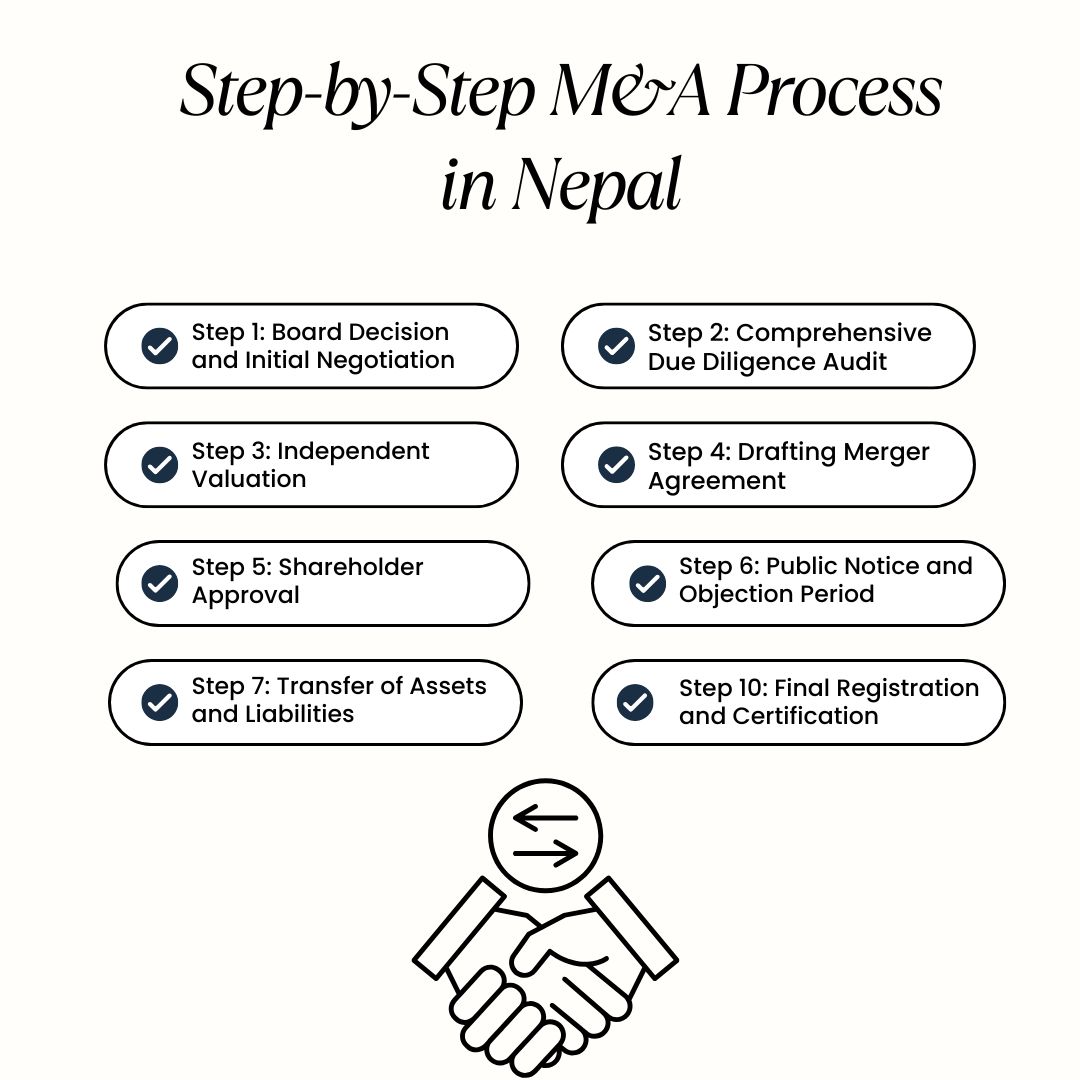
Step 1: Board Decision and Initial Negotiation
The M&A process in Nepal commences when boards of directors approve the proposal in principle. Companies sign a Memorandum of Understanding (MoU) outlining basic terms, transaction structure, and confidentiality obligations. Preliminary due diligence is often conducted to assess feasibility.
Step 2: Comprehensive Due Diligence Audit
A thorough Due Diligence Audit (DDA) is mandatory under Nepal corporate law. This independent audit examines:
- Financial statements and tax compliance records
- Assets and liabilities valuation
- Legal contracts and litigation history
- Regulatory compliance status
- Human resources and employee benefits
- Intellectual property rights
- Loan facilities and banking arrangements
In Kathmandu, professional advisory firms specializing in merger acquisition Nepal transactions typically conduct this phase, which may take 4-8 weeks depending on company complexity.
Step 3: Independent Valuation
Companies must be valued by independent experts approved by regulatory bodies. Common valuation methods include:
- Net asset value approach
- Market value comparison
- Discounted cash flow analysis
- Earnings multiple methodology
For banks and financial institutions, Nepal Rastra Bank provides specific valuation guidelines that must be followed during corporate consolidation Nepal processes.
Step 4: Drafting Merger Agreement
The Merger Agreement is prepared as a formal contract detailing:
- Share swap ratios and consideration structure
- Post-merger governance framework
- Employee retention and severance terms
- Asset and liability transfer mechanisms
- Conditions precedent and warranties
- Effective date of transaction
Legal firms in Kathmandu specializing in M&A process in Nepal ensure agreements comply with all statutory requirements.
Step 5: Shareholder Approval
Special resolutions must be passed by at least 75% of shareholders present at general meetings of each company. This requirement is strictly enforced under Section 177 of the Companies Act. Notice must be provided to all shareholders at least 21 days before the meeting.
Step 6: Public Notice and Objection Period
Under Section 178, public notice must be published in national daily newspapers. Stakeholders have 35 days to submit objections to the Office of Company Registrar (OCR) in Kathmandu. This transparency requirement ensures protection of creditor and minority shareholder rights.
Step 7: Regulatory Approvals
Multiple approvals are required depending on company type:
Office of Company Registrar (OCR): All M&A applications must be submitted within 30 days of shareholder approval. OCR reviews documentation and typically decides within three months.
Nepal Rastra Bank: Mandatory for banking and financial institution mergers. NRB assesses capital adequacy, fit-and-proper tests for directors, and systemic impact.
Securities Board of Nepal (SEBON): Required for listed companies. SEBON evaluates disclosure compliance, share swap fairness, and minority shareholder protection.
Competition Commission: Reviews market concentration effects. Approval is needed if combined market share exceeds thresholds.
Department of Industry: Required for foreign investment under FITTA. Approval must be obtained within 7 days for complete applications.
Investment Board Nepal: For large-scale foreign investments exceeding specified thresholds.
Step 8: Transfer of Assets and Liabilities
Upon receiving all approvals, legal transfer of assets, liabilities, and shareholdings is executed. The surviving company updates its records with OCR and other regulatory bodies. Bank accounts, tax registrations, and licenses are transferred accordingly.
Step 9: Final Registration and Certification
OCR issues a Certificate of Merger or acquisition completion. The merged entity obtains updated company registration certificates reflecting new capital structure and shareholding patterns.
Step 10: Post-Merger Integration
Critical for realizing synergies, this phase includes:
- IT system harmonization
- HR restructuring and culture alignment
- Brand consolidation
- Operational process standardization
- Compliance and reporting framework unification
Integration planning should begin early, as post-merger challenges often determine transaction success in Nepal's business environment.
Timeline Expectations for M&A Completion
The M&A process in Nepal typically requires 6 to 18 months for completion. Simpler transactions between private companies may conclude within 4-6 months, while complex cross-border deals or regulated sector mergers can extend beyond 18 months.
Standard timeline breakdown:
- Due diligence: 6-10 weeks
- Valuation and agreement drafting: 4-6 weeks
- Shareholder meetings and approvals: 4-8 weeks
- Public notice period: 5 weeks
- Regulatory approvals: 8-16 weeks
- Closing and integration: 4-8 weeks
Banking sector mergers are often faster due to Nepal Rastra Bank's streamlined procedures, whereas first-time foreign investors may experience longer timelines due to FITTA compliance requirements.
Tax Considerations in Nepal M&A
Capital Gains Tax
Significant tax implications arise during merger acquisition Nepal transactions. Under Section 57 of the Income Tax Act, a "deemed disposal" occurs if 50% or more ownership changes within three consecutive years. This triggers capital gains tax at market value.
Tax rates vary based on:
- Shareholder residency status (resident vs. non-resident)
- Share type (listed vs. unlisted)
- Holding period
Tax Relief Provisions
Sections 45 and 46 provide tax neutrality for legitimate business reorganizations, including mergers and share swaps. However, these reliefs are denied if Section 57 thresholds are breached. Careful structuring is essential to maintain continuity of ownership.
Stamp Duty and Transfer Taxes
Asset transfers attract stamp duty (typically 0.5-5% depending on asset type). Share transfers listed on NEPSE may have different treatment. Tax clearance certificates from Inland Revenue Department are mandatory before OCR approval.
Double Taxation Avoidance Agreements
Nepal has DTAAs with several countries. Treaty benefits may be denied if beneficial ownership conditions aren't satisfied, affecting cross-border merger acquisition Nepal structures.
Foreign Investment in Nepal M&A
FITTA Compliance Requirements
Foreign investors must follow specific procedures under FITTA:
- Application to Department of Industry or Investment Board Nepal
- Obtain approval letter within 7 days (for complete applications)
- Incorporate company under Companies Act 2063
- Register with Inland Revenue Department for PAN
- Notify Nepal Rastra Bank of investment source
- Remit funds through authorized banking channels
Sectoral Restrictions
Certain sectors are restricted or require special approvals:
- Media and broadcasting: foreign investment capped
- Retail business: generally prohibited for foreign investors
- Financial services: requires NRB approval
- Aviation: special licensing required
Repatriation Rights
Foreign investors can repatriate profits and capital after meeting tax obligations and obtaining NRB approval. Proper documentation of initial investment is critical for smooth repatriation.
Challenges and Best Practices
Common Challenges
Regulatory Delays: Despite statutory timelines, regulatory bodies in Kathmandu may require additional documentation, causing delays. Proactive engagement and complete application submission mitigate this risk.
Valuation Disputes: Independent valuations may differ from management expectations. Early involvement of approved valuers is recommended.
Tax Clearance Issues: Inland Revenue Department scrutiny of historical tax compliance can delay transactions. Pre-emptive tax audits are advisable.
Cultural Integration: Post-merger integration often fails due to cultural mismatches, especially in cross-border deals. Dedicated change management teams should be established.
Best Practices
- Early Regulatory Engagement: Pre-consultation with OCR, NRB, and SEBON helps identify potential issues.
- Complete Documentation: All filings must be comprehensive to avoid rejection.
- Local Legal Counsel: Experienced Kathmandu-based law firms familiar with M&A process in Nepal navigate complexities effectively.
- Phased Approvals: For complex deals, seek conceptual approval before detailed documentation.
- Stakeholder Communication: Transparent communication with employees, customers, and suppliers maintains business continuity.
Case Study: Kathmandu Bank Merger Success
In 2023, two Kathmandu-based commercial banks underwent successful corporate consolidation Nepal. The merger was driven by Nepal Rastra Bank's capital adequacy requirements and competitive pressures.
Transaction Overview:
- Combined assets: NPR 120 billion
- Timeline: 11 months from board decision to completion
- Regulatory approvals: NRB, OCR, SEBON
- Share swap ratio: 1:1.25 (based on independent valuation)
Key Success Factors:
- Early NRB Engagement: Preliminary discussions with Nepal Rastra Bank occurred 6 months before formal application
- Comprehensive Due Diligence: A 10-week audit covered all branches in Kathmandu, Pokhara, and Biratnagar
- Employee Retention: 95% of staff were retained through clear communication and retention bonuses
- IT Integration: Core banking systems were harmonized within 4 months post-closing
- Brand Consolidation: New brand identity was launched simultaneously across all branches
Challenges Overcome:
- Regulatory approval took 14 weeks (vs. standard 8 weeks) due to additional NRB queries
- Minority shareholders objected initially, requiring additional negotiations
- Integration of different corporate cultures required third-party HR consultants
This case demonstrates how proper planning and regulatory engagement can facilitate successful merger acquisition Nepal transactions even in highly regulated sectors.
Frequently Asked Questions
How do mergers work in Nepal?
Mergers in Nepal require board approval, due diligence, independent valuation, shareholder resolution (75% majority), public notice, regulatory approvals from OCR and sectoral regulators, and final registration. The process typically takes 6-18 months.
What are the legal requirements for M&A in Nepal?
Key legal requirements include Companies Act 2063 compliance, special shareholder resolution, public notice under Section 178, regulatory approvals (OCR, NRB, SEBON as applicable), independent valuation, and tax clearance.
What is the M&A timeline in Nepal?
Standard timeline is 6-18 months: due diligence (6-10 weeks), shareholder approval (4-8 weeks), public notice (5 weeks), regulatory approvals (8-16 weeks), and closing/integration (4-8 weeks). Banking sector deals may be faster.
Which regulatory bodies approve M&A in Nepal?
Office of Company Registrar (all transactions), Nepal Rastra Bank (banks/financial institutions), SEBON (listed companies), Competition Commission (market concentration), Department of Industry (foreign investment), and Investment Board Nepal (large FDI).
What taxes apply to M&A transactions in Nepal?
Capital gains tax under Income Tax Act Section 57, stamp duty on asset transfers, and potential deemed disposal tax if 50%+ ownership changes within 3 years. Tax relief available under Sections 45-46 for qualifying reorganizations.
Can foreign companies acquire Nepali businesses?
Yes, under FITTA 2019. Foreign investors must obtain approval from Department of Industry or Investment Board Nepal, register a company, and comply with sectoral restrictions. Repatriation requires NRB approval.
What is the role of Nepal Rastra Bank in M&A?
NRB regulates all banking and financial institution mergers, sets capital adequacy requirements, conducts fit-and-proper tests for directors, and ensures systemic stability. NRB approval is mandatory for BFI transactions.
How are companies valued in Nepal M&A?
Independent valuation by approved experts using net asset value, market comparison, discounted cash flow, or earnings multiple methods. NRB provides specific guidelines for banks and financial institutions.
What happens to employees after a merger in Nepal?
Employee rights are protected under labor laws and merger agreements. Typically, most employees are retained with harmonized terms. Severance packages are provided for redundant positions. Post-merger integration includes cultural alignment.
What documents are required for M&A approval?
Key documents include board resolutions, special shareholder resolution, merger agreement, independent valuation report, due diligence report, audited financial statements, creditor consents, amended memorandum/articles of association, and tax clearance certificate.
Conclusion: Expert Guidance for Nepal M&A Success
The M&A process in Nepal presents significant opportunities for business growth and market expansion, but requires meticulous navigation of complex legal and regulatory frameworks. Successful corporate consolidation Nepal transactions depend on early planning, comprehensive due diligence, proactive regulatory engagement, and expert legal guidance.
For businesses considering merger acquisition Nepal strategies, engaging experienced Kathmandu-based corporate law firms is essential. Professional advisors familiar with local regulatory bodies—including OCR, NRB, and SEBON—can streamline approvals, minimize delays, and ensure compliance.
Call to Action:
Are you planning an M&A transaction in Nepal? Our Kathmandu-based corporate advisory team specializes in guiding businesses through every stage of the merger acquisition Nepal process. From initial due diligence to final registration and post-merger integration, we provide end-to-end legal and regulatory support. Contact us today for a confidential consultation and discover how our expertise can help your business achieve successful corporate consolidation Nepal outcomes.
Disclaimer: This guide is for informational purposes only and does not constitute legal advice. Specific M&A transactions require customized legal consultation based on individual circumstances.