-medium.webp)
Mutual Divorce Process in Nepal | Expert Divorce lawyer in Nepal | Female Divorce lawyer in Nepal
The Mutual Divorce process in Nepal is governed by the National Civil Code, 2017 (Muluki Civil Code). When a marriage is no longer sustainable, and both spouses agree to separate, this legal pathway is chosen. Unlike contested divorce, this process is often faster, less expensive, and less emotionally draining. However, specific legal procedures must be followed strictly.
In Nepal, divorce is considered a last resort. Therefore, the law ensures that the decision to separate is made with full consent and understanding. This guide provides a detailed breakdown of how mutual divorce in Nepal is initiated, the required documentation, court fees, and the timeline involved.
New Divorce law in Nepal 2026 Legal Framework for Mutual Divorce in Nepal
The Mutual Divorce process in Nepal is primarily regulated by the National Civil Code, 2017. Specifically, Section 70 of the Code outlines the provisions for divorce by mutual consent. According to the law, a marriage can be dissolved if both husband and wife file a joint application at the District Court.
Furthermore, the Civil Procedure Code dictates the procedural aspects. It is mandated that a cooling-off period is observed to ensure that the decision for divorce by mutual consent in Nepal is not impulsive. During this period, the court may attempt reconciliation, though this is often brief if the consent is firm.
Why Mutual Divorce is Preferred
Compared to contested litigation, mutual divorce in Nepal offers several advantages:
- Time Efficiency: The case is resolved faster than contested battles.
- Cost Effectiveness: Legal fees and court costs are reduced.
- Privacy: Sensitive details are not aired in public hearings as extensively.
- Control: Spouses retain control over terms like alimony and child custody.
Step-by-Step Mutual Divorce Process in Nepal
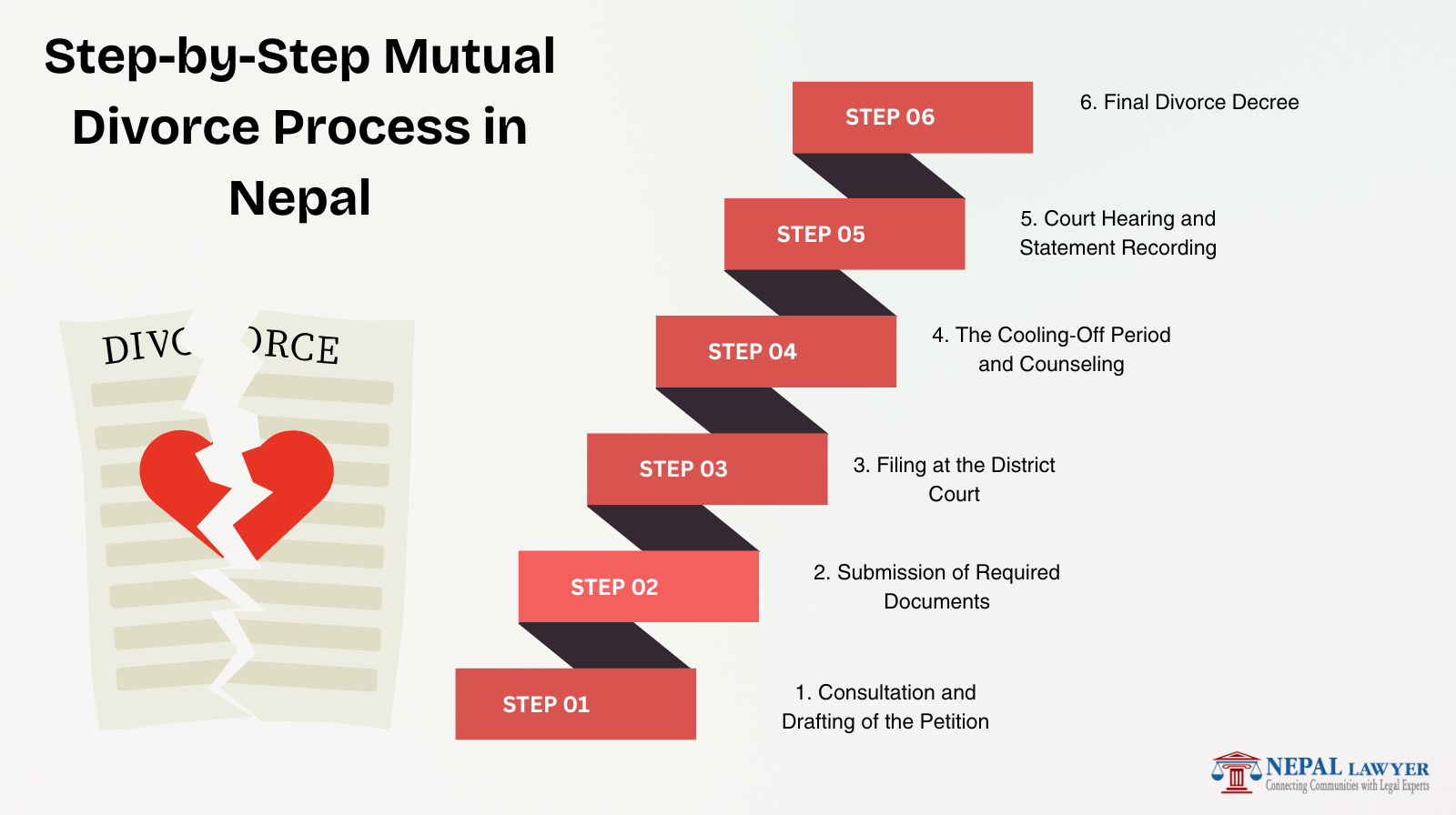
To successfully navigate the Mutual Divorce process in Nepal, the following sequential steps must be adhered to. Failure to comply with these steps can result in the rejection of the petition.
1. Consultation and Drafting of the Petition
Initially, both parties must consult a legal expert. A joint petition is drafted, stating that the marriage cannot be continued. The petition must include personal details of the spouses, marriage registration information, and the terms of separation. Crucially, the divorce application in Nepal must explicitly state that the consent is free and not obtained through force or fraud.
2. Submission of Required Documents
Documentation is the backbone of the legal procedure. The following documents are typically required:
|
Document Type |
Purpose |
Verification |
|
Marriage Certificate |
Proof of legal union |
Must be attested |
|
Citizenship Copies |
Identification of both parties |
Self-attested |
|
Photographs |
Recent passport-sized photos |
For court records |
|
Property Details |
Asset division agreement |
Not mandatory but advised |
|
Child Custody Plan |
Welfare of minor children |
Mandatory if kids are involved |
3. Filing at the District Court
The joint petition is submitted to the District Court where the marriage was registered or where the couple currently resides. A court fee is paid, which varies depending on the amount of property or alimony involved. Upon filing, a case number is assigned, and the mutual divorce procedure in Nepal officially commences.
4. The Cooling-Off Period and Counseling
Once the petition is filed, the court does not grant an immediate divorce. A mandatory waiting period, often referred to as the "cooling-off period," is imposed.
- Duration: Generally, the court allows a period ranging from 15 days to several months to reconsider the decision.
- Counseling: During this phase, the court may refer the couple to a counseling center. The objective is to explore the possibility of reconciliation.
5. Court Hearing and Statement Recording
If reconciliation fails, the court schedules a hearing. Both spouses must appear in person. Statements are recorded separately to confirm that the consent is voluntary. The judge will inquire about the settlement terms regarding property and children. If the judge is satisfied that the Mutual Divorce process in Nepal criteria are met, a decision is made.
6. Final Divorce Decree
Finally, the court issues a divorce decree. This legal document officially dissolves the marriage. It is essential that this decree be registered at the respective ward office for the record to be updated.
Key Considerations: Alimony and Property
In the context of mutual divorce in Nepal, financial settlements are agreed upon by the parties.
- Alimony (Bharata): The husband is generally required to provide alimony to the wife unless she waives her right. However, the amount and frequency are decided mutually.
- Property Division: If the couple owns joint property, it is divided as per the agreement mentioned in the petition. The law ensures that the wife’s share is protected.
- Child Custody: Custody of minor children is granted based on the child’s best interest. Usually, mothers are preferred for younger children, but mutual agreements can specify different arrangements.
Timeline and Costs
The duration of the Mutual Divorce process in Nepal depends on the court’s schedule and the complexity of the settlement.
- Minimum Time: Approximately 3 to 6 months.
- Court Fees: Nominal fees for filing, but lawyer fees vary.
Below is a summary of the typical timeline:
|
Stage |
Estimated Duration |
Notes |
|
Drafting & Prep |
1-2 Weeks |
Depends on agreement speed |
|
Court Filing |
1 Day |
Immediate upon submission |
|
Cooling-Off Period |
15-90 Days |
Mandatory per judge's discretion |
|
Final Hearing |
1 Day |
Scheduled after cooling period |
|
Decree Issuance |
Immediate |
Verdict given on hearing day |
Frequently Asked Questions (FAQs)
To address common queries regarding the Mutual Divorce process in Nepal, the following questions have been answered based on current legal practices.
1. How long does a mutual divorce take in Nepal?
Typically, the process takes between 3 to 6 months. The duration largely depends on the court’s schedule and the length of the mandatory cooling-off period.
2. Is a lawyer mandatory for mutual divorce?
While not strictly mandatory, legal representation is highly recommended. A lawyer ensures that the petition is drafted correctly and that all legal rights regarding property and alimony are protected.
3. Can mutual divorce be filed if one spouse is abroad?
Yes, it can be filed. However, the spouse abroad may need to provide a Power of Attorney (POA) to a representative in Nepal, or appear virtually if court regulations permit.
4. What happens if we change our mind during the process?
If the couple reconciles during the cooling-off period or before the final decree, the petition can be withdrawn. The court will dismiss the case upon joint request.
5. Is the cooling-off period always required?
Yes, under the National Civil Code, 2017, the court is required to provide an opportunity for reconciliation. This ensures that the decision for divorce by mutual consent in Nepal is final and well-considered.
6. How is property divided in mutual divorce?
Property is divided according to the agreement reached by both spouses. If no agreement is reached, the court may decide based on the contribution of each party.
7. Who gets child custody in a mutual divorce?
Custody is decided based on the child’s welfare and the parents' agreement. For infants, the mother is usually given preference, but this can be varied by mutual consent.
Conclusion and Call to Action
The Mutual Divorce process in Nepal is designed to be straightforward, provided that both parties are in agreement. It offers a dignified exit from a marital relationship without the acrimony of a court battle. However, the legal nuances require careful attention.
If you are considering this step, professional legal assistance is advised. Contact a qualified family law expert today to ensure your rights are safeguarded and the process is completed without delay.
References
For further reading and verification of the laws mentioned, please refer to the following sources:
- National Civil Code, 2017 (Muluki Civil Code) - Official Translation - Full text of the governing law.
- Office of the Prime Minister and Council of Ministers - Law & Justice - Official government portal for legal updates.
- Supreme Court of Nepal - Family Law Precedents - For case laws and judicial interpretations.
- Ministry of Law, Justice and Parliamentary Affairs - Legislative authority.
- United Nations - Women's Rights in Nepal - Context on gender and property rights.
Note: This blog is intended for informational purposes only and does not constitute legal advice.