Overview of Nepal Pharmaceutical Registration System
Pharmaceutical company registration in Kathmandu and across Nepal is governed by stringent regulations designed to ensure public health safety. The Department of Drug Administration (DDA), operating under Nepal's Ministry of Health and Population, serves as the primary regulatory authority for drug licensing Nepal processes. Before any pharmaceutical operations can commence, multiple layers of approval must be obtained from various government bodies.
Nepal's pharmaceutical sector has experienced rapid expansion, with the market valued at approximately USD 1.2 billion in 2023. This growth has been driven by rising healthcare awareness, government import substitution policies, and increasing regional market access. For entrepreneurs seeking pharmaceutical registration Nepal opportunities, understanding the regulatory landscape is crucial for successful market entry.
Regulatory Framework for Pharmaceutical Businesses in Nepal
Primary Legislation
Pharmaceutical operations in Nepal are regulated under several key legal instruments:
- Drugs Act, 1978 - Governs manufacturing, import, distribution, and sale of medicines
- Companies Act, 2006 - Regulates corporate structure and governance
- Drug Registration Regulation, 2038 (1981) - Specifies product registration requirements
- Good Manufacturing Practice (GMP) Guidelines - Mandates quality standards
Regulatory Bodies
Multiple agencies are involved in Nepal pharma business registration:
|
Regulatory Body |
Primary Responsibility |
Location |
|
Department of Drug Administration (DDA) |
Drug licensing Nepal, product approvals, GMP inspections |
Bijulibazar, Kathmandu |
|
Office of Company Registrar (OCR) |
Corporate registration |
Tripureshwor, Kathmandu |
|
Department of Industry (DOI) |
Industrial licensing for manufacturing |
Kathmandu |
|
Inland Revenue Department (IRD) |
Tax registration (PAN/VAT) |
Nationwide offices |
|
Local Municipality |
Business operation permits |
District-level offices |
Pharmaceutical Business Concentration by District
Analysis of registered pharmaceutical manufacturers reveals distinct geographic clustering:
Kathmandu Valley Districts (Highest Concentration)
Kathmandu District: Serves as the national regulatory and business hub. Hosts major companies including Chemidrug Industries, Deurali Janta Pharmaceuticals, Lomus Pharmaceuticals, and Nepal Aushadhi Limited. Both allopathic and ayurvedic pharmaceutical company registration Kathmandu activity is concentrated here.
Lalitpur District: Emerging pharmaceutical zone with companies like Aadee Remedies, Accord Pharmaceuticals, and Quest Pharmaceuticals maintaining operations. Proximity to Kathmandu makes it attractive for Nepal pharma business registration.
Bhaktapur District: Traditional manufacturing center housing Everest Pharmaceuticals, Hukam Pharmaceuticals, and MEERA BIOTECH. Lower operational costs compared to Kathmandu proper.
Eastern Terai Districts (Manufacturing Belt)
Bara District: Demonstrates highest concentration with 20+ registered facilities including Alliance Pharmaceuticals, Global Pharmaceuticals, and Quest Pharmaceuticals. Strategic location near Indian border facilitates raw material import.
Parsa District: Major pharma hub with 11+ companies including Apex Pharmaceuticals, GD Pharmaceutical, and LIFESTAR PHARMACEUTICALS. Birgunj's customs point advantage supports drug import license Kathmandu operations.
Chitwan District: Growing cluster with 11 facilities like Harvard Pharmaceuticals, Kasturi Pharmaceuticals, and Royal Pharmaceuticals. Good infrastructure and agricultural base for herbal manufacturing.
Western Districts (Regional Distribution Centers)
Rupandehi District: Key western hub with 12+ companies (Siddhartha Pharmaceuticals, Asian Pharmaceuticals, Universal Formulations). proximity to Indian border benefits pharmaceutical registration Nepal applicants targeting western regions.
Step-by-Step Pharmaceutical Company Registration Process
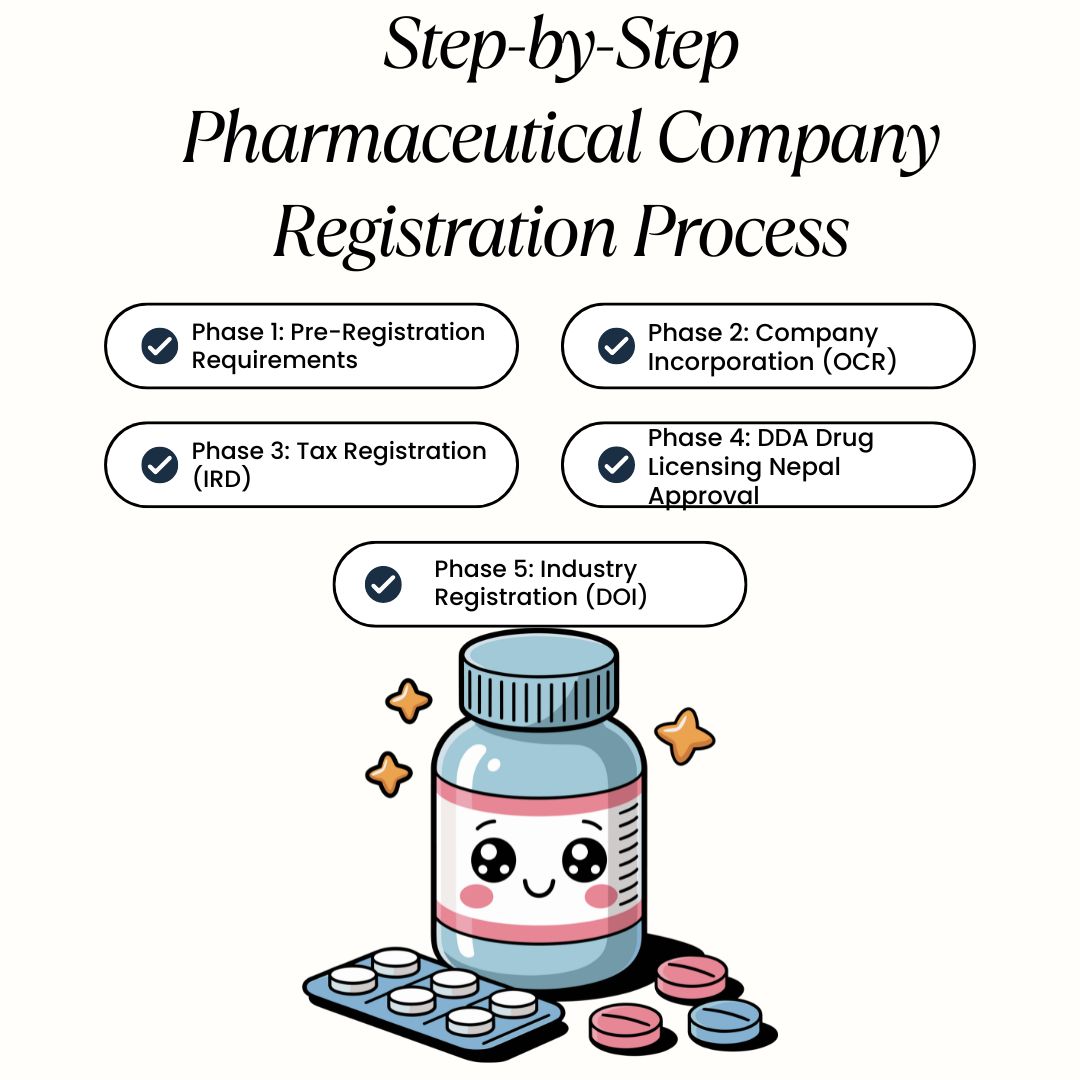
Phase 1: Pre-Registration Requirements
Before formal applications are submitted to OCR, several prerequisites must be fulfilled:
- Business plan development specifying manufacturing, import, wholesale, or retail operations
- Qualified technical personnel (registered pharmacist) must be identified
- Suitable premises must be secured (factory/warehouse/office)
- Environmental and safety compliance plans must be drafted
- Minimum capital investment must be available: NPR 5 million for manufacturing, NPR 1 million for wholesale
Phase 2: Company Incorporation (OCR)
- Name Reservation: Unique company name reflecting pharmaceutical activities is submitted to OCR
- MOA and AOA Drafting: Memorandum must explicitly state pharmaceutical objectives (manufacturing/import/distribution)
- Document Submission: Including citizenship/passports, photos, lease agreements, and promoter details
- Certificate Issuance: Certificate of Incorporation is typically granted within 2-4 weeks
Phase 3: Tax Registration (IRD)
- PAN Registration: Permanent Account Number must be obtained within 7 days of incorporation
- VAT Registration: Mandatory if projected turnover exceeds NPR 5 million annually
Phase 4: DDA Drug Licensing Nepal Approval
This represents the most critical phase for pharmaceutical registration Nepal:
For Manufacturing Companies
|
Step |
Action |
Timeline |
Cost (NPR) |
|
1 |
Manufacturing license application submission |
Week 1 |
100,000 |
|
2 |
Factory layout and GMP documentation review |
Weeks 2-4 |
50,000 |
|
3 |
DDA inspection of premises |
Week 5-6 |
25,000 |
|
4 |
Sample testing and analysis |
Weeks 7-8 |
75,000 |
|
5 |
License issuance |
Week 9-12 |
Included |
Total DDA manufacturing license cost: Approximately NPR 250,000
For Import/Wholesale Companies
- Storage facility inspection (temperature-controlled warehouse required)
- Qualified pharmacist verification
- Product registration for each medicine to be imported
- Import license fee: NPR 50,000 annually
Phase 5: Industry Registration (DOI)
For manufacturing-scale operations, industrial license must be obtained:
- Feasibility study submission
- Environmental Impact Assessment (if applicable)
- Land ownership/lease documentation
- Processing time: 4-6 weeks
Documentation Requirements for Pharmaceutical Registration Nepal
OCR Documents
- Name approval certificate
- Memorandum and Articles of Association
- Citizenship/passport copies of shareholders/directors
- Passport-sized photographs
- Lease agreement or ownership certificate of premises
- Bank deposit certificate for share capital
DDA-Specific Documents
- Application form for pharmaceutical company registration
- Detailed project report with financial projections
- Site master file describing facility layout
- List of proposed products with therapeutic categories
- Quality control protocols and SOPs
- GMP compliance plan aligned with WHO guidelines
- Technical staff qualification certificates
- Environmental clearance from Ministry of Forests and Environment
Costs Associated with Nepal Pharma Business Registration
Government Fees
|
Service |
Fee (NPR) |
|
Company registration (OCR) |
15,000 - 50,000 (based on capital) |
|
DDA manufacturing license |
100,000 |
|
DDA import/wholesale license |
50,000 |
|
Industrial license (DOI) |
10,000 - 100,000 |
|
PAN registration |
Free |
|
VAT registration |
Free |
Professional and Setup Costs
- Legal and consultancy fees: NPR 150,000 - 300,000
- GMP facility setup: NPR 5 million - 50 million (varies by scale)
- Quality control laboratory: NPR 2 million - 10 million
- Documentation and notarization: NPR 25,000 - 50,000
Total estimated cost for small-scale manufacturing facility: NPR 8-15 million
Timeline for Pharmaceutical Company Registration Kathmandu
Average timeline from initiation to operational readiness:
|
Phase |
Duration (Weeks) |
|
Pre-registration planning |
2-4 |
|
OCR company registration |
2-4 |
|
Tax registrations |
1-2 |
|
DDA license approval |
8-12 |
|
DOI industrial license |
4-6 |
|
Local municipality permit |
2-3 |
|
Facility setup and GMP certification |
12-24 |
Total estimated time: 6-12 months for complete operational readiness
Post-Registration Compliance Requirements
After pharmaceutical company registration Kathmandu is completed, ongoing obligations must be met:
Annual Renewals
- Company registration renewal (OCR)
- DDA license renewal (annual)
- Product registration renewal (every 3-5 years)
- Industrial license renewal
Regulatory Compliance
- GMP standards adherence with regular DDA inspections
- Quality control testing of each batch
- Pharmacovigilance system maintenance
- Adverse drug reaction reporting
Financial Obligations
- Annual tax return filing with IRD
- Mandatory audit by registered auditor
- Quarterly VAT returns
- Monthly tax deposits
Reporting Requirements
- Monthly production reports to DDA
- Quarterly sales data submission
- Annual quality review reports
- Import/export declarations
Official resources
For credible Nepal pharma business registration content, reference:
- Department of Drug Administration (DDA) Official Website
- World Health Organization (WHO) GMP Guidelines
- Office of Company Registrar (OCR)
- International Pharmaceutical Federation (FIP)
- Pharmaceutical Export Promotion Council of India (for regional context
Frequently Asked Questions
What is the fastest way to get pharmaceutical registration Nepal approval?
Expedited processing is not officially offered. However, complete documentation submission, pre-inspection consultancy, and direct liaison with DDA officers can reduce timeline from 12 weeks to 8 weeks.
Where can pharmaceutical companies be registered outside Kathmandu?
While DDA headquarters is in Kathmandu, regional offices in Biratnagar, Pokhara, and Nepalgunj accept applications. However, final approval is granted by central office. Manufacturing facilities can operate in any district meeting GMP standards.
How much paid-up capital is required for drug licensing Nepal?
NPR 5 million minimum for manufacturing, NPR 1 million for wholesale/import. Capital must be deposited in Nepali bank before DDA application.
Which district has lowest pharmaceutical business registration costs?
Parsa and Bara districts offer lower land costs (30-40% cheaper than Kathmandu) and municipal fees, reducing total setup costs by NPR 2-3 million.
When should product registration be initiated?
Product registration should begin parallel to company registration. Each product requires 8-12 weeks for DDA evaluation, so batch submission is recommended.
Who can apply for pharmaceutical company registration Kathmandu?
Any Nepali citizen aged 21+ or foreign company through joint venture (minimum 51% Nepali ownership) can apply. At least one director must be registered pharmacist.
Why is GMP certification mandatory in Nepal?
GMP certification ensures medicines meet WHO quality standards. It became mandatory after 2015 Drug Act amendment following counterfeit drug incidents.
How are pharmaceutical business districts Nepal selected?
Districts are selected based on infrastructure availability, proximity to major markets, raw material access, and skilled workforce availability. Kathmandu, Bara, and Parsa dominate due to these factors.
Professional Registration Assistance
Comprehensive Pharmaceutical Company Registration Kathmandu Services
Navigating pharmaceutical registration Nepal complexities requires expert guidance. Professional services include:
- Complete Documentation Preparation: MOA/AOA drafting, DDA application compilation, site master file creation
- Liaison Services: Direct coordination with OCR, DDA, DOI, and IRD officials
- Facility Design Consultancy: GMP-compliant layout planning to pass DDA inspection
- Product Registration Support: Dossier preparation for individual medicine approvals
- Compliance Auditing: Pre-inspection audits identifying potential non-conformances
- Renewal Management: Annual license and registration renewal handling
Service packages range from NPR 150,000 (consultation only) to NPR 750,000 (end-to-end registration)
Conclusion: Key Takeaways for Pharmaceutical Company Registration Kathmandu
Successful pharmaceutical business registration in Nepal demands meticulous planning, substantial capital investment, and regulatory expertise. Kathmandu remains the central hub for pharmaceutical company registration Kathmandu processes, though manufacturing opportunities exist in districts like Bara, Parsa, and Rupandehi where costs are lower and infrastructure is developing.
The DDA's stringent requirements, while challenging, ensure product quality and public safety. Entrepreneurs should budget 6-12 months and NPR 8-15 million for small-scale manufacturing setup.
For Nepal pharma business registration, professional consultancy is not merely advisable—it is essential for navigating complex regulatory requirements and achieving timely approval in Nepal's growing pharmaceutical market.