Vehicle accident law Nepal has been established to protect road crash victims through comprehensive legal frameworks. Every year, more than 24,000 accidents are reported across Nepal, with motorcycles involved in 70% of these incidents. The Motor Vehicle and Transport Management Act 2049 (1993) serves as the primary legislation governing these matters.
This guide provides step-by-step instructions for navigating bike and car accident law procedures. Practical advice is offered for insurance claims, compensation recovery, and legal protection. Recent amendments to the Insurance Act 2079 have streamlined claim settlements, making timely action more critical than ever.
Legal Framework for Bike and Car Accidents in Nepal
Primary Legislation Governing Vehicle Crashes
Multiple statutes have been enacted to address vehicle accident law Nepal comprehensively. The framework includes both criminal and civil provisions.
|
Statute |
Year |
Application to Vehicle Accidents |
|
Motor Vehicle and Transport Management Act |
2049 (1993) |
Section 161 penalties; mandatory insurance; licensing |
|
Muluki Criminal Code |
2074 (2017) |
Criminal negligence; culpable homicide charges |
|
National Civil Code |
2074 (2017) |
Compensation rights; liability determination |
|
Insurance Act |
2079 (2022) |
30-day claim settlement mandate; consumer protection |
|
Consumer Protection Act |
2075 (2018) |
Policyholder rights against unfair insurer practices |
Section 161 of the Motor Vehicle Act has been structured with three penalty tiers:
- Deliberate killing: Lifetime imprisonment
- Reckless driving causing death: 3 to 10 years imprisonment
- Accidental death without recklessness: Up to 1 year imprisonment
Criminal vs Civil Liability Distinction
Criminal charges may be filed by the state for serious bike and car accidents. Civil compensation claims, however, must be initiated by victims or their families within three years. Both proceedings can run simultaneously, and compensation can be pursued regardless of criminal case outcomes.
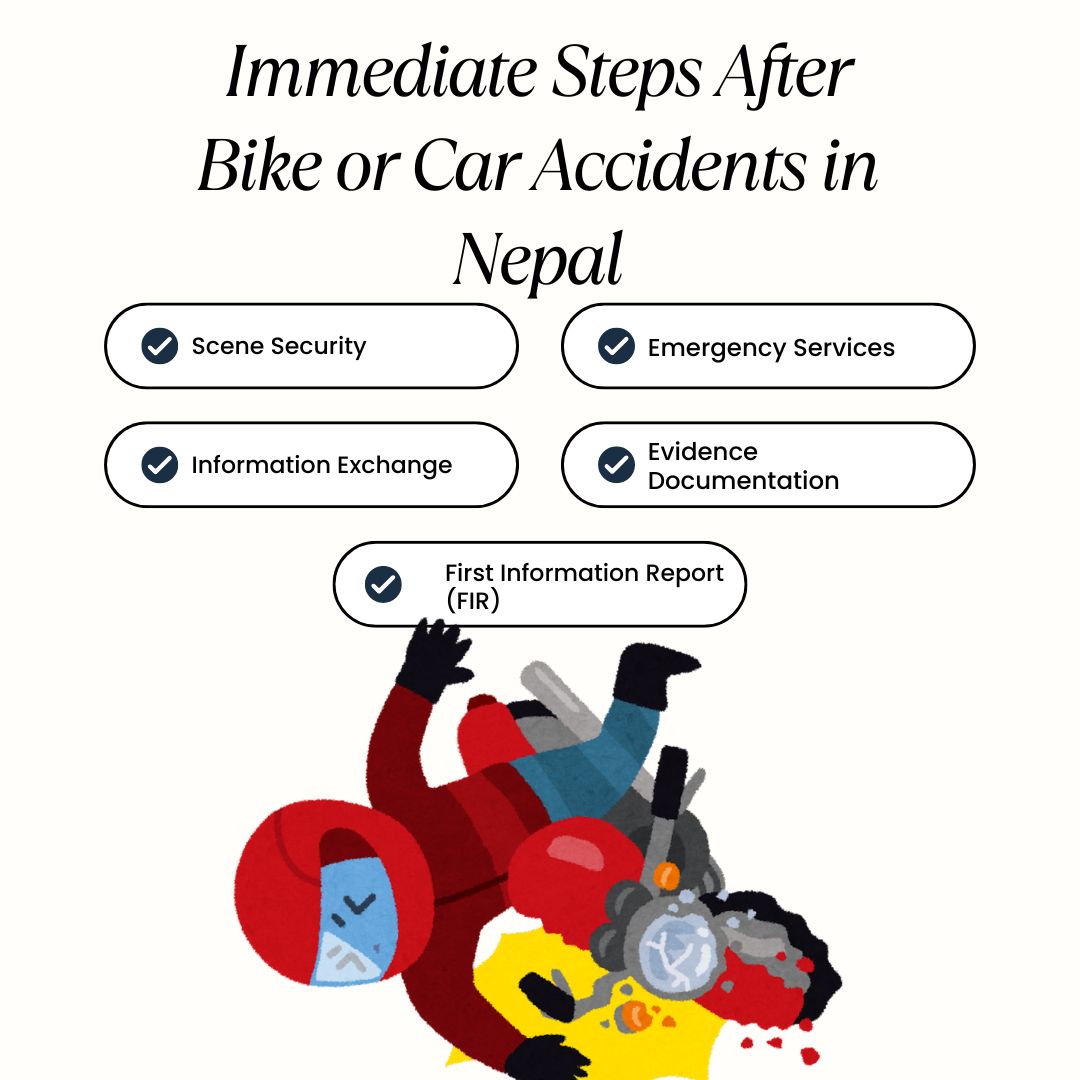
Immediate Steps After Bike or Car Accidents in Nepal
First 24-Hour Actions
- Scene Security: The accident scene must be secured immediately. Hazard lights should be activated. Warning triangles must be placed at appropriate distances. If safe, vehicles should be moved to prevent secondary crashes.
- Emergency Services: Nepal Police (100), ambulance (102), and fire services (101) should be contacted without delay. Location details, injury severity, and vehicle count must be provided accurately.
- Information Exchange: Driver's license details, vehicle registration (bluebook), insurance policy numbers, and contact information should be exchanged between parties. Witness contact details should also be collected.
- Evidence Documentation: Photographs of vehicle damage, license plates, road conditions, and injuries should be taken from multiple angles. These images will be required for insurance claims and legal proceedings.
- First Information Report (FIR): An FIR must be filed at the nearest police station. The FIR serves as the foundation for all subsequent legal and insurance actions. Accuracy in statements is essential, as discrepancies may be exploited by insurers to deny claims.
Insurance Notification Requirements
Insurance companies must be notified within 24-72 hours of the bike or car accident. The Insurance Act 2079 mandates that delays can result in automatic claim rejection. Required documents include:
- FIR copy
- Medical reports
- Vehicle photographs
- Driver's license
- Bluebook
- Insurance policy document
Critical Warning: Vehicle repairs should not be initiated before the insurance surveyor inspection. Unauthorized repairs frequently void coverage under vehicle accident law Nepal.
Compensation Claim Process for Vehicle Accidents in Nepal
Insurance Claim Stages
Systematic procedures have been established for processing bike and car accident claims. Each stage must be completed within specified timelines.
|
Stage |
Timeline |
Required Actions |
|
Initial Notification |
24-72 hours |
Inform insurer; submit basic accident details |
|
Surveyor Assignment |
3-7 days |
Vehicle inspection; damage assessment by certified surveyor |
|
Document Verification |
7-15 days |
Medical record review; police report validation |
|
Compensation Calculation |
15-30 days |
Loss evaluation; settlement offer preparation by adjuster |
|
Payment Processing |
30 days maximum |
Fund transfer as mandated by Insurance Act 2079 |
Third-Party vs Comprehensive Insurance Claims
Third-Party Liability Insurance (legally mandatory):
- Coverage is provided for damages to other vehicles and persons
- Own vehicle damage is not covered
- Minimum coverage limits are prescribed by Beema Samiti
Comprehensive Insurance:
- Own vehicle damage coverage is included plus third-party liability
- Additional riders are available for medical expenses and passenger injury
- Premium calculation is based on vehicle value, claim history, and location risk
Compensation Components Available
Victims of bike and car accidents may claim:
- Medical expenses (immediate and future treatment)
- Lost income and reduced earning capacity
- Property damage (vehicle repair or replacement)
- Pain and suffering damages
- Funeral and burial costs (for fatal accidents)
- Loss of consortium for family members
Legal Costs and Timeline for Vehicle Accident Cases
Cost Breakdown for Accident Proceedings (NPR)
|
Service Category |
Simple Property Damage |
Serious Injury Case |
|
Lawyer Fees |
15,000 - 50,000 |
100,000 - 500,000 |
|
Court Filing |
500 - 2,000 |
2,000 - 5,000 |
|
Expert Witness |
5,000 - 15,000 |
15,000 - 75,000 |
|
Medical Documentation |
3,000 - 8,000 |
10,000 - 25,000 |
|
Total Estimated Cost |
25,000 - 75,000 |
150,000 - 600,000 |
Contingency fee arrangements are sometimes offered by lawyers, where payment is collected only upon successful settlement. However, this practice is not universal in Nepal's legal market.
Case Resolution Timeframes
- Insurance claims: 30-90 days for settlement
- Civil compensation cases: 6 months to 2 years
- Criminal proceedings: 1-3 years depending on severity
- Appeals: Additional 1-2 years for higher courts
The landmark US-Bangla Airlines case demonstrates that complex litigation may require 7+ years for final resolution, though this involved international law applications.
Government Authorities Handling Vehicle Accident Law Nepal
Agency Responsibilities
Nepal Police Traffic Division:
- First response and FIR preparation for bike and car accidents
- Accident scene investigation and evidence collection
- Traffic law enforcement and fine collection (NPR 94.6 million collected in Poush 2081)
Department of Transport Management (DoTM):
- Driver licensing verification and validation
- Vehicle registration (bluebook) authentication
- Road safety policy implementation nationwide
Nepal Insurance Authority (NIA):
- Regulation of claim settlement timelines
- Consumer complaint redressal for insurance disputes
- Policy coverage standardization across insurers
District Courts:
- Civil compensation adjudication for accident victims
- Criminal prosecution for negligent driving
- Settlement agreement enforcement
Ministry of Physical Infrastructure and Transport:
- Road infrastructure maintenance and improvement
- National road safety campaign development
- Transport policy formulation
Local Governments:
- Municipal road maintenance in urban areas
- Local emergency response coordination
- Traffic management at intersections
Critical Mistakes That Destroy Bike and Car Accident Claims
Actions That Must Be Avoided
|
Mistake |
Consequence Under Vehicle Accident Law Nepal |
Prevention Method |
|
Fleeing the scene |
Hit-and-run criminal charges; automatic claim denial |
Remain at scene; contact police immediately |
|
Repairing before survey |
Claim voided by insurer |
Wait for insurance inspector approval |
|
Delayed reporting (>72 hours) |
Automatic claim rejection under Insurance Act 2079 |
Notify insurer within 24 hours |
|
Incomplete FIR filing |
Evidence ruled inadmissible in court |
Verify all details before signing police report |
|
Skipping medical exam |
Injury claims rejected without documentation |
Get examined even for minor discomfort |
|
Accepting quick settlement |
Inadequate compensation received |
Consult lawyer before signing any release |
|
Driving without valid license |
Criminal charges filed; coverage denied |
Always carry current license and insurance |
Police Refusal to Register FIR: Your Rights
If police delay or refuse to register an FIR for a bike or car accident, victims may:
- File directly with District Police Office
- Submit complaint to Traffic Police Division
- Request intervention from Chief District Officer (CDO)
- Engage legal counsel for immediate court direction
Landmark Court Cases Shaping Vehicle Accident Law Nepal
State v. Ramesh Kumar Sharma (2005)
A bus driver operating without sufficient headlights struck and killed a pedestrian. Criminal negligence was established under Section 12 of the Penal Code. 3 years imprisonment and NPR 50,000 fine were imposed. This case determined that inadequate vehicle maintenance constitutes gross negligence.
Suman Adhikari v. State (2010)
A truck driver under alcohol influence caused a fatal motorcycle accident. The court ruled that drunk driving combined with speeding constitutes culpable homicide. 5 years imprisonment and NPR 100,000 fine were sentenced. DUI accidents were elevated to serious criminal offenses by this precedent.
US-Bangla Airlines Flight 211 (2018)
Though an aviation case, this verdict sets precedent for all vehicle accident law Nepal:
- $2.74 million compensation was ordered for 17 families
- Insurance payouts were distinguished from compensation awards
- Gross negligence was established as grounds for unlimited liability
- Psychological damages were recognized for family members
Frequently Asked Questions on Bike and Car Accident Law Nepal
What immediate actions should be taken after an accident in Nepal?
The accident scene must be secured, emergency services contacted, information exchanged with other parties, photographs taken from multiple angles, witness details collected, and an FIR must be filed at the nearest police station within 24 hours.
How long do victims have to file accident compensation claims?
Insurance notification is required within 24-72 hours. Civil compensation claims must be filed within 3 years under the National Civil Code. Criminal cases should be reported immediately for proper investigation.
What documents are mandatory for bike and car accident claims?
Driver's license, vehicle bluebook, insurance policy, police FIR, medical records, repair estimates, photographs, witness statements, and citizenship documents are required.
Can compensation be claimed without a police report?
Generally, no. Police reports are mandatory for insurance claims and court proceedings under vehicle accident law Nepal. Minor property damage may be settled privately, but this practice is strongly discouraged.
What happens if the accident was not my fault?
Full compensation can still be claimed from the at-fault party's insurance. Legal representation is advised to ensure proper fault determination and maximum recovery.
**How much do *bike and car accident* lawyers charge in Nepal?**
Legal fees range from NPR 15,000 for simple cases to NPR 500,000 for complex injury claims. Contingency arrangements may be available with some law firms.
Are foreigners entitled to accident compensation in Nepal?
Yes. Foreign nationals have identical legal rights as Nepalese citizens. Passports, international driving permits, and proper documentation facilitate claim processing under vehicle accident law Nepal.
Which laws cover bike accidents specifically?
The Motor Vehicle and Transport Management Act 2049, Insurance Act 2079, Muluki Criminal Code 2074, Civil Code 2074, and Consumer Protection Act 2075 all apply to motorcycle accidents.
What causes most road accidents in Nepal?
Over-speeding causes 50% of accidents. Drink-driving contributes to 247 monthly accidents. Night driving (6 PM-midnight) accounts for 39% of all crashes.
What are penalties for hit-and-run accidents?
Hit-and-run is prosecuted under Section 161 of the Motor Vehicle Act. imprisonment, fines up to NPR 10,000, and license cancellation are imposed.
Protect Your Legal Rights: Recommended Actions
Vehicle accident law Nepal has been structured to protect victims, but procedural compliance is critical. Compensation claims must be filed promptly with complete documentation. Legal representation significantly improves outcomes, particularly for serious injuries or disputed liability cases.
Immediate action checklist:
- Police must be contacted within 24 hours
- Insurance notification must be sent within 72 hours
- All medical records should be preserved
- Qualified legal counsel should be consulted before accepting settlements
Recent amendments to the Insurance Act 2079 have mandated faster claim settlements. Staying informed about these changes ensures maximum protection under Nepalese law.
Need Legal Assistance for Bike or Car Accidents?
Professional legal guidance can be obtained from experienced attorneys specializing in vehicle accident law Nepal. Free consultations are often provided to evaluate case merits. Timely action is essential—delay may result in lost evidence and reduced compensation.
Contact qualified lawyers today to protect your rights and secure fair compensation for your bike or car accident claim.
Disclaimer: This guide provides general information about bike and car accident law Nepal and does not constitute legal advice. Specific cases require consultation with qualified legal professionals. Laws and procedures are subject to change.