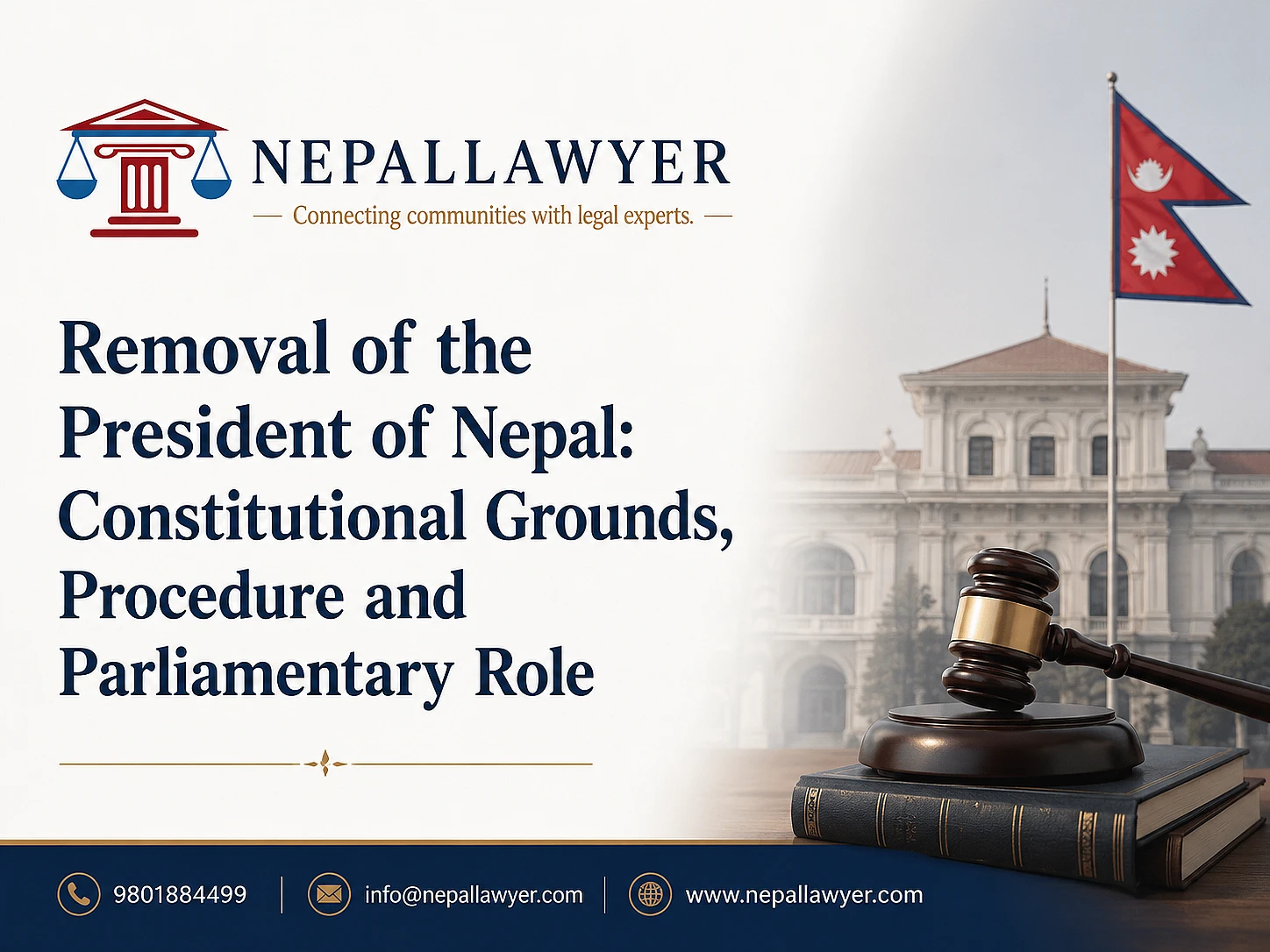
In the constitutional system of Nepal, the President holds office as the Head of State under Article 61 of the Constitution. Nepal follows a parliamentary constitutional system in which executive powers are primarily exercised by the Council of Ministers, the President functions mainly as a constitutional and ceremonial Head of State. While the role is largely ceremonial, it is still bound strictly by constitutional limits. To ensure accountability, the Constitution provides a structured impeachment mechanism under Article 101, which governs the removal of the President.
Constitutional Ground for Removal
Under Article 101, the President may be removed only on one specific ground: Violation of the constitution. The Constitution does not permit removal on political dissatisfaction, policy disagreement, or loss of parliamentary confidence. A violation of the Constitution generally refers to situations where the President:
- Acts beyond the authority granted by the Constitution.
- Disregards mandatory constitutional procedures,or
- Exercises powers in a manner inconsistent with constitutional supremacy.
This strict limitation ensures that impeachment is a constitutional remedy,not a political tool.
Procedure for Removal
The process begins with the registration of an impeachment motion in the House of Representatives. Under Article 101 of the Constitution of Nepal, 2072, the motion must be supported by at least one-fourth of the total number of the then members of the House of Representatives before it can be formally initiated. This requirement ensures that the impeachment process is not triggered by a very small political group or for purely partisan reasons.
Once the motion is admitted, the matter is discussed and deliberated upon within the Federal Parliament. During this stage, members examine whether the conduct of the President amounts to a serious violation of the Constitution of federal law. The process is therefore not merely political in nature, but a constitutional mechanism for accountability.
After deliberation,the motion is put to vote, and Article 101 requires approval by at least a two-thirds majority of the total number of the then members of both Houses of the Federal Parliament. If the required majority is achieved, the President is immediately removed from office under the Constitution without the need for any further approval.
Role of Parliament
The Federal Parlaiment plays a decisive constitutional role in the removal process. The Federal Parliament performs three key roles:
- It acts as a gatekeeping body, since the motion requires a minimum level of support before being admitted. This prevents arbitrary or politically motivated impeachment attempts.
- It serves as a deliberative forum, where members assess whether the President’s conduct truly constitutes a constitutional violation.
- It acts as a final decision-making authority,as the removal become effective only if the two-thirds threshold is met in a joint sitting.
Conclusion
The removal mechanism of the President under Article 101 of the Constitution of Nepal 2072 reflects a carefully balanced constitutional design.By limiting the ground strictly to constitutional violation and requiring a two-thirds majority in the Federal Parliament of Nepal, the Constitution ensures both accountability and stability.It protects the dignity of the presidential office while simultaneously reinforcing a core constitutional principle: rule of law.
Disclaimer: This blog is for educational purposes only and does not constitute legal advice. Information is accurate as of the date of publication and may change over time.